

On Dec. 1, the Singapore Food Agency announced that it had approved the sale of cultured meat, the first country in the world to approve such a food product. The meat, which will be produced by the United States startup Eat Just, will be lab-grown chicken sold as nuggets.
In a press release, Eat Just co-founder and CEO Josh Tetrick stated: “I'm sure that our regulatory approval for cultured meat will be the first of many in Singapore and in countries around the globe. Working in partnership with the broader agriculture sector and forward-thinking policymakers, companies like ours can help meet the increased demand for animal protein as our population climbs to 9.7 billion by 2050.”
The lab-grown chicken is grown using cells from a cell bank, which does not require the slaughter of live animals, in a 300-gallon bioreactor, and is later combined with plant-based ingredients to produce a product safe for human consumption.
The cultured nuggets began to be sold to the general public on Dec. 19 at 1880, an upscale restaurant which has a menu centered around experimental cuisine. The inaugural date saw a little over 40 diners try out the cultured meat for the first time.
Eat Just will also begin producing a mung bean-based egg substitute in Singapore, which the company has already been selling commercially in the United States for several years in supermarkets, restaurants, and through partnerships with college campuses.
The approval of cultured meat in any form in Singapore specifically is significant given the nation’s history of being a global food capital. The city-state of 5.7 million is renowned for its hawker centers, food markets home to both traditional and contemporary tastes from around Asia.
Will Other Countries Follow Suit?
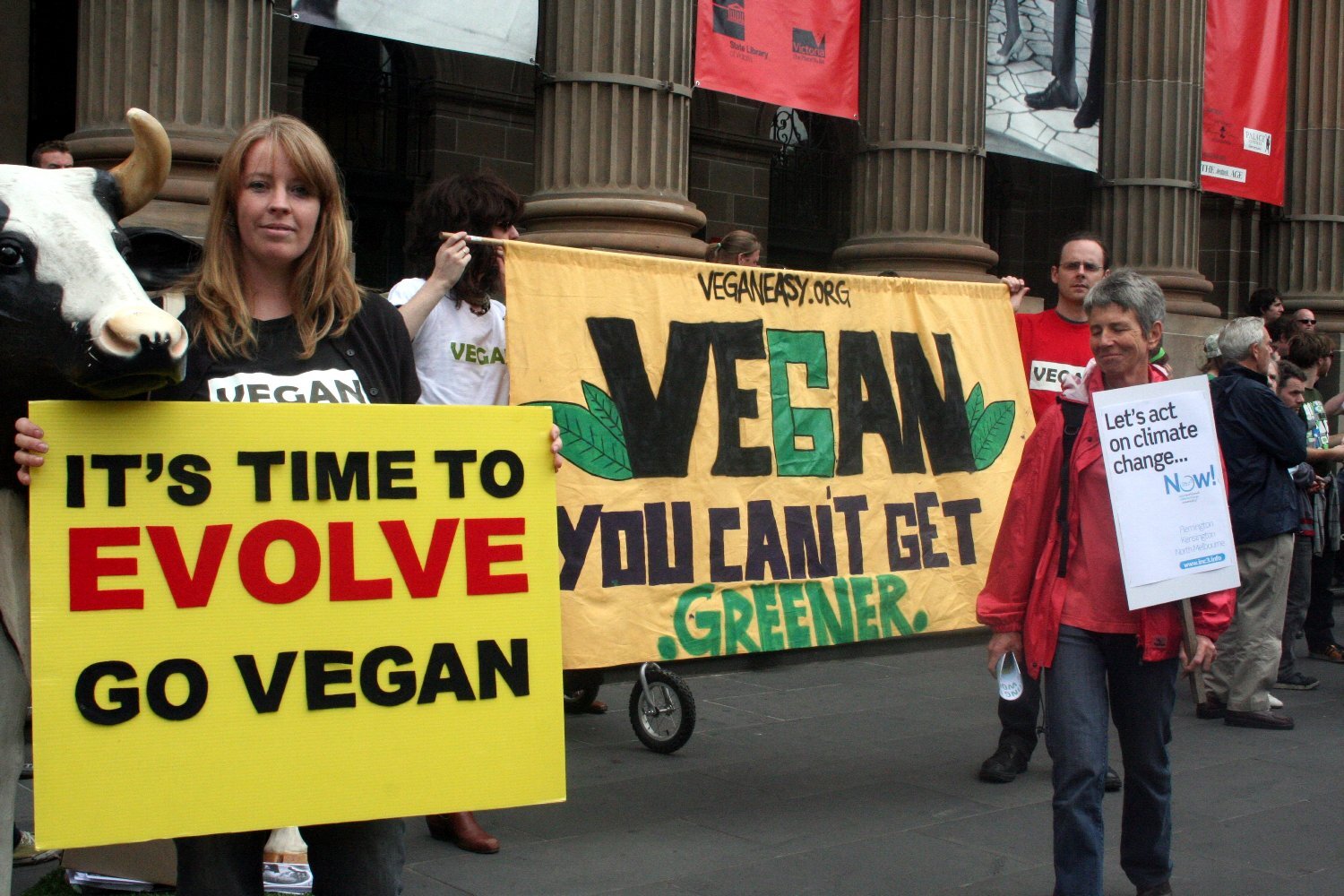
Vegan protesters in Melbourne, Australia. John Englart. CC BY-SA 2.0.
While Singapore’s approval of the production of cultured meat marks a global first, several moral, environmental and social concerns stand which could hinder other countries from following along.
A 2014 study from the Journal of Applied Philosophy discussed the implications for transitioning from farm-bred meat to cultured meat. While one of the most prominent reasons given for transitioning to cultured meat is that it does not require the inhumane practices used to produce traditional farm-bred meat, animal cells still need to be obtained from a source for the production of cultured meat to begin. The researchers conclude that while animals cannot consent to “donating” their cells themselves, “a responsible and respectful caretaker or other representative [to the animals] would need to consent and risks would have to be minimal, minimized and reasonable.”
More prominent, however, are environmental and social concerns. With global temperatures continuing to rise at an alarming rate, researchers generally agree that in order to reduce one’s carbon footprint, the single best way to do this is to avoid meat and dairy products, as livestock accounts for 14% of annual greenhouse gas emissions.
Cultured meat on paper mitigates this issue, as the transition has the potential to significantly reduce the amount of emissions generated by the food industry. However, given that the current small scale of production for cultured meat requires high use of energy and thus generates high levels of carbon emissions, the industry for cultured meat will have to become much more mainstream if it is to achieve the goal of lower carbon emissions.
Finally, one of the most relevant concerns surrounding both the approval and acceptance of cultured meat is whether or not people will actually want to make the transition. A 2018 Michigan State University poll found that while 51% of those aged 18-29 and 60% of those aged 30-39 would be willing to try cultured meat, only 26% of those aged 40-54 and 11% of those aged 55-plus said that they would do the same.
Tetrick himself recognizes this concern. “Is it different? For sure,” Tetrick said in an interview with The Guardian. “Our hope is through transparent communication with consumers, what this is and how it compares to conventional meat, we’re able to win. But it’s not a guarantee.”
Conversely, Andrew Noyes, head of global communications for Eat Just, expressed optimism for future governmental approval in an interview with CATALYST.cm.
“In the U.S., Eat Just is actively engaged with the FDA regarding our process to produce meat,” Noyes said. ”Currently, the FDA and USDA are building a framework and process for regulatory approval of cultured meat. We're hopeful that Singapore's regulatory approval can be a model for other countries formulating a pathway to market for cultured meat products.”
No other countries have so far signaled plans to approve the sale and production of any form of cultured meat. However, given the success of Eat Just in Singapore, as well as the financial backing recently received by competitors like Memphis Meats and Shiok Meats, cultured meat products may very well soon hit the shelves of local supermarkets around the globe.

Jacob Sutherland
Jacob is a recent graduate from the University of California San Diego where he majored in Political Science and minored in Spanish Language Studies. He previously served as the News Editor for The UCSD Guardian, and hopes to shed light on social justice issues in his work.