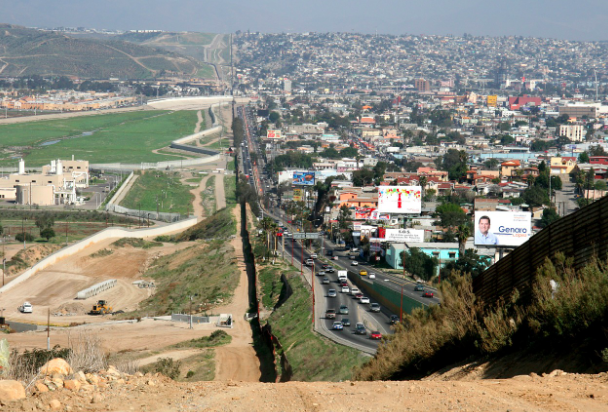
African migrants, mostly from Angola and the Democratic Republic of Congo, are beginning to congregate at U.S. border cities, especially San Antonio, Texas and Portland, Maine, seeking asylum.
Many are flying to South America and joining fellow migrants in traveling well-trodden paths across Central America to the U.S.-Mexico border, since they have been proven to work. Europe has also recorded a sharp drop in the number of African migrants and refugees who have reached its border.
Migrants who do try to make the treacherous journey across the Meditteranean often never make it there. The EU began a regional disembarkation policy last June, which named Libya as the new center for processing refugee and asylum applications for those seeking to leave Africa for Europe. However, asylum-seekers stopped by the EU-trained and equipped Libyan Coast Guard are brought back to civil war-torn Libya. Roughly 700,000 refugees are in local detention centers, facing starvation, sexual violence, and torture, according to Foreign Policy. There is also the possibility of being captured by Libyan smugglers. Many people have either gone missing or died. Official numbers have not been released.
Niger is taking in refugees so they don’t need to stay in Libya while they wait to be fully resettled in a new host country, but is only accepting a limited number of people due to its own low poverty rate. The resettlement process can take anywhere from 8 to 12 months. Often, Africans are finding that it is easier to avoid the Mediterranean altogether, due to the trouble Libya’s smugglers and detention centers can cause. 12 countries have so far pledged to help resettle the refugees, though the U.S. is not one of them.
American border agents first started noticing the high numbers at the Del Rio border station in southern Texas last month. According to Time, the sheer number of people is overwhelming. “When we have 4,000 people in custody, we consider it high,” Customs and Border Patrol’s commissioner John Sanders said, according to the BBC. “If there’s 6,000 people in custody, we considered it a crisis. Right now, we have nearly 19,000 people in custody. So it’s just off the charts.”
According to NPR, one such refugee journey involved a family of six flying to Ecuador and traveling by foot across Central America to eventually end up in the border city of Portland, Maine. They were fleeing civil unrest in the Democratic Republic of Congo. Their destination was a makeshift border shelter—a converted sports arena—that was described as “paradise” by the father. Randy Capps, the director of research for U.S. programs at the Migration Policy Institute, said, "That journey through Central America and Mexico has been facilitated by these large migrant caravans, by more sophisticated and faster smuggling routes, and it's an easier journey from Guatemala onward than it has been in the past."
Once they get through the border station, migrants are brought to relief shelters. Staff have been bringing in Swahili and French translators. Portland city officials are hopeful for the future, seeing the migrants as a necessary part of the future workforce, especially since the city has an elderly population. Still, the influx has stressed the city in terms of space. The converted arena currently houses over 200 people.
Volunteers assist at the shelter, offering food and medical supplies and playing games with the children. Donations of both money and supplies have been pouring in. Maine governor Janet Mills has stated that she wants the state to help out, saying that Maine’s residents have a “proud tradition” of caring for their neighbors.
NOEMI ARELLANO-SUMMER is a journalist and writer living in Boston, MA. She is a voracious reader and has a fondness for history and art. She is currently at work on her first novel and wants to eventually take a trip across Europe.