
Elise Kelly
Although millions are spent on safari hunting tourism in South Africa and Zimbabwe, there is little evidence that these funds genuinely promote economic growth, improve the lives of local people or contribute to animal conservation.
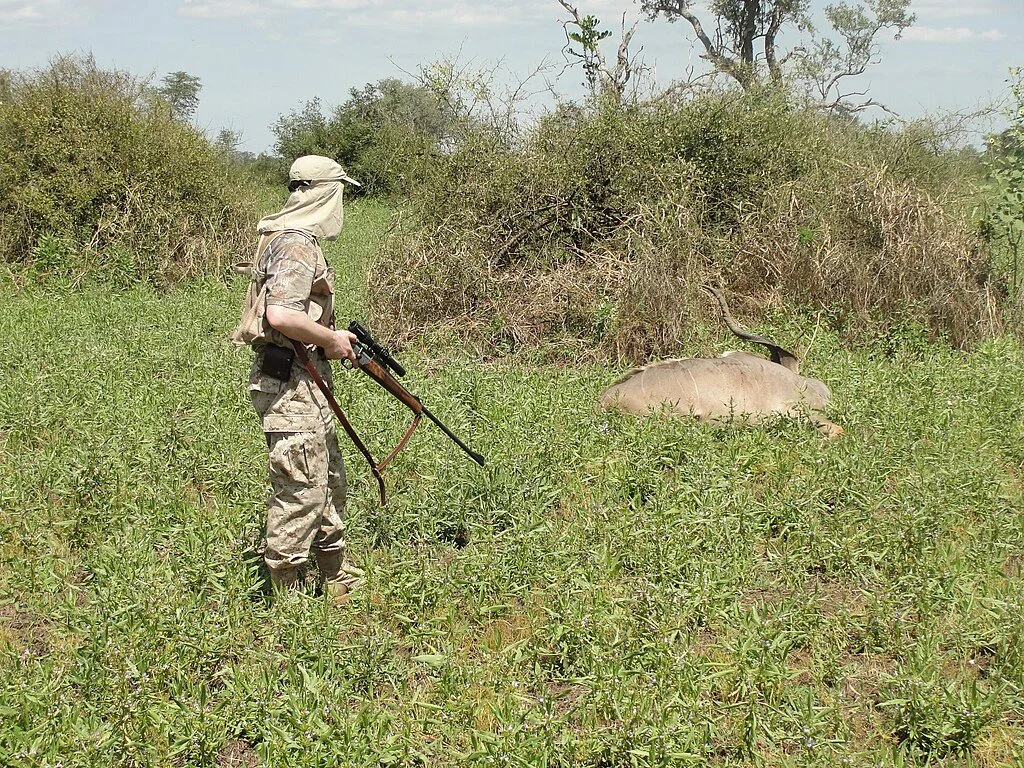
A hunter approaching a Greater Kudu. Lord Mountbatten. CC0.
"Eat all of your dinner; there are starving kids in Africa!" joked an American guest at a South African hunting safari lodge. The remark drew easy laughter from the owners, personal hunting guides and others gathered around the table. But the Black African waitstaff looked on with silent, uncomfortable smiles in an unsettling contrast that hinted at the reality beneath the surface of the hunting safari experience.
The longer we stayed in South Africa, the more emboldened the hunting guests around us became. The coded statement, making light of the surrounding poverty while we ate choice steaks from recent hunts, was the start of an escalation of remarks throughout our fourteen-day stay, which would end with overt statements connecting people's phenotypes to hygiene, work ethic and criminality, and ended with outright support for segregated spaces.
Disregard for human lives mirrored the disregard held for animal lives at the camp. However, hunters, hunting safari operators and even some African government officials would dispute this. There are two main justifications you’ll hear for safari hunting: the first is that hunting safaris are a means of species management and conservation, and the second is that hunting is necessary to provide meat and income to locals, a notion derived from a strong discourse of "feeding the natives," which plays into white savior myths. Both suggest that hunters hold a deep regard for both the animals they hunt and the people whose ancestral lands they hunt on; however, the conditions under which hunts occur and the treatment of people and animals suggest otherwise.
Around 8,000 people each year travel internationally to hunt big game in South Africa, spending approximately $250 million and supporting 17,000 jobs, with hunting tourism generating around $20 million of annual revenue for Zimbabwe. Despite the millions generated from hunting safari tourism, many question whether the majority of revenue from safari hunts actually goes back to the local economy or even conservation.
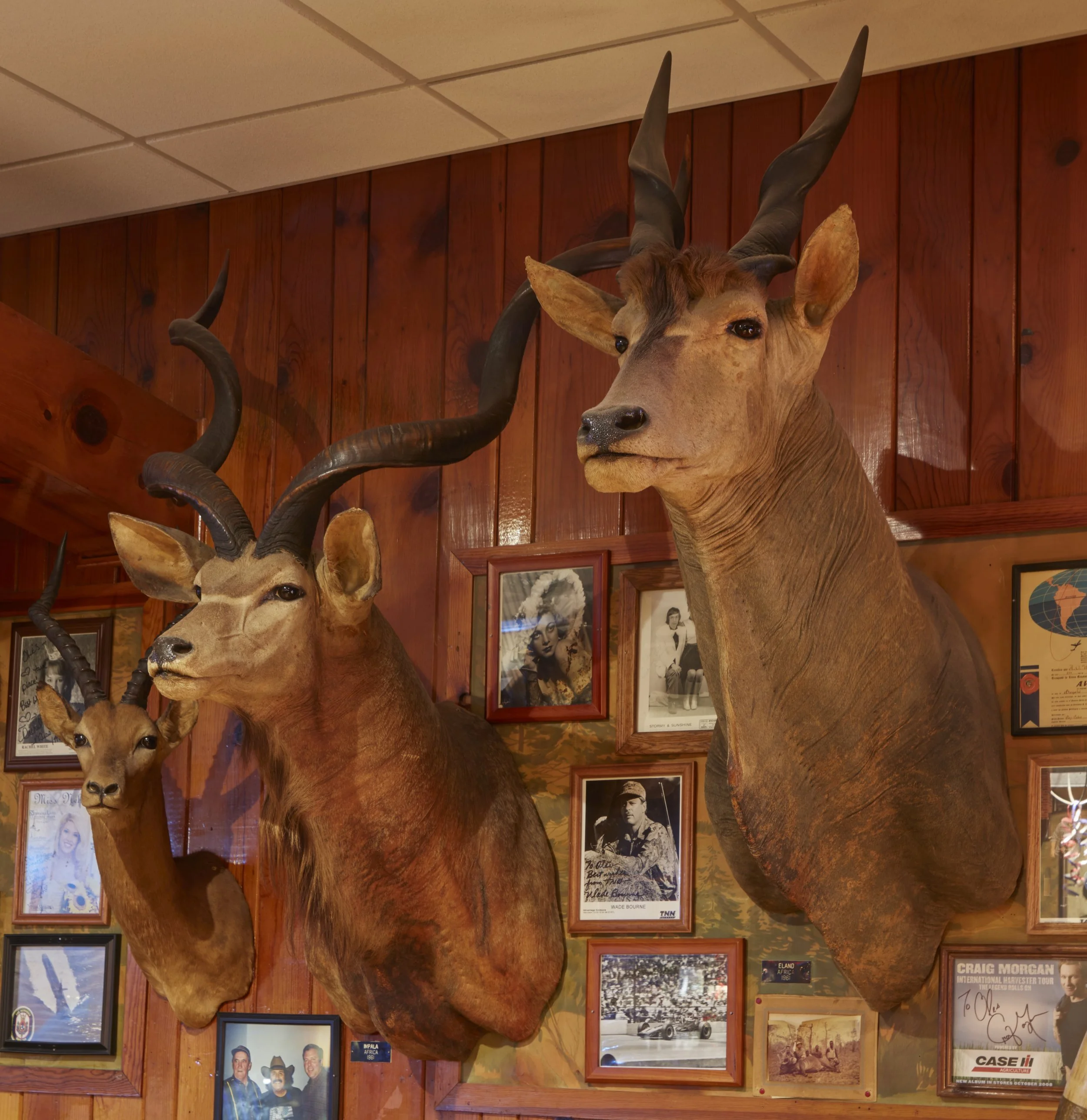
African antelope mounts at a steakhouse in Nebraska. Library of Congress. CC0.
Safari tour operators take the largest portion of income from hunts. Hunting tours charge a fee per animal killed, which can cost thousands of dollars per animal. Prices go from $400 for a baboon to over $13,000 for a large crocodile or lion, and even up to $29,000 for a rhino. Meanwhile, the bulk of the service staff, trackers and skinners, all employees who tend to be Black Africans, make as little as $1.70 per hour. Even the money from permits and hunting fees is unlikely to be spent on conservation. A 2016 report conducted after the controversial killing of Cecil the lion in Zimbabwe revealed that trophy hunting fees seldom support wildlife and instead are lost to corruption within the government and mismanagement of conservation programs.
Proponents of hunting-as-conservation argue that safari hunting operations boost species populations through breeding programs, claiming these initiatives keep hunters from targeting threatened or endangered animals in the wild. In this type of hunting operation, called "canned hunting," safari operators breed game animals within high-fenced (at least 8 feet tall) enclosures, which must be 1,000 hectares to 100 hectares in size (2,471 acres to 247 acres), depending on the local legal minimum.
Though the fenced area may be thousands of acres, hunts often take place at managed feed or water stations, and the captive-bred animals are less wary of humans. In my experience at a South African canned hunting operation, hunts were moved to these locations to guarantee a kill if the day had been unsuccessful or if the hunter was a novice.
Some pro-hunting conservationist groups, such as the Boone and Crockett Club, have released statements against canned hunts, which they say violate the principles of "fair chase" and have contributed to the spread of diseases amongst penned animals. Animals at canned hunting operations are likely to suffer from chronic illness and poor health due to inbreeding, especially in cases where they are purpose-bred for traits, such as coat color.
Despite ethical concerns about animal health and suffering, there is evidence that high-fence breeding and hunting operations may have helped increase populations for some endangered species. Commercialized rhino breeding for canned hunting may have significantly boosted numbers. Save the Rhino International, one of the largest single-species charities in the world, states, "Like it or not, trophy hunting has played a key role in the recovery of the Southern white rhino population in South Africa." However, others argue that such practices commodify wildlife in ways that fundamentally conflict with conservation ethics.
Canned hunting operators argue that they keep hunters from killing wild game, but critics argue that these operations can actually increase the allure of targeting wild animals. In June of this year, a lion named Blondie was lured from a conservancy in Zimbabwe and killed by a hunter, mirroring the infamous death of Cecil almost a decade earlier. “He was a breeding male in his prime, making a mockery of the…repeated claims that trophy hunters only target old, non-breeding males,” says Simon Espely, CEO of Africa Geographic, the luxury, non-hunting safari company that sponsored research on Blondie. Studies also demonstrate that removing individuals like Blondie destabilizes social structures within wild populations, reduces genetic diversity and ultimately changes the evolutionary trajectory of a group.
Ultimately, in day-to-day operations, hunting safaris are little concerned with animal or human welfare. "If it flies-it dies," "whack 'em and stack 'em" and "if it stands proud and tall, let it fall" were common refrains from the hunting guides before everyone loaded up into the back of the safari trucks to hunt.
Animals were killed at a rate of nearly one per group per day. When an animal was shot, the guide walked up and jabbed a stick in its still-blinking eye, testing to see if it was still alive. He commanded the tracker to clear the surrounding brush and drag the animal's limbs into a more flattering position. A photo shoot ensued, featuring shots of the hunter, the hunter with friends and the hunter with the guide and dog. Finally, the tracker alone dragged the several-hundred-pound body to the truck to be winched into the back. Later, after the animal was processed, the trackers and skinners would walk away with only a wheelbarrow full of offal to bring home.