
By Julia Sassaman
In 2026, many global youth protests have gained traction on social media, but what exactly are Gen Z’s demands?
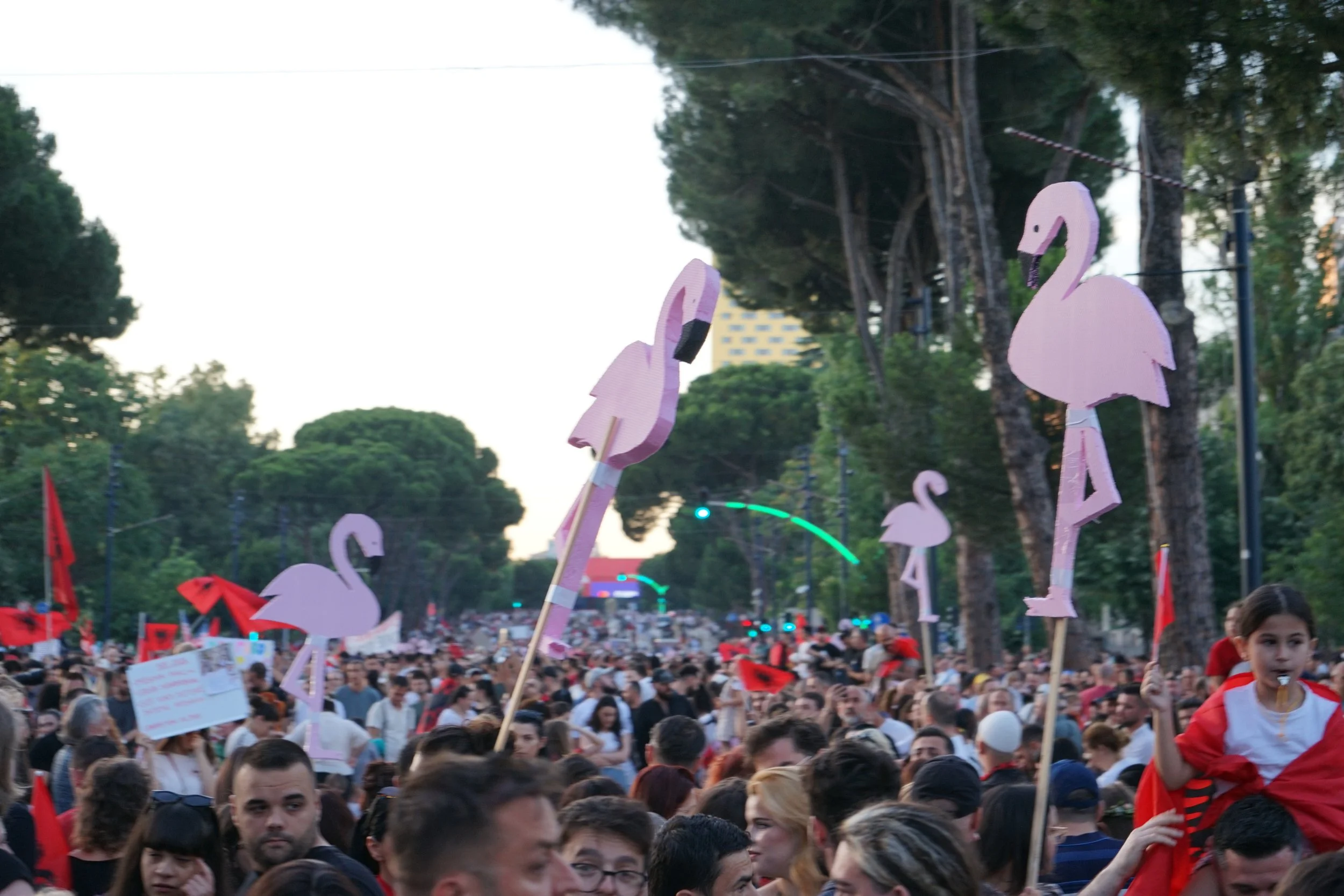
Flamingo Revolution protests in Tirana. Albinfo. CC BY 4.0.
2025 marked a year of youth mobilization worldwide, and 2026 has been no different. From Albania to India and from Nepal to Peru, youth protesters echo similar grievances: government corruption, economic hardship, censorship, environmental exploitation and war.
Harvard Kennedy School has found that protests involving younger generations are more than twice as likely to succeed in achieving their demands, a trend that has held up in 2026. In India, sustained pressure from student protesters led to the resignation of the country’s education minister. In Nepal, the Gen Z movement that toppled the government in 2025 ultimately resulted in the election of the country’s youngest-ever prime minister.
Symbolism has played a defining role in many of these movements. In Albania, protesters carried pink flamingo cutouts in protest of a resort development backed by Jared Kushner and Ivanka Trump, located in a biologically diverse wetland. In Japan, demonstrators brought K-pop concert lightsticks to protests, chanting slogans such as “Lightsticks Over Swords” to reflect their antiwar ambitions. Across Asia, Africa and Europe, young protesters waved flags from the anime “One Piece,” a symbol that started in Indonesia before becoming a transnational emblem of rebellion against government corruption.
The Cockroach Movement in India emerged after Chief Justice of India Surya Kant compared unemployed youth to cockroaches in May. Reclaiming the insult, the movement grew from a small June sit-in into a demonstration of tens of thousands of people in the capital, New Delhi. Protesters focused on reforming the NEET-UG medical entrance exam, which was voided after a leak and resulted in the suicides of more than 12 students. A mainstream media blackout and police crackdowns further fueled the movement on Instagram and YouTube, pressuring Education Minister Dharmendra Pradhan to resign.
Albania saw a similar surge in youth mobilization in May after fencing was quietly installed around the Narta Lagoon, a biodiverse protected wetland and a stopover for migratory birds such as flamingos. The land was being cleared for a luxury resort development backed by Ivanka Trump and Jared Kushner. In response, tens of thousands of protesters have gathered over the course of the movement, in what’s been named the Flamingo Revolution. They are calling for the wetlands to be protected and for the resignation of Prime Minister Edi Rama, who has publicly endorsed the project.
Meanwhile, Peru’s Gen Z march, which began in 2025, has continued with repeated demonstrations against corruption, police violence, and pension reforms that disproportionately burden young workers. The government responded by declaring a state of emergency in Lima and using force against protesters, including tear gas and rubber bullets. Hundreds were injured, and at least one protester was killed.
In Nepal, protests broke out in September 2025 after the government banned numerous social media platforms, including Discord and Instagram, silencing digital resistance against political corruption, youth exclusion and nepotism. What followed was a wave of Gen Z protests met with deadly police violence, leaving more than 2,000 people injured and over 70 dead. Within days, the government was toppled. Since then, Nepal’s first female interim prime minister, Sushila Karki, and its youngest prime minister, Balen Shah, have assumed positions of power due in part to youth support.
Though many of these movements were sparked by individual grievances, they point to a broader pro-democratic sentiment among younger generations. Symbolism and social media have proved especially valuable to these resistance movements, giving Gen Z new ways to organize, communicate and build cross-border solidarity. Drawing on their expertise with digital platforms, young protesters are challenging corruption and socioeconomic inequality, demonstrating the potential for youth-led movements to drive political change.

Julia Sassaman
Julia is a fourth-year student at the University of Michigan studying political science and international studies. She recently studied abroad in Geneva, Switzerland, researching post-conflict tourism and international human rights law. After graduation, she hopes to move to Europe to pursue a career centered on global human rights. In her free time, she enjoys painting, baking, journaling, and reading.