
Alex Jung
For 500 years, the Royal Hill of Ambohimanga has remained a symbol of Madagascar's spiritual, historical and cultural heritage.
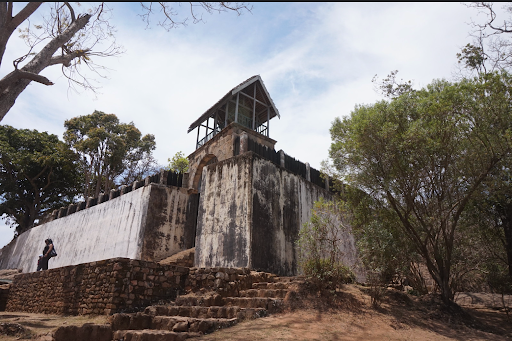
The Royal Hill of Ambohimanga. Martin Kalfatovic. CC BY-NC-SA 2.0.
Madagascar is renowned for its stunning natural landscapes. The country is a significant hub of biodiversity, featuring unique and endemic life, such as its iconic baobab trees, some of which have been growing for over 800 years, over 100 species of lemurs, and diverse ecosystems, including rainforests, dry forests, coral reefs and coastal areas. Alongside its rich biodiversity and vast landscapes, Madagascar also has a long and complex history; as a result, it has many remnants of Indigenous societies and cultures, as well as a French colonial legacy visible in its architectural structures and historical sites.
Madagascar has one UNESCO World Heritage Site: the Royal Hill of Ambohimanga. It is an expansive area with a complex of structures comprising a royal city, surrounded by a large array of nature. This site has remained in place for 500 years and has become a significant reflection of the various periods of history in Madagascar. The Royal Hill of Ambohimanga is an hour's drive away from the city centre of the nation's capital, Antananarivo.
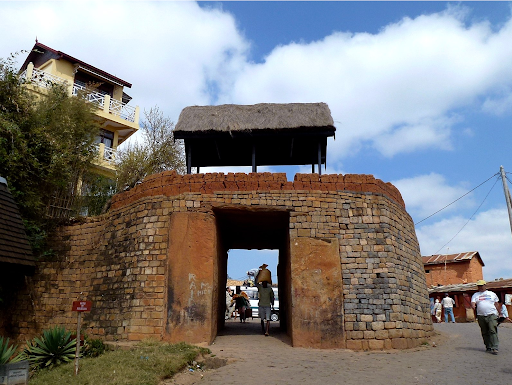
Malagasy people. Antony Stanley. CC BY-SA 2.0.
The history of the Royal Hill of Ambohimanga dates back to the 15th century. Its rich past makes it an important spiritual and religious site for many residents of Madagascar, especially the Malagasy people. The Malagasy people are an Indigenous society in Madagascar who have been worshiping at the Royal Hill since the 15th century. The Royal Hill of Ambohimanga was the political capital and sacred town of the kingdom of Madagascar, earning this significance in the 18th century, where it served as the royal palace during the reign of King Andriantsimitoviaminandriana. It also became the burial site for many of Madagascar's sovereigns during the 18th and 19th centuries.
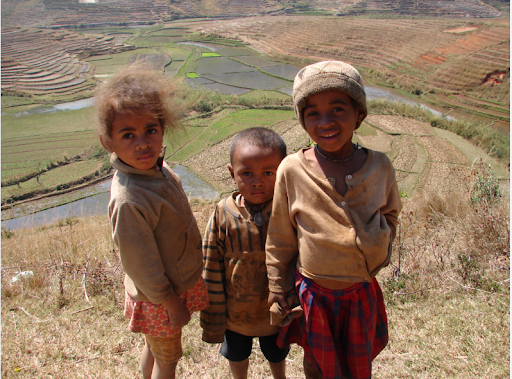
Architecture of the Royal Hill of Ambohimanga. Hiroki Ogawa. CC BY 3.0.
The architecture of the Royal Hill of Ambohimanga is a significant reason for the site's importance and beauty. The site has seven gates, with a main gate that forms the defensive walls of the site. Surrounding the area is a forest that is considered sacred by the Malagasy people, with several endemic species, such as the fig tree. The site also includes royal buildings, burial grounds, places of ritual and fortification systems that reflect the long history of the site. Symbolically, the former seat of justice is also in the Royal Hill of Ambohimanga, located on a granite rock and shaded by a royal fig tree. Despite efforts during the 19th century to undermine the religious and spiritual significance of the structure by French colonial authorities, the Royal Hill of Ambohimanga remained a significant place of worship and a reflection of the resilience of the people of Madagascar.
The Royal Hill of Ambohimanga is protected under Madagascar's heritage laws; these laws have been recognized by the UNESCO World Heritage Center. However, according to the World Monuments Watch, the Royal Hill of Ambohimanga requires consistent monitoring and maintenance. The structure has received insufficient financial resources for maintenance in the past, resulting in the inability to repair damages around the area. Furthermore, Hurricane Giovanna damaged the historic site in February 2012. Though conservation strategies were attempted by various NGOs, including the World Monetary Fund, restoration efforts have often been slow and ineffective based on the financial support the site has received.
Each year, tens of thousands of travelers visit the Royal Hill of Ambohimanga to be immersed in the cultural and spiritual scene of the site. The site is an empowering reminder of the importance of preserving structures with cultural significance for travelers and local people to enjoy and respect.
Alex Jung
Alex is from New Zealand and South Korea, and is currently a student at the University of Chicago. He is majoring in Political Science and International Relations, and minoring in Middle Eastern Studies. He is passionate about social justice for minorities and indigenous communities. In his free time, he enjoys learning languages (Korean, English, Mandarin, and Persian) and writing novels and short stories.