
Julia Kelley
As countries ban the practice of shark finning, Costa Rica disregards conservation policies through illegal fishing exports.
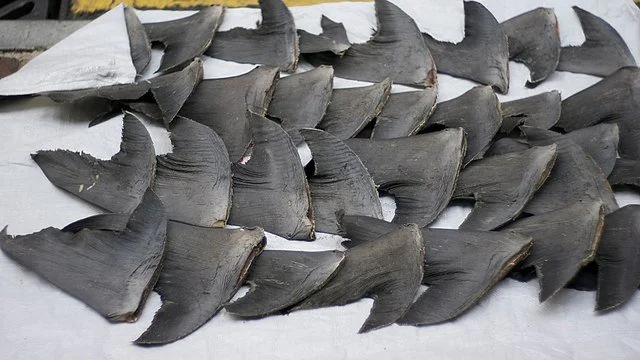
Shark fins being sold in Hong Kong. Cloneofsnake. CC BY-SA 2.0.
Every year, nearly 100 million sharks fall victim to the vicious practice of shark finning. This process, in which fishermen catch sharks to slice off their fins before discarding their bodies in the water, has long been an important cultural practice. Dating back to China’s Ming Dynasty during the 15th century, shark fins were a delicacy enjoyed by emperors and other high-status individuals, as powerful animals were believed to transmit their strength to those who would eat them. Since this time, shark fin soup in particular has gained a reputation synonymous with high status and wealth. The dish has remained a significant cultural marker, only increasing sharks’ monetary value over the centuries. As demand rose, fishermen adapted to only bringing fins to market rather than an entire shark body due to the fins’ higher value. In addition to these cruel deaths, sharks age and reproduce at very slow rates, already making their threats of extinction extremely high. Shark finning only elevates these concerns, as shark overfishing has led to a 71% decline in population since the 1970s.
Shark finning numbers continue to grow despite these brutal circumstances. The demand for shark fins has particularly increased throughout Asian countries where this tradition persists, generating a prominent shark fin market, with about 90% of fins imported by China, Hong Kong, Singapore and Malaysia. In many places, sharks are hunted locally, including Indonesia, Taiwan and Japan as some of the largest exporters of fins. China, too, has gained attention in recent years due to partially state-owned fishing companies being caught using banned gear to catch hundreds of thousands of sharks every year. As a result, sharks around these countries are distinctly threatened, and general coastal fish populations are extremely depleted, with only 5-30% of unexploited levels. While on a much smaller scale, the controversial market is found elsewhere in countries such as South Africa and the U.S., despite heavy restrictions; the U.S., especially, has played a substantial role in not only disseminating shark fins within its own borders but also moving them from Latin America to Hong Kong. Sharks are additionally finned in waters around the world, namely in European and Latin American countries, with Spain and Peru being some of the biggest exporters.
As of today, almost 50 countries and territories across the world, as well as many fishery management organizations, have introduced partial or full bans on the controversial practice. However, many of these countries still find themselves at the center of the shark fin trade, including Costa Rica. Known for its conservation efforts, Costa Rica implemented a shark finning ban in 2012 after then-President Laura Chinchilla announced government investments into protecting marine wildlife. The decision came after controversies resulted in the country’s association with the shark fin market; the Costa Rican town, Puntarenas, was particularly infamous as a hotspot for the practice. In the years since then, many other Costa Rican territories have encountered such problems. Cocos Island, for example, has been a protected marine area since 1982 and is a popular spot for shark diving, but its remote location has made illegal fishing hard to control. Moreover, shark fishing is still authorized in many other protected marine areas across the country, and enforcement of shark finning bans is largely neglected.
Despite earlier attempts to limit the amount of deadly fishing, China and Thailand still heavily influence exports. Many sharks were listed as endangered species in international trade in 2013, but legislation coming out of Costa Rica in 2020 once again allowed the fishing and exporting of one of these listed sharks. Such decisions are also swayed by the Taiwanese and Indonesian mafias, who control a large part of shark fin trading, even operating their own private docks in Puntarenas. As a result, the shark fin trade in Costa Rica continues to thrive. In an investigation conducted by Mongabay, researchers found that between 2023 and 2024, 12.6 tons of shark fins were authorized to be transported from Nicaragua to Costa Rica. Additionally, between 2003 and 2020, Costa Rica continued to be the largest supplier of shark fin products to Asian trade markets. Activists note how previous regulations are repeatedly ignored, and the government tolerates shark fishing for its monetary benefits. However, many continue to fight for protections, including conservationist Randall Arauz, who has been at the forefront of this fight for decades. Now, his focus is turned toward achieving the declaration of sharks as wildlife in Costa Rica, after the country famously labeled them as a commercial species in 2017. In an interview with the Goldman Environmental Prize, Arauz emphasizes this critique of the government, stating that to ensure preservation, “[w]e have to change policy” and warning that shark species will be extinct “unless trade is closely controlled.”
GET INVOLVED:
Those looking to help support the end of shark finning can look into organizations aimed toward policy changes and activism against the practice, including the Shark Research Institute, the Shark Trust, Shark Stewards, Oceana and Shark Angels. Additionally, you can check out conservation groups like the World Wildlife Fund, the Sea Shepherd, the Ocean Conservancy, PADI AWARE and the International Fund for Animal Welfare, which are focused on protecting endangered species around the world, both on land and in the sea.

Julia Kelley
Julia is a recent graduate from UC San Diego majoring in Sociocultural Anthropology with a minor in Art History. She is passionate about cultural studies and social justice, and one day hopes to obtain a postgraduate degree expanding on these subjects. In her free time, she enjoys reading, traveling, and spending time with her friends and family.