
Alex Jung
The implementation of Te Reo Maori, a national language of Aotearoa New Zealand, into the country’s education system is a significant step forward for post-colonial Indigenous revitalization, though its inclusion is met with debate.
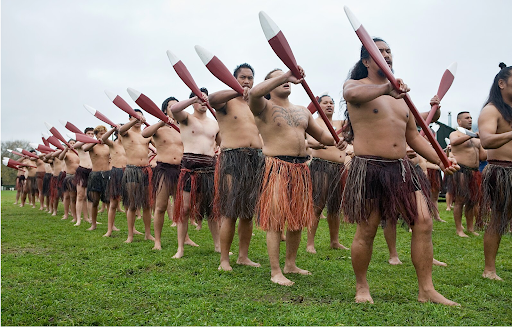
Maori people of Aotearoa New Zealand. Jorge Royan. CC BY-SA 3.0.
One of Aotearoa New Zealand's national languages is Te Reo Maori. The language dates back to the 13th century, when the Indigenous Maori people, through oral traditions and history, brought the language to the land of New Zealand, or what the Maori people call Aotearoa. As someone who has lived in the country my whole life, I am grateful to be part of a nation with a unique cultural identity.. But despite Aotearoa New Zealand's striving for multiculturalism, Te Reo Maori has not had an easy history.
During the colonial period, Te Reo Maori saw a sharp decline in the number of its speakers. A large reason for this was the Native Schools System, which lasted from 1867 to 1969. This oppressive legislation banned the spoken or written use of Te Reo Maori in all schools, and students were punished for speaking it. Before the Native Schools System, over 200,000 Maori people were living on the island and speaking Te Reo Maori. Though, as of 2025, after the historical decrease, the number of speakers has only recently rebounded to 200,000. The devastating impact of colonial rule on the language is even steeper than this number makes it seem; before the Native Schools System, those who spoke Te Reo Maori represented a significant majority of the population, whereas according to the 2023 census, the 200,000 speakers today only represent 4% of the population. The spread of Te Reo Maori is a vital step for Indigenous revitalization and respect for the Maori people. It is ultimately the responsibility of all citizens of Aotearoa New Zealand to support and encourage the use of Te reo Maori in school curriculum, classroom settings and daily life.
An important part of revitalizing the language is through the mandatory implementation of Te Reo Maori across all schools in the country. Even though the vast majority of schools are taught in English, teachers are required to teach Te Reo Maori vocabulary and Maori culture. The inclusion of Te Reo Maori in education has been attempted to varying degrees since the end of the Native Schools System, but recent developments are more assertive. The 2020 Education Training Act of New Zealand includes a series of articles that describe the importance of ensuring local curriculum reflects Maori culture, heritage and language. Schools often have programs required for students of all ages that teach specific aspects of Maori culture. For instance, many schools teach kapa haka, or Maori action songs, which is a traditional form of performing art by youth that has been celebrated for many years at local and national events, like the annual ASB Polyfest. Te Reo Maori has also been implemented in schools through a nationwide program, Te Ahu o Te Reo Maori (The Maori Language in Education Strategy). Te Ahu o Te Reo Maori is an intensive training program for all teaching staff at primary and high schools across the country. Language programs go beyond basic greetings and ensure teachers, regardless of their background, have a rudimentary understanding of the language to teach students. In turn, Maori students in the classroom “thrive when their identity, language and culture is embedded into their learning, and they have a strong sense of belonging,” says the Ministry of Education.
A notable debate surrounding the implementation of Te Reo Maori in education is the question of either mandating the language for all students or making it optional for those who are willing to learn. The former Race Relations Commissioner of New Zealand, Meng Foon, highlighted the key reasons why he believed learning the language should be compulsory, noting that it plays a key role in building meaningful relationships within an array of communities. The Labor Party government of New Zealand, though having some worries about the backlash from mandating Te Reo Maori education, has shown encouraging signs of embracing the language. This creates a rather positive atmosphere for the implementation of compulsory learning. Certainly, many news agencies, including The Guardian and National Geographic, have praised New Zealand for being a pioneer in Indigenous revitalization movements.
However, progress is still greatly required, as many in the nation also strongly oppose the mandate of Te Reo Maori. An exclusive interview with Ted Johnson, the leader of the right-wing TOP, revealed that he believes Maori language education is not an important issue to be investing in. Similarly, the right-wing party, ACT, also claimed that mandating the language in schools was ultimately going to “destroy people's passion” in the culture and language. These perspectives display the difficulty and long-term debate surrounding the implementation of the language to its fullest potential in schools around the nation.
Ultimately, as the United Nations Declaration of Human Rights believes, human rights are indivisible and inalienable. Therefore, Indigenous revitalization through education programs is of vital importance not only to the preservation of Indigenous rights within the nation but also to uplifting a cultural identity that Aotearoa New Zealanders take great pride in.
Alex Jung
Alex is from New Zealand and South Korea, and is currently a student at the University of Chicago. He is majoring in Political Science and International Relations, and minoring in Middle Eastern Studies. He is passionate about social justice for minorities and indigenous communities. In his free time, he enjoys learning languages (Korean, English, Mandarin, and Persian) and writing novels and short stories.