
Julia Kelley
Experts seek to protect the colossal Bamiyan Buddha statues, after Afghanistan’s Taliban coordinated their destruction.
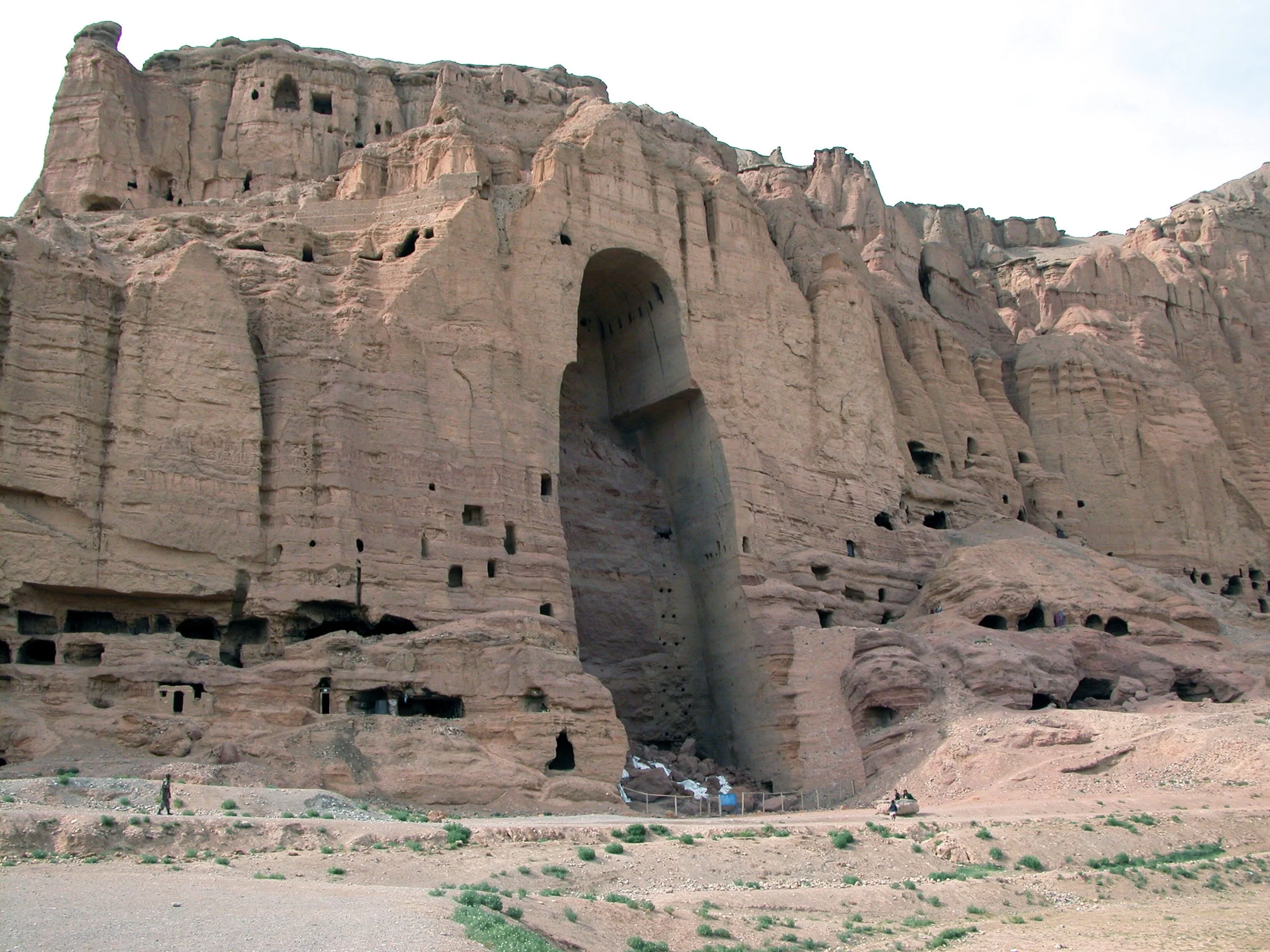
Destroyed remains of the Bamiyan site. Mario Santana. CC BY-SA 3.0.
Located in Afghanistan’s center at an elevation of 8,200 feet, the vast Bamiyan Valley has sustained a population since the third century B.C. This area, serving as a natural passageway between the Hindu Kush and Koh-i-Baba mountain ranges, facilitated the movement of traders during the Silk Road era. Major cultural exchange was additionally coordinated by the Kushan Empire, an Indo-European nomadic civilization that conquered other Central Asian tribes throughout modern-day Afghanistan and Pakistan. They eventually stretched from the Aral Sea to Northern India, allowing widespread groups to share new ideologies, including Buddhism.
Buddhism in Afghanistan thrived during the Kushan Period, and Bamiyan’s ancient city became an important hub of religious study thanks to its advantageous position as an intermediary between China, India and Rome. Searching for a way to express religious teachings to a larger population, sculptors from the Gandhara region, which is now Pakistan, borrowed from Hellenistic art practices to create large concrete forms of the Buddha and bodhisattvas. These sculptures were carved across the Bamiyan Valley as structures to house religious relics. Today, approximately 1,000 Buddhist caves remain carved on the cliffs of the valley; however, it is two large Buddha figures, carved into niches on this same cliff face in the sixth century, that have stood out for their monumental size. One statue, measuring about 175 feet high, stands at the western end of the cliff and is believed to depict the Buddha Vairochana, or the transcendent Buddha. The other, situated to the east, is smaller at 120 feet high and represents the Buddha Shakyamuni, or the historical Buddha, who was believed to have lived sometime during the fourth to sixth centuries B.C.
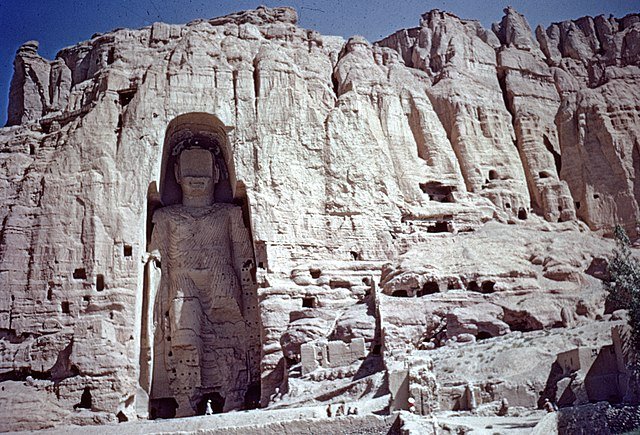
Larger Buddha before destruction. Francoise Foliot. CC BY-SA 4.0.
Long regarded as some of the most important archaeological remains of Afghanistan, the Buddha images have been admired since their construction. However, in the midst of Afghanistan’s Taliban rule, the two Buddhas were destroyed from the cliff face in 2001. Despite fierce opposition when they first announced their plans, the Taliban, a Sunni Islamic nationalist movement that sought to rule from a strict interpretation of the Qur’an, destroyed the Buddhas because they were considered “un-Islamic” and a form of idol worship. The statues, having stood for over 1,000 years, had become a source of national pride, reinforced when the Bamiyan Valley was posthumously announced as a World Heritage Site in 2003. The demolition of the artifacts devastated the Afghan people. After the Taliban was overthrown, outrage and protest from around the world inspired attempts to protect the important site. Since 2003, UNESCO has focused on preventing further damage through a three-phase plan to guard the property, including another objective to conserve the remains. Additionally, in 2015, the Afghan government, working with UNESCO and the Republic of Korea, launched a plan to construct a Bamiyan Cultural Center as a way to drive economic development and spotlight cultural resilience after years of civil unrest.
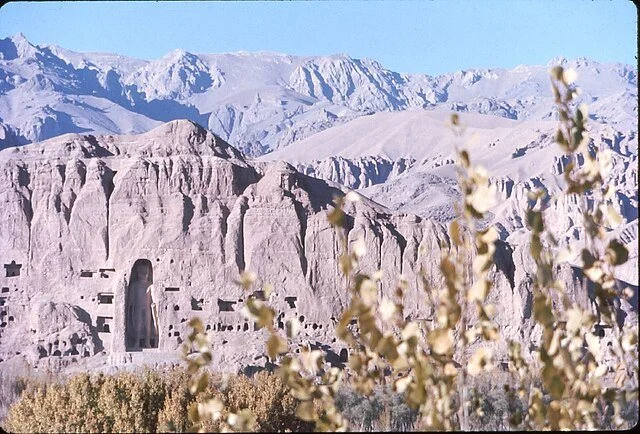
Smaller Buddha before destruction. Wendy Tanner. CC BY 2.0.
Despite numerous plans for their preservation, the Taliban, who recently returned to power in 2021, have not only taken attention away from the Bamiyan Valley but also have allowed it to once again deteriorate, despite claims of supporting cultural conservation. Reports of illegal settlements, looting and unauthorized excavations have concerned the researchers and experts who spent years planning for their safeguarding. As of 2024, the Afghan government continues to have protections in place for heritage sites, and the Taliban has reinforced its commitment to preservation, as well as agreed to invest money into the heritage fund. But many do not trust the regime’s claims due to its history of injustice and substandard human rights record, shaking the hope of many for the relics’ future.
GET INVOLVED:
Those looking to help support cultural preservation of the Bamiyan Valley can look into organizations such as the Institute for the Study of Ancient Cultures, which works with the National Museum of Afghanistan to ensure cultural conservation through multiple projects, the Peaceland Foundation, an NGO that has conducted regular inspections of the Bamiyan Valley, or Turquoise Mountain, which offers support to Afghanistan through humanitarian aid, health services and heritage preservation in many areas, including Bamiyan. Moreover, groups such as the Aga Khan Development Network, which runs cultural programs dedicated to preserving historic sites, and the Association for the Protection of Afghan Archaeology, which aims to protect archaeological artifacts, are also committed to helping safeguard cultural heritage in Afghanistan.
Julia Kelley
Julia is a recent graduate from UC San Diego majoring in Sociocultural Anthropology with a minor in Art History. She is passionate about cultural studies and social justice, and one day hopes to obtain a postgraduate degree expanding on these subjects. In her free time, she enjoys reading, traveling, and spending time with her friends and family.