
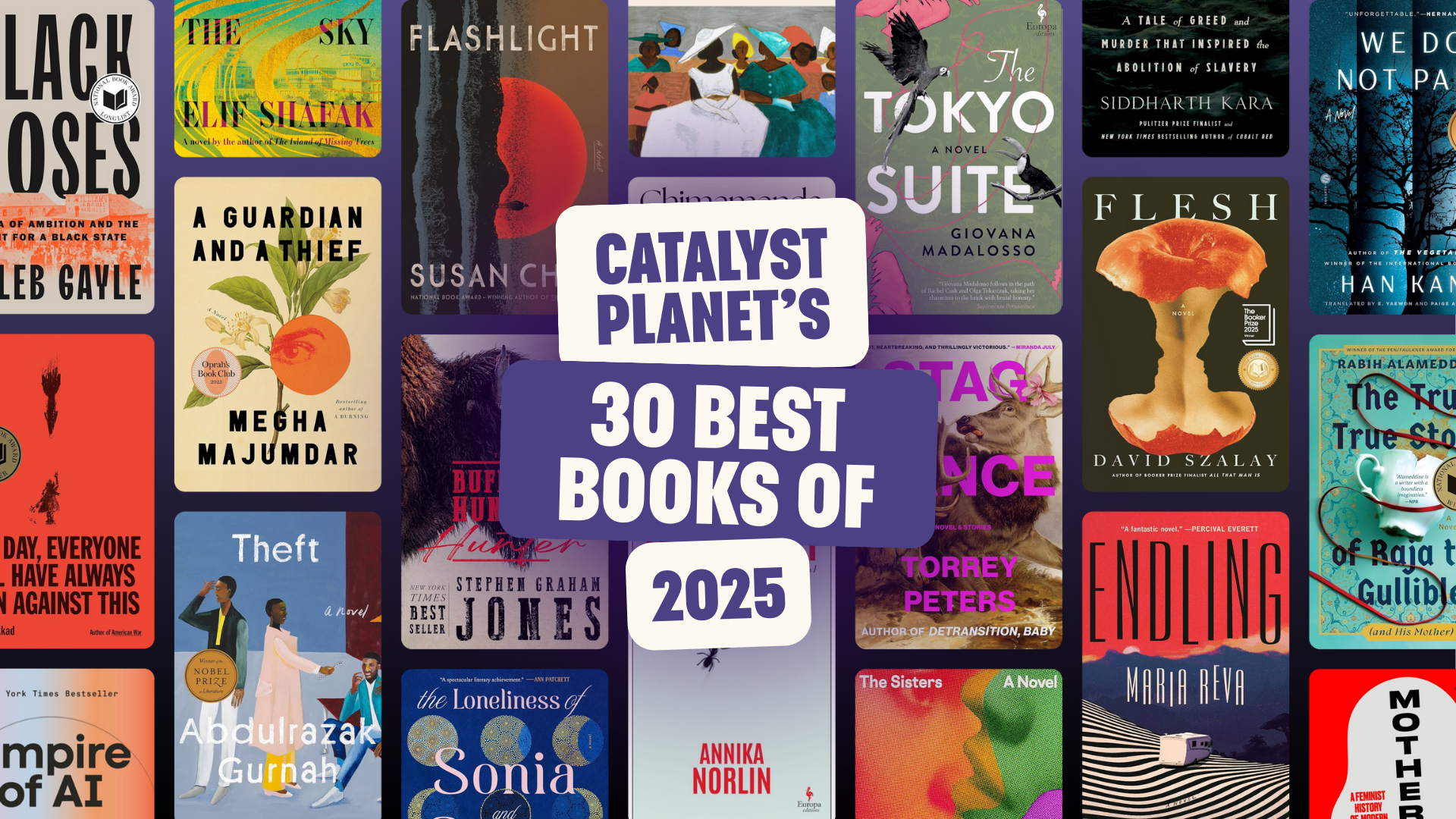
An abundance of thought-provoking titles were published this year, covering a wide spectrum of genres, countries, global issues and diverse perspectives. Below is a list of our top fiction and nonfiction picks from authors around the world.
Fiction
1. There Are Rivers in the Sky
by Elif Shafak
Award-winning novelist Elif Shafak’s novel, “There Are Rivers In The Sky,” follows the lives of three characters spread across three different eras, each connected through a single drop of water. Shafak’s captivating prose weaves between periods of history that are uncovered by both the characters and the reader. In 19th-century London, Arthur pursues the missing pieces of the Epic of Gilgamesh to escape a life of poverty. In 2014, set by the Tigris River, Zarin becomes caught in a genocide by the Islamic State against the Yazidi, a religious minority historically persecuted in the region. Lastly, in 2018, water scientist Zaleekhah makes a curious discovery while studying the River Thames. Equal parts informative and thought-provoking, Shafak’s novel explores the relationship between the power of water, memory and human history.
2. A Guardian and a Thief
by Megha Majumdar
Megha Majumdar’s “A Guardian and a Thief” is a gripping work of speculative fiction that centers on two families fighting for survival in a rapidly deteriorating world. Set in a near-future version of Kolkata, India, climate visas are the only chance citizens have at escaping the devastating effects of climate change in their city. Right before her family is to reunite in the U.S., Ma’s immigration documents are stolen by Boomba in an act of desperation to provide for his own family. Driven by love and hope for their families, Ma and Boomba test how far they will go to escape their city, devastated by famine, floods, crime and corruption.
3. Theft
by Abdulrazak Gurnah
From the 2021 Nobel Prize winner Abdulrazak Gurnah comes “Theft,” the story of three young people growing up in post-colonial Tanzania and how their lives intersect. Gurnah’s vivid portrait of life in Tanzania’s transitional state provides the foundation for understanding the ever-evolving relationships between the novel’s three protagonists: Karim, Fauzia and Badar. As their intertwined lives unfold, Gurnah draws attention to questions of belonging and identity in a rapidly changing society.
4. Endling
by Maria Reva
“Endling” by Maria Reva is a literary curiosity full of innovative prose that blends reality into fiction. The book follows Yeva, a Ukrainian biologist who joins the marriage tourism industry to fund her true work of saving a rare breed of snails from extinction. While entertaining American tourists as a potential bride, she bonds with a pair of sisters who hatch a plot to expose the exploitation of the marriage industry. Reflecting on the devastation of Russia’s invasion of Ukraine in 2022, “Endling” is an emotional and existential tale of survival.
5. The Buffalo Hunter Hunter
by Stephen Graham Jones
“The Buffalo Hunter Hunter” is a gothic-horror novel that retells the historical events of the 1870 Marias Massacre through confessional-style interviews between the mysterious Good Stab, a surviving member of the Blackfeet Nation, and a priest. Jones brilliantly uses supernatural elements to contrast real-world horrors committed by the United States Army, namely the slaughter of 217 Blackfeet people and the poaching of the buffalo populations.
6. Stag Dance
by Torrey Peters
Torrey Peters’ “Stag Dance” collects a novel and three related short stories, each united by their meticulous exploration of queerness and the trans experience. Through a variety of genres and a cast of complex characters, Peters ensures that the narratives are anything but homogenous. From a dystopian gender hormone epidemic to toxically competitive trans lumberjacks, each story uniquely addresses the endless intricacies of gender, sexuality and identity.
7. The Colony
by Annika Norlin
Currently one of Sweden's bestselling contemporary novels, Annika Norlin’s “The Colony” dissects the definition of community. Suffering from burnout, Emile seeks an escape from city life by retreating to the forest, where she comes across a cult-like group of misfits. Norlin delves into all of the characters’ personal histories and philosophies, creating a detailed study of the colony members and their complicated dynamics.
8. Dream Count
by Chimamanda Ngozi Adichie
Set during the pandemic, “Dream Count” is about four Nigerian women’s musings on womanhood, past loves and lasting friendships, strung together with stunning lyricism and wit. At the heart of the novel is Chiamaka, a Nigerian travel writer living in America, and the equally resilient women who surround her. Grounded in panoramic views of American and Nigerian life, Adichie pens four interconnected, emotional and pleasantly wandering stories.
9. Flashlight
by Susan Choi
Susan Choi’s family drama, “Flashlight,” begins with the disappearance of young Louisa Kang’s Japanese-born Korean father, Serk, while they are walking together on a beach in Japan. The mystery of Serk’s disappearance tests the relationship between Louisa and her American mother, Anne. As the characters unravel the truth behind Serk’s life, Choi threads the novel with the geopolitical history of postwar connections between Japan, North and South Korea and the U.S.
10. Flesh
by David Szalay
2025 Booker Prize winner David Szalay writes “Flesh,” a cautionary coming-of-age novel about a boy named Istvan, examining themes of masculinity and desire. Szalay’s minimalistic prose skillfully constructs a main character disconnected from himself as he stumbles his way through life. Beginning in Hungary as a teenager, Istvan accepts the tragedies and fortunes that pull him across Europe in adulthood. Throughout the novel, Istvan’s detached attitude encourages readers to ponder what Szalay leaves unsaid on the nature of trauma and our own agency.
11. The Loneliness of Sonia and Sunny
by Kiran Desai
Blending magical realism with romance, “The Loneliness of Sonia and Sunny” follows the converging journey of two young writers from India living in the U.S. Separated from their traditional upper-class Indian families, Sonia and Sunny search for true belonging and identity in different places. Desai’s immersive, epic-length novel studies every aspect of loneliness centered around the Indian-American immigrant experience.
12. The Sisters
by Jonas Hassen Khemiri
Jonas Hassen Khemiri’s family saga, “The Sisters,” chronicles the vibrant lives of the Mikkola sisters, three Swedish-Tunisian women haunted by the same ominous curse that shapes their every decision. Across three decades, a Swedish-Tunisian author, Jonas, narrates his varied interactions with the sisters and how their lives inevitably intertwine. In this sprawling, temporally shifting novel, Khemiri’s alluring cast of characters sweeps readers away into their enchanted lives.
13. The Tokyo Suite
by Giovana Madalosso
Brazilian author Giovana Madalosso’s English-language debut, “The Tokyo Suite,” investigates the nuances of modern family life, motherhood and the search for identity. The novel begins when Maju, a nanny, suddenly abducts Cora, the 4-year-old daughter of a high-powered executive, Fernanda. Told through Fernanda’s and Maju’s perspectives, the novel examines the women’s respective and shared struggles in their stratified parts of Brazilian society. Initially portraying the women as opposites, Madalosso earnestly portrays Fernanda’s and Maju’s motivations, sending the women on a path toward understanding one another.
14. The True True Story of Raja the Gullible (and His Mother)
by Rabih Alameddine
Winner of the 2025 National Book Award for Fiction, “The True True Story of Raja the Gullible (and His Mother)” records the remarkable life of a queer Lebanese philosophy teacher, Raja, and his prying yet well-meaning mother. Raja’s story takes place through the shards of Lebanese history, rooted in his relationship with his mother and the reflections on his difficult past. Alameddine writes Raja through times of tragedy, civil war and uncertainty with a balance of poignancy and self-deprecating humor that brings this novel to life.
15. The Feeling of Iron
by Giaime Alonge
Two Jewish survivors of a Nazi concentration camp, Shlomo and Anton, are reunited on a quest for vengeance against Hans, an SS officer turned Cold War CIA operative, who tortured them. Alternating between the 1940s and 1980s, Alonge’s compelling prose in “The Feeling of Iron” explores the repercussions of the Holocaust and the hunt for justice across the globe.
16. The South
by Tash Aw
After the death of his grandfather, Jay is sent by his father, Jack, to tend to his family’s farm in southern Malaysia. There, he meets Chuan, and the two teens are unable to resist the budding attraction between them. As Jay and Chuan’s romance develops, both of their families are forced to face their dramatic pasts at a transitional point in Malaysia’s history. Tash Aw’s bittersweet novel delves into the fleeting nature of young love and illustrates the complex dynamics of a multigenerational family.
17. We Do Not Part
by Han Kang
From the author of “The Vegetarian,” Nobel Prize winner Han Kang’s “We Do Not Part” follows Kyungha’s trip to Jeju Island to save her friend Inseon's pet bird in the middle of a dangerous snowstorm. Kang’s writing is at once atmospheric and dreamlike as Kyungha stumbles into the haunted landscape of Inseon’s past, marred by the tragedy of the Jeju Island April 3 massacre. Kang’s surreal tale emphasizes the weight of remembering collective traumas and the love that can endure amidst suffering.
Nonfiction
1. One Day, Everyone Will Have Always Been Against This
by Omar El Akkad
Winner of the 2025 National Book Award for Nonfiction, journalist Omar El Akkad shares a personal and thoughtful critique of Western liberal attitudes, contextualized with Gaza and the ongoing genocide against the Palestinian people. Drawing from his experience as an emigrant, Akkad urges readers to confront and recognize the hypocrisy of Western ideals and empires.
2. Black Moses
by Caleb Gayle
“Black Moses” by Caleb Gayle is an enthralling biography of Edward McCabe, a man who attempted to establish an all-Black state during the early 20th century. Gayle traces McCabe’s noteworthy political career as an advocate for Black people, envisioning Oklahoma at the center of possibility. Exploring McCabe’s ambitious plans and the obstacles in his way, Gayle captures one man’s unwavering dream of hope.
3. There Is No Place for Us
by Brian Goldstone
Brian Goldstone sheds light on the lives of “the working homeless,” an increasingly common issue across major cities in the U.S. With a detailed view of five displaced families in Atlanta, Georgia, “There is No Place For Us” thoroughly examines the devastating impacts of gentrification and underscores the ultimate failure of the government to support or recognize those affected by the housing crisis.
4. Daughters of the Bamboo Grove
by Barbara Demick
In “Daughters of the Bamboo Grove,” Barbara Demick investigates the blurred line between international adoption and abduction during China’s one-child policy in this shocking story of separated twin sisters. During the early 2000s, a family from Texas adopted a baby girl, not knowing that she was forcibly taken from her parents and her identical twin sister living in rural China. Corresponding with both families, Demick illuminates the girls’ stories and her role in reuniting the sisters.
5. Is a River Alive?
by Robert Macfarlane
Robert Macfarlane uses his immersive and stylish travel writing to address urgent environmental concerns in “Is A River Alive?” In journeying through Ecuador, India and Canada, Macfarlane aims to change perceptions of the natural world, rooted in the idea that nature, like all living things, has rights. Macfarlane’s poetic and cerebral prose celebrates nature while calling attention to the human activity that threatens it.
6. A Flower Traveled in My Blood
by Haley Cohen Gilliland
Haley Cohen Gilliland tells the story of Rosa, her daughter Patricia and Patricia’s missing son, Guillermo. Under Argentina’s dictatorship, hundreds of pregnant women, including Patricia, were taken by the military and executed, while the children remained missing. The grandmothers of this missing generation formed the Abuelas de Plaza de Mayo, a group dedicated to recovering the stolen grandchildren. Gilliland memorializes Rosa and the other Abuelas' courage and resilience as they work to find their scattered families.
7. Empire of AI
by Karen Hao
Investigative journalist Karen Hao presents a well-researched analysis of everything surrounding OpenAI, from the company’s CEO, Sam Altman, to the conditions of underpaid data laborers in the Global South and AI’s significant environmental consequences. Hao provides a thorough and unique perspective on the history and future of AI’s role in our world.
8. Being Jewish After the Destruction of Gaza
by Peter Beinart
Peter Beinart’s “Being Jewish After the Destruction of Gaza” is an appeal that asks Jewish people to redefine what it means to be a Jew. Beinart calls for empathy for Palestinians and a reevaluation of Jewish history, wherein “Jewish and Palestinian safety is not mutually exclusive but intertwined.”
9. Motherland
by Julia Ioffe
“Motherland” by Julia Ioffe is both a memoir and a historical narrative that reexamines Russia’s modern history through a feminist lens. Ioffe features the stories of noteworthy women, including those from her own family, starting during the Russian Revolution and ending in modern-day Russia.
10. Born in Flames
by Bench Ansfield
In “Born in Flames,” Bench Ansfield reveals the truth behind a series of fires that spread across American cities in predominantly Black neighborhoods during the 1970s. He shares findings that the fires were intentionally set by landlords seeking money from insurance companies. Coordinated by the real estate and insurance industries, Ansfield focuses on the Bronx fires that left residents devastated and displaced.
11. Mother Emanuel
by Kevin Sack
Pulitzer Prize-winning journalist Kevin Sack writes a powerful history of the Emanuel African Methodist Episcopal Church and its importance in shaping race relations in the U.S. Sack traces the church’s 200-year history, beginning in 1817 and continuing into the present, sharing profiles of various historical members of the congregation, including the nine church members who were murdered in 2015. “Mother Emanuel” is a story of resistance, forgiveness and strength.
12. The Zorg
by Siddharth Kara
Siddharth Kara’s “The Zorg” untangles the events surrounding a disastrous 1781 slave ship incident that eventually helped push anti-slavery to the forefront of the U.K. and the U.S. After the slave ship is blown off course, the crew of the Zorg proposes to conserve resources by throwing the women and children overboard. Kara’s research and skillful storytelling dive into the lives of the slaves and the details of the following trial, showing how the devastating incident was a monumental catalyst for the future of the abolitionist movement.
13. King of Kings
by Scott Anderson
Centered around the overthrow of Shah Mohammad Reza Pahlavi and the Iranian Revolution, “King of Kings” by Scott Anderson revisits the factors that made the revolution possible. Anderson analyzes every angle through research and detailed interviews with figures from American officials and Iranians who were close to the Shah. Anderson constructs an engaging argument about the fall of the Shah and the lasting effects of American foreign policy failure in the Middle East.
Caleigh Capio
Caleigh is a recent graduate from Wellesley College with a B.A. in English and a minor in Italian Studies. She has always had a passion for storytelling, language and culture studies, and all things literary, and will continue to pursue these interests. In her free time, she enjoys reading, writing book reviews, spending time with friends, and discovering new music.