
By Hafsah Khanam
This college turns women who have never held a textbook into solar engineers who power entire villages.
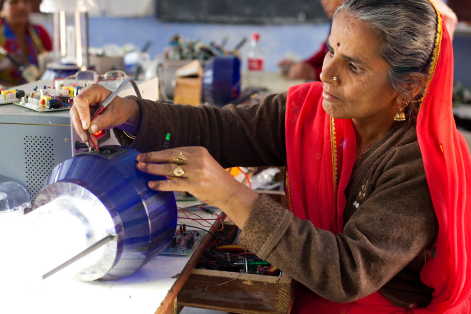
A solar engineering trainer at Barefoot College, India. UN Women. CC BY-NC-ND 2.0.
Tilonia is a small village in Rajasthan, India, that the world might never have heard of were it not for one man's vision. In 1972, Sanjit “Bunker” Roy founded Barefoot College, a community-based organization rooted in Gandhian philosophy: the belief that villages already hold the wisdom and skills needed to drive their own development. Importantly, the college has no entry barriers, and anyone, regardless of formal schooling or even the ability to read, can enroll. Here, a person can receive a meaningful education without ever having read a single word.
Central to Roy's mission is the empowerment of women, and the college puts that conviction into action by prioritizing opportunities for marginalized women.
Since its founding, the college's reach has grown enormously. Today, over 10 million people across 5,000 remote villages have been positively impacted by its initiatives. Roy's efforts have earned him wide recognition. In 2010, Time magazine named him one of its 100 Most Influential People. Additionally, distinguished visitors, including the Dalai Lama and King Charles III, have visited the campus.
At Barefoot College, the curriculum is built around practice, not textbooks. Over the years, the institute has trained solar engineers, doctors, dentists and teachers, giving marginalized communities practical, lasting skills across a wide range of fields. In water management, women have been trained as hand pump mechanics and water testing professionals, challenging the idea that engineering is a male-only domain. In healthcare, illiterate rural women run a unit that produces affordable and largely plastic-free sanitary pads. Not only does this create sustainable livelihoods for these women, but it also helps break the stigma around menstruation. In education, the institute has established 250 Solar Digital Night Schools, bringing learning to children ages 6 to 14 who work during the day. Lastly, in environmental work, the college has planted over 60,000 native trees and plants, transforming degraded wastelands into thriving green spaces with noticeably cooler temperatures.
The college's most celebrated program is its Solar Mamas initiative. Women from remote, unelectrified villages around the world come to Tilonia for six months of intensive, hands-on training in solar engineering. Afterward, they return home equipped to install, maintain and repair solar lighting systems in their communities.
Backed by UN Women, the Asian Development Bank and India's Ministry of External Affairs, the program has so far trained 1,708 rural women from 96 countries, bringing electricity to over 75,000 households and saving an estimated 45 million liters of kerosene. This is a triple win for development, women’s empowerment and climate change mitigation.
The Barefoot College campus is itself a living demonstration of its values. Rainwater is harvested and stored in underground tanks, and solar energy powers everything from mobile phones and laptops to cooking appliances. Meanwhile, nothing goes to waste as everything is recycled.
Visitors are warmly welcomed by the institute. They can stay in on-site accommodations, eat fresh organic vegetables grown locally, browse a range of handcrafted items and take a stroll among sprawling neem trees and vibrant bougainvillea.
GET INVOLVED:
To support Barefoot College, you can visit, volunteer, fundraise or donate. Picking up their book, “Walking Barefoot, The Tilonia Way,” is another way to contribute, with all royalties going directly to the college.

Hafsah Khanam
Hafsah is an English grad student from India. When not curled up with a book and a steaming cup of chai, she can be found traveling, inhaling the nearest snack, and spending time with friends and family. She aspires to pursue a PhD.