
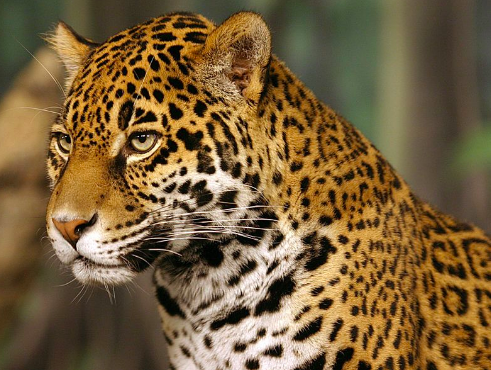
Last month, at the Convention for Biological Diversity in Sharm El-Sheikh, Egypt, the United Nations Development Programme (UNDP), World Wildlife Fund (WWF), Wildlife Conservation Society (WCS), Panthera, and government officials from several Latin American countries came together to announce the designation of November 29th as International Jaguar Day, and also to unveil the The Jaguar 2030 Conservation Roadmap for the Americas, a plan for increasing wild jaguar populations. Once widespread throughout the Americas, the jaguar has seen its numbers decline over the last few decades. By increasing international awareness and funding programs that can protect jaguars, conservationists hope to help the animal restore its population numbers.
The jaguar, or Pathera Onca, is the third largest cat in the world, behind the tiger and lion, respectively. While these animals are typically found in South America, sightings have occurred as far north as Los Angeles. Jaguars are often confused with two other spotted big cats, the cheetah and leopard, but they are easily distinguished when one inspects their coats. Cheetahs are covered in singular, dot-like spots while leopards have ringed markings called rosettes. Jaguars have large rosettes with singular spots in the center, a combination of the two smaller cats’ markings. All three cats were hunted extensively for their fur, or to keep them from preying on livestock at local farms. In the 1960s the wild jaguar population stood at around 400,000. Hunters killed 18,000 jaguars each year and today, estimates place the total population at around 15,000. The jaguar has been listed as a “near threatened species” by the International Union for Conservation of Nature, meaning that there is a high risk that it could become endangered or even extinct in near future.
There is some good news, however. Thanks to conservation programs enacted in 2005, Mexico saw its jaguar population increase by 20 percent over the last 8 years. Last year, the Arizona Game and Fish Department released footage of a female jaguar prowling through southern Arizona, the first female sighted there since the 1960s. Instances such as these give conservationists hope that the big cats can make a comeback. The Jaguar 2030 Conservation Roadmap for the Americas aims to bolster Jaguar conservation in an area between Mexico and Argentina known as “The Jaguar Corridor”. The organizers hope to create 30 jaguar conservation sites in this area and to stimulate programs that mitigate hunting and promote ecotourism, thus creating a more peaceful coexistence to between the animals and the people they share space with. It’s a huge undertaking, but if it succeeds, we can look forward to seeing more spotted cats in the coming years.
JONATHAN ROBINSON is an intern at CATALYST. He is a travel enthusiast always adding new people, places, experiences to his story. He hopes to use writing as a means to connect with others like himself.
