
Alex Jung
The Drowned Church of Potosi in Uribante remains a powerful reminder of the historical resilience of the Venezuelan people and the challenges they endure today.
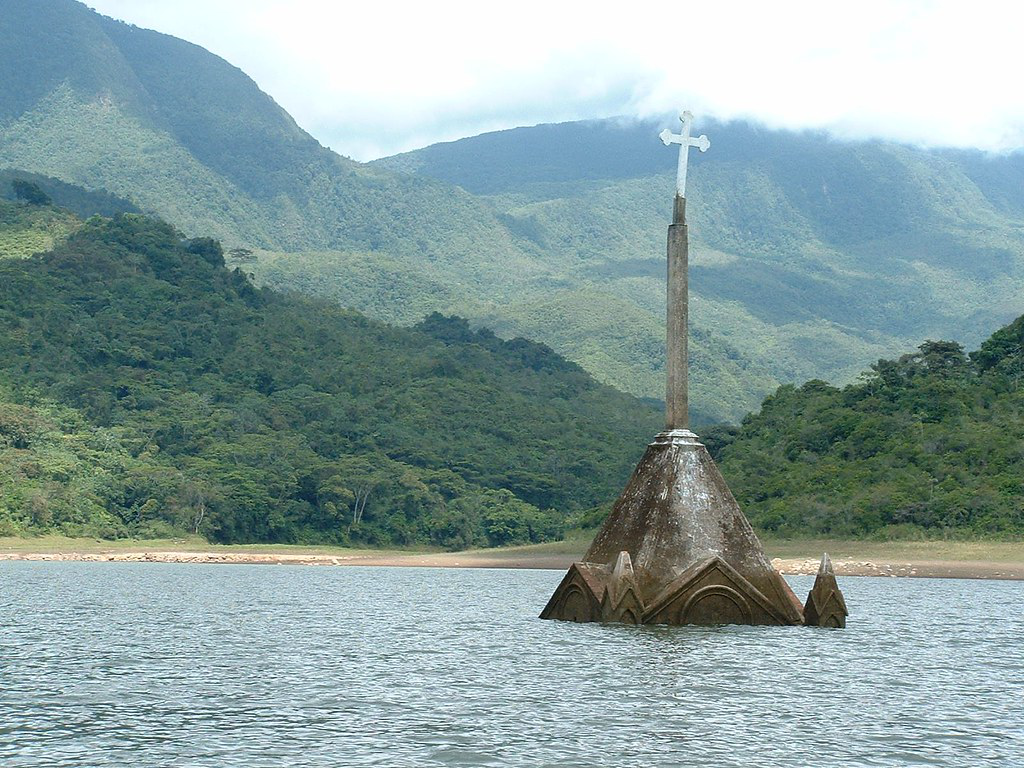
The Drowned Church of Potosi. Juan Tello. CC BY 2.0
Uribante is a small municipality in Tachira, Venezuela, with a population of 20,000 residents. It is known for its wide range of mountains, rivers and lakes that attract many nature-loving travelers. One of Uribante's most unique sights is the Drowned Church of Potosi, located in General Juan Pablo Penaloza National Park. For 30 years, the church was completely submerged underwater, where travelers could only see the tip of the building. However, beginning in 2008, more of the church's structure became visible, revealing its beautiful architecture below. Now, depending on the time of the year and the climate, travelers may see large portions of the church or only the tip of the cross. It is recommended that travelers visit between December and April, as there are lower sea levels.
The history of the church is as fascinating as the unique phenomenon of its appearance on the surface of the Uribante River. Potosi was once a small town with around 1,200 people who worked on the land. The town used to have many stores, a school and a public square, but this changed in 1985, when the Venezuelan government needed to build the Uribante Caparo Hydropower Dam. The townspeople were forced to leave as Potosi became a reservoir for the development of this hydropowered dam. After the city was purposely flooded, many homes were destroyed, and Potosi was largely abandoned. Due to the severe flooding, the only remnants of the town’s existence were the tip of its church, visible on the surface of the Uribante River.
Flooding cities to develop dams is not uncommon. St. Thomas, Nevada, was also flooded to generate hydroelectric power. However, this Venezuelan church is unique as it has never sunk beneath the water's surface completely. Many see it as a window into Potosi's past, a perfect balance between the natural world and human activity.
Significantly, in 2003 and again in 2010, water levels dropped due to an increase in the frequency of droughts, making the entire shell of the church completely visible. Water shortages have also contributed to this pattern. Thus, the church has now become a symbol for the legacy of the town of Potosi and the ongoing climate crisis in South America. El Nino weather patterns, which severely disrupt the balance of the Earth's temperatures, have been seen as the main cause of the droughts and water shortages. In Venezuela, rainfall has been reduced by 50% to 65% lower than the norm from 2013 to 2016. As the impacts of climate change continue to visibly appear in societies, travelers may be able to see even greater portions of the church.
GETTING THERE:
As of May 8, 2025, many countries have released travel precautions and recommendations about travel to Venezuela. It is advised to check the recommendations from your country of residence on travel to Venezuela and accordingly. To visit the Drowned Church of Potosi, travelers can fly from the Simon Bolivar International Airport to the San Antonio del Tachira Airport or the Santo Domingo Airport (approximately one hour one way). It is advised to have a professional travel guide while traveling throughout the country. For lodging in the Tachira area, Lidotel San Cristobal offers lodging for $80 per night, and Hotel Casa Colonial offers lodging for $24 per night, although prices are subject to change.

Alex Jung
Alex is from New Zealand and South Korea, and is currently a student at the University of Chicago. He is majoring in Political Science and International Relations, and minoring in Middle Eastern Studies. He is passionate about social justice for minorities and indigenous communities. In his free time, he enjoys learning languages (Korean, English, Mandarin, and Persian) and writing novels and short stories.