
Isabella Feraca
Cities tend to be hotter on average than rural areas as a result of their infrastructure, and the warming of our climate is only making it worse.
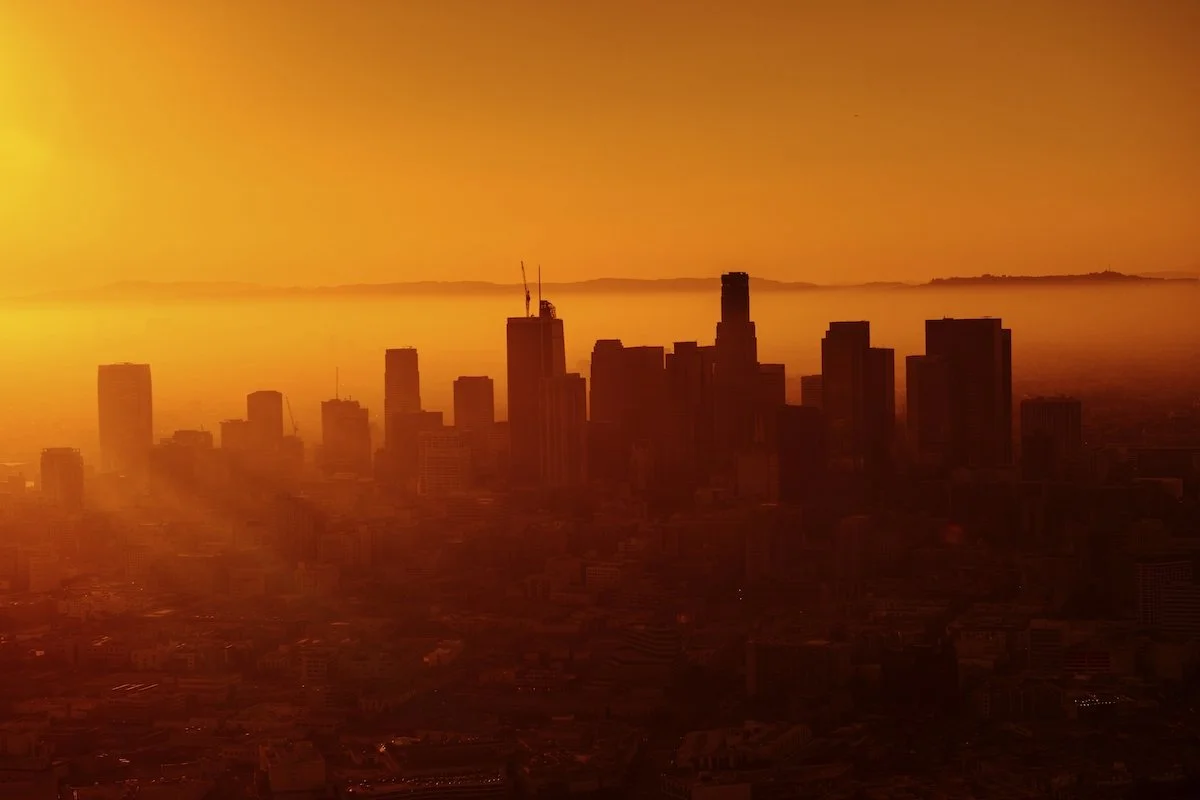
Extreme heat over Los Angeles. Josh Rose. CC0
Climate change has transformed our environment in drastic ways, and cities are no exception. As rural areas grapple with extreme weather, natural disasters and ecosystem disruptions, urban cities are now grappling with intense heat driven by the Urban Heat Island Effect. The Urban Heat Island Effect, or UHI, is a phenomenon in which dense, urbanized areas experience higher temperatures than rural areas.
The phenomenon arises due to the common infrastructure of developed cities. Things like buildings and asphalt roads absorb and re-emit heat from the sun at a higher rate than forests and bodies of water found in natural landscapes. The effect is exacerbated by the fact that the infrastructure of such urban “islands” is typically built very close together and features a lot of activity from cars and people, thus producing even more heat in the form of energy. During nighttime, UHI temperatures remain high, as sidewalks, buildings and roads trap heat and prevent it from rising.
The rise of global temperatures is now intensifying the phenomenon, resulting in dangerously high summer months and heat waves. In fact, some large cities often reach temperatures up to 59 degrees Fahrenheit hotter than their rural counterparts. Given the fact that cities currently hold more than half of the world’s population and that severe heat can result in serious health impacts, cities must acknowledge the issue and begin implementing the appropriate measures to mitigate it.
One of the most important measures in mitigating the effect is introducing vegetation and water into cities’ infrastructure as much as possible. This is because UHI largely arises from the lack of it, while rural areas are conversely able to absorb heat better in having natural greenery. Such infrastructure can come in the form of things like green roofs and planting more trees, as well as bodies of water, which can act as natural cooling agents.
Beyond vegetation and natural landscape, cities can also implement combative structures within their layout and design. For example, reflective roofs, also known as cool roofs, help to reflect solar radiation and thus mitigate the effect of trapped heat. Cool pavements are also being introduced as an alternative to traditional pavement, which attracts and traps heat at a high rate. Cool pavement can also be evaporative instead of reflective. Evaporative pavement works by introducing pores into the concrete for water to flow through and thus evaporate, taking the heat with it and cooling the area as a result.
While more work must be done to mitigate these effects in the wake of extreme global temperatures, some cities have already begun to do so. Medellin, Colombia, for example, has managed to decrease its average temperature by about 36 degrees Fahrenheit after introducing corridors lined with trees and plants around the city. Similarly, New York City has reduced its annual greenhouse gas emissions by 16,000 tons since 2009 as a result of installing over 10 million square feet of green roofs. Such measures will be urgent as we continue to grapple with climate change and its exacerbating effect on Urban Heat Islands in the coming years.

Isabella Feraca
Isabella is a junior at Carnegie Mellon University studying professional writing and music technology. In her free time, she can be found reading, making music, and playing shows with her band around Pittsburgh.