
By Joseph Morales
As the United States prepares for its anniversary celebrations, Indigenous communities are using the national spotlight to emphasize tribal sovereignty and history.
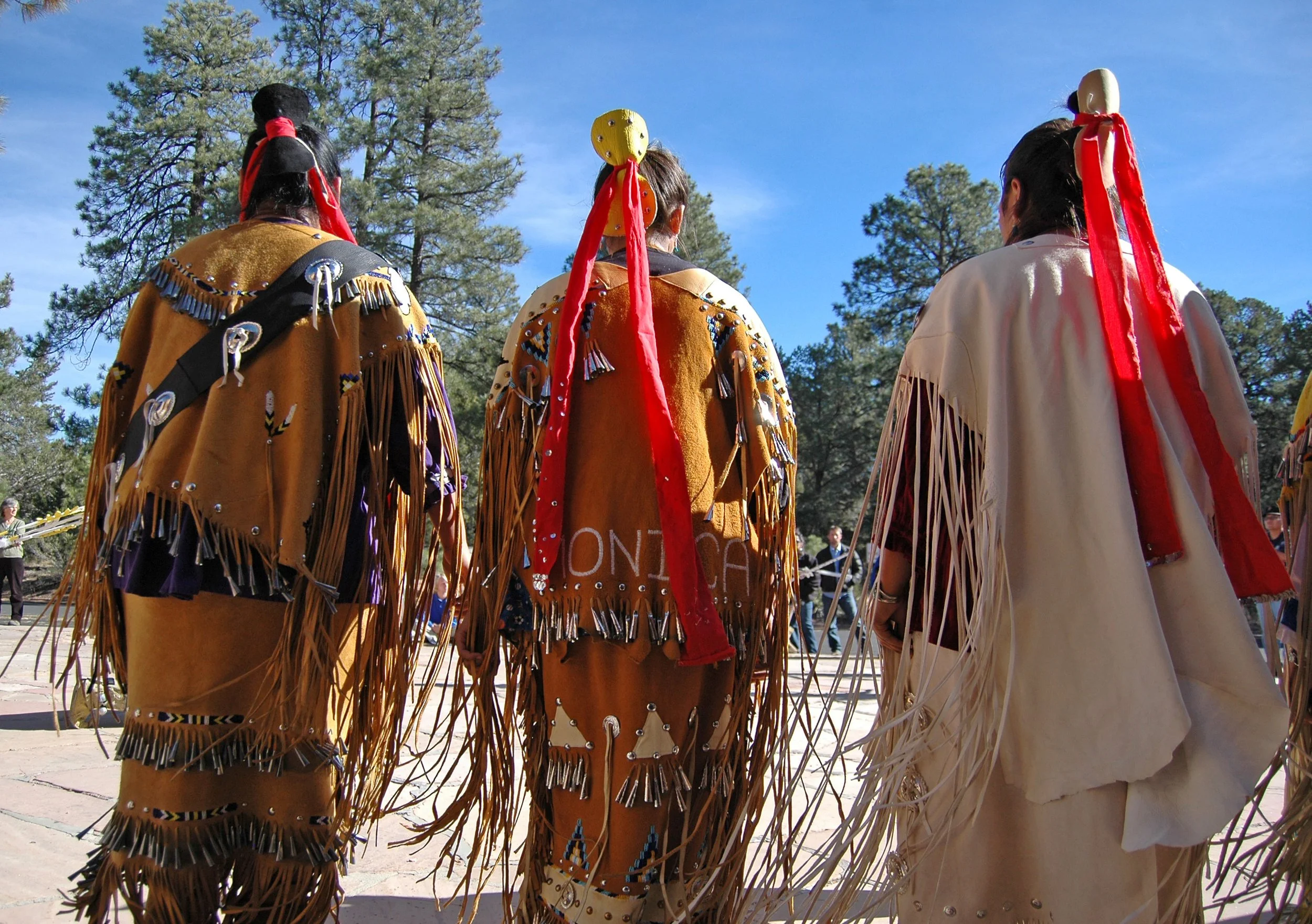
Apache Crown Dance performers stand together during Heritage Day at the Grand Canyon. Erin Whittaker. CC BY 2.0.
As the United States is approaching its 250th anniversary, federal agencies, historical organizations and media networks are all launching national campaigns to honor the events of 1776. In response, many tribal nations and Indigenous advocacy groups are organizing counter-campaigns nationwide to expand the public’s understanding of early American history. Native media outlets and academic organizations have launched dedicated historical series, such as the Indian Country Today News America 250 initiative, which analyzes the severe impact of U.S. founding policies on Native peoples. The efforts by tribal administrators and legal scholars aim to provide vital context regarding the complexity of sovereign tribal communities and systems long before European contact. These initiatives showcase how traditional tribal communities maintained diplomacy and managed resources centuries before the very first colonies were established in North America.
These community movements focus heavily on correcting the exclusion of Native people’s history in public education. Modern public awareness efforts, for example, frequently reference the original version of the Declaration of Independence, which explicitly characterized Indigenous peoples as "merciless Indian Savages.” At the same time, tribal communities are continuing to challenge modern federal land policies that cut through ancestral lands. This tension is surfacing in ongoing policy debates over land rights and federal compliance as tribal nations ask federal courts to enforce tribal consultation requirements and safeguard sacred places from unauthorized development. United South and Eastern Tribes Sovereignty Protection Fund, a nonprofit intertribal organization, emphasizes that even positive infrastructure developments must not happen at the expense of tribal consultation.
Throughout Indian Country, residents focus on bringing historically verified facts into modern conversations. Through the American Indian College Fund advocacy platform, Indigenous students and scholars are publishing analytical pieces discussing early democratic frameworks. These resources highlight that the structural design of the U.S. government was partly modeled after the pre-existing system of the Haudenosaunee Confederacy, comprising multiple Native nations, and governed through collective decision-making. This connection was formally recognized by the U.S. Congress in 1988, acknowledging the similarities of early American democracy to that of traditional tribal structures.
In an American Indian College Fund piece, Marcel Blackbird of the Omaha Tribe of Nebraska wrote, "Reclaiming democracy begins with participation. As Native people, we reclaim democracy by voting, serving our communities, protecting tribal sovereignty, supporting education, and encouraging our youth to become future leaders."
Thus, the upcoming anniversary has evolved into a platform for demanding legislative clarity on federal treaties and trust rooted in the U.S. Constitution. From the Indigenous America 250 initiative, a community-driven research project funded by the National Park Service to study the Revolutionary War's impact in the Northeast, to the release of a podcast about Indigenous peoples' thoughts on this celebration, tribal communities are demonstrating their modern political endurance and resilience. As the national countdowns begin, Indian Country continues to position its history as foundational, rather than secondary, to the mainstream American narrative.
Joseph Morales
Joseph Morales is an enrolled member of the Tohono O’odham Nation and an English major at Arizona State University. Through his education he has built years of experience in digital media and tribal journalism, focusing on representation and community storytelling.