
By Kaitlin Murray
After centuries of near disappearance, Mexico's oldest sport is being reclaimed by a new generation.
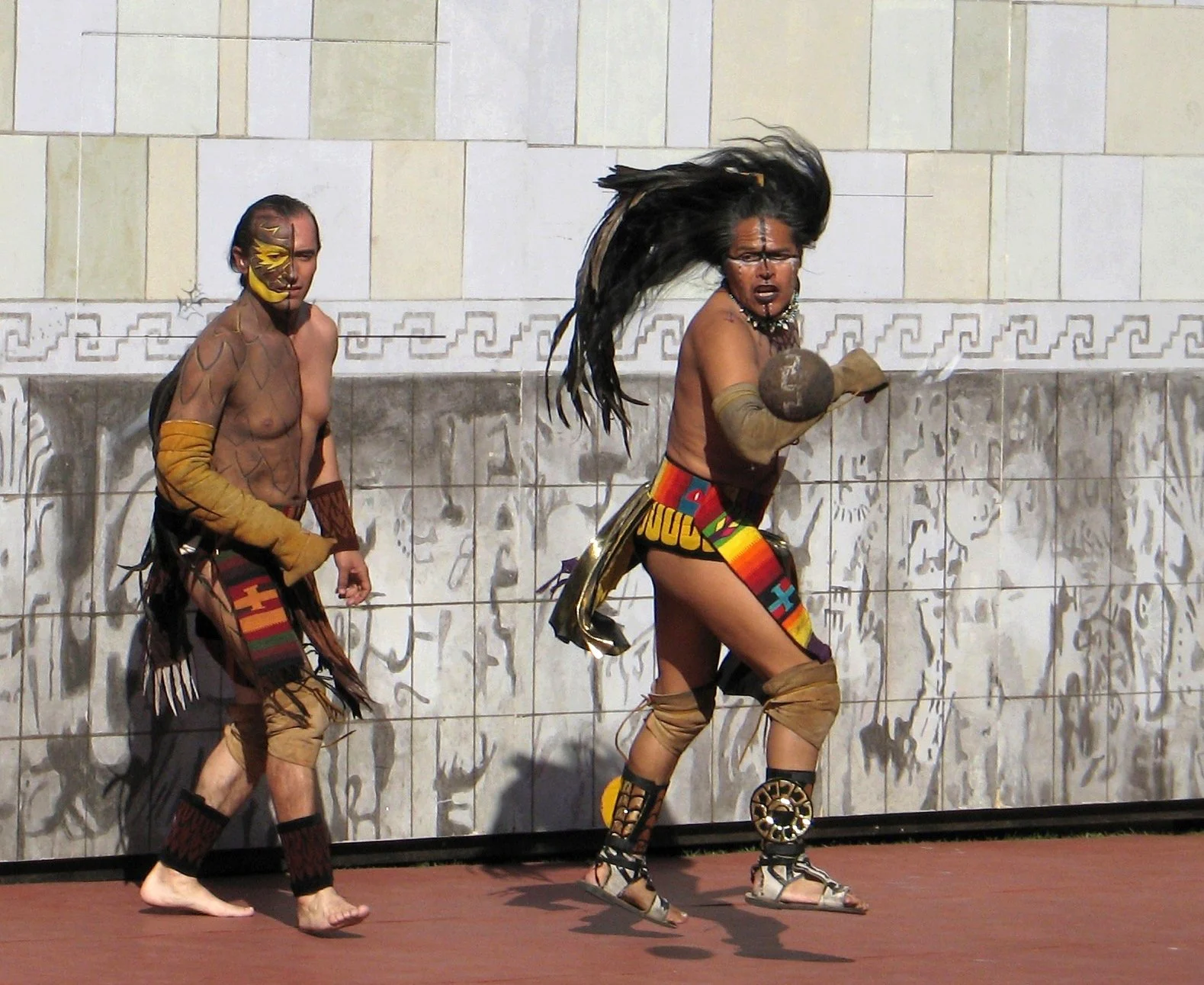
Pok-ta-pok players in Mexico. Sputnik. CC-BY-SA-2.5.
In the ruins of Chichen Itza, the most iconic Mayan site in the Yucatan Peninsula, a vendor waves me over and presses a black rubber ball into my hands. This is the same kind of ball used in the Mesoamerican ball game for thousands of years, made of natural rubber from the jungles of southern Mexico. “Games take place in Piste on Fridays and Saturdays,” he mentions, welcoming visitors to witness the games in the town closest to the ruins. Holding the ball, it is hard not to sense the weight of something larger: 3,000 years of history and traditions, still persisting in the face of colonialism and erasure.
The Mesoamerican ball game, often called ulama from Nahuatl or pok-ta-pok from Mayan, almost disappeared. For centuries after the Spanish conquest, it survived in a handful of towns, kept alive by a small number of communities who refused to let it go. It was a crucial part of society across ancient Mesoamerican civilizations, including the Mexica (Aztecs), Olmecs, Maya, and Toltecs, with evidence of similar games found as far north as tribes in the American Southwest. Today, in the face of colonization, Indigenous cultural erasure attempts and the passing of time, the game is making a comeback as younger generations are reviving it. Games are being played on university campuses, international tournaments are being held, and exhibition games are taking place in town squares. This is the story of a sport that has remained against all odds.
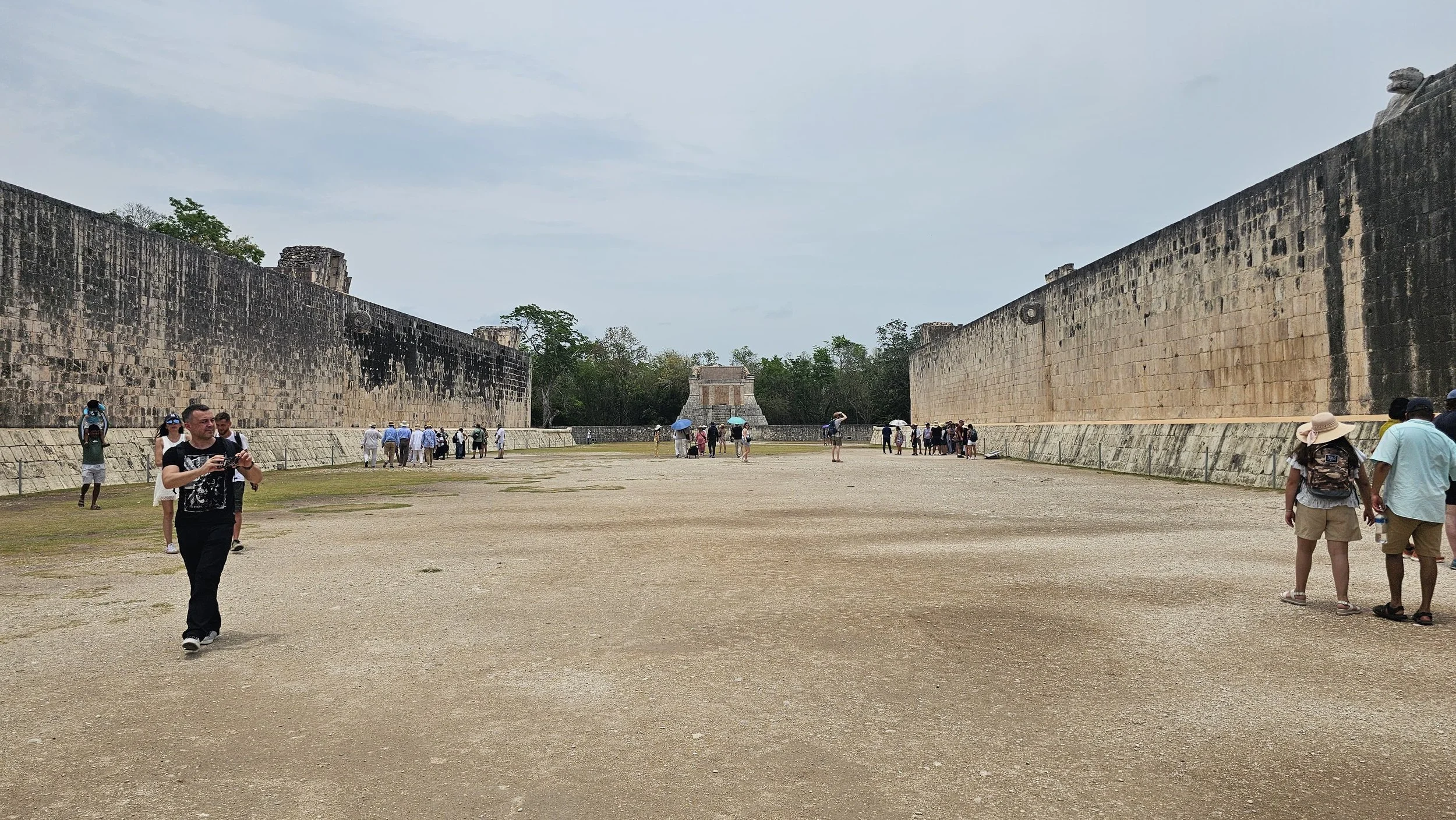
The ballcourt of Chichen Itza. Kaitlin Murray.
The earliest evidence of a ballcourt dates back to around 1600 B.C., making it one of the oldest organized sports in the world. It spread across civilizations not as entertainment but as an important ritual for negotiation between communities, a symbol of life and death, and a bridge between humans and worlds beyond. Over 2,000 ballcourts have been found throughout Mesoamerica, all with a similar architectural design: a sunken court, high walls on either side, and stone rings.
In the Popol Vuh, a Mayan text, legend goes that the game was created after hero twins are summoned to Xibalba (the underworld), where they defeat the lords of death in a ball game and resurrect their father. Despite the countless legends, the most common connection to the ball game in popular culture is the ritual of human sacrifice. With the striking imagery of “native savages” and misconceptions created through racist ideologies, the idea of Mesoamerican players being sacrificed after games has captured the modern public’s imagination. The reality, however, is more complex. Human sacrifice was sometimes practiced, though always within the broader context of their religious and cosmic views.
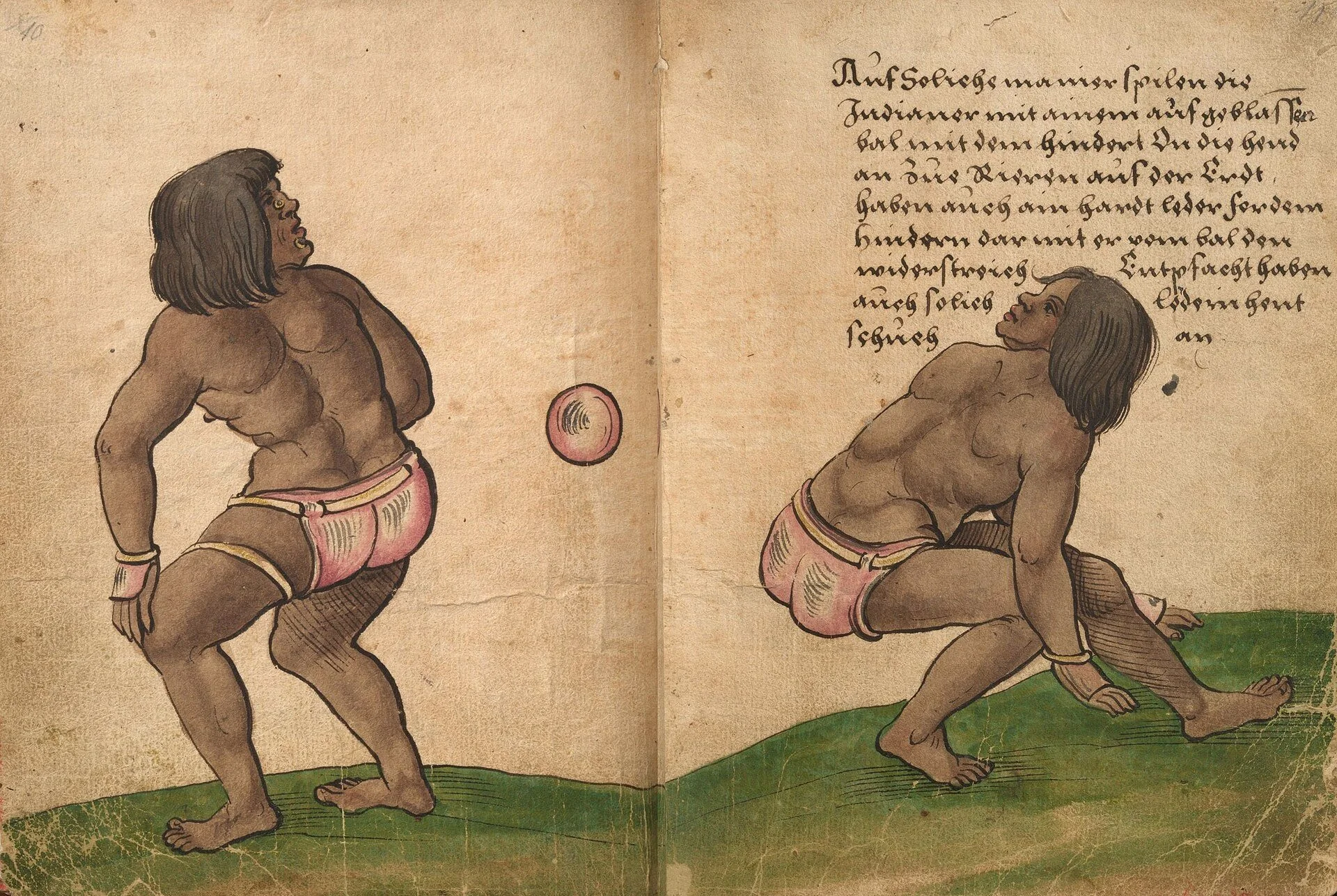
Drawings of two ulama players from Christoph Weiditz’s “Trachtenbuch” (1529). CC0.
With the arrival of the Spanish and the suppression of Indigenous traditions, the game came close to disappearing entirely. For centuries, only a handful of towns in the state of Sinaloa kept alive what we know today as hip ulama. However, the game also seeped into the cultural traditions of other Mexican states, from the pelota mixteca in Oaxaca to the pelota purepecha in Guerrero and Michoacan. While the ballcourts were no longer used, the symbolism persisted, particularly in Catholic rituals, with the cemetery becoming a new meeting place between the living and the dead.
The modern revival movement gained momentum after the 1968 Summer Olympics in Mexico City, where an exhibition game introduced the sport to the world. With the growth of Xcaret, the eco-archaeological park in Quintana Roo, a new audience of international tourists witnessed matches. Today, the sport is expanding rapidly, with university teams competing across Mexico and tournaments held between nations. The sixth Pok-Ta-Pok World Cup was held in 2025 in Honduras, with teams across Mexico and Central America competing.
On April 18, 2026, the Xipe Totec 2026 Tournament took place in Mexico City. During the opening ceremony, Ana Francis Lopez, the city’s Secretary of Culture, shared, “Contributing to the continuation of its practice is everyone's responsibility. It involves uniting efforts, promoting its teaching, supporting players, recognizing those who preserve it, and fostering conditions that keep this game alive.”
The tournament focused on helping Mexican society learn about the native worldviews and traditions while also integrating modern practices into the game. Today, women and men can compete together, and the rubber balls can vary in weight. The attire has remained traditional, though, with players donning the lion cloth, leather belts, and shawls as depicted in ancient sculptures and artwork.
While there are many regional variations, the rules of the game widely played today are based on hip ulama, in which two teams face each other on a narrow rectangular court. There is a complex point system, with some saying it took them years to learn, in which players gain points for hitting the ball out of bounds or not crossing it back over the center line. In ancient times, when the ball went through the stone ring mounted high above, it was an instant win. The point system is not linear or cumulative like most Western games, instead operating on an oscillating basis. Today, rubber balls can weigh between 2 and 4 kg, while exhibition game balls weigh around 400 grams.
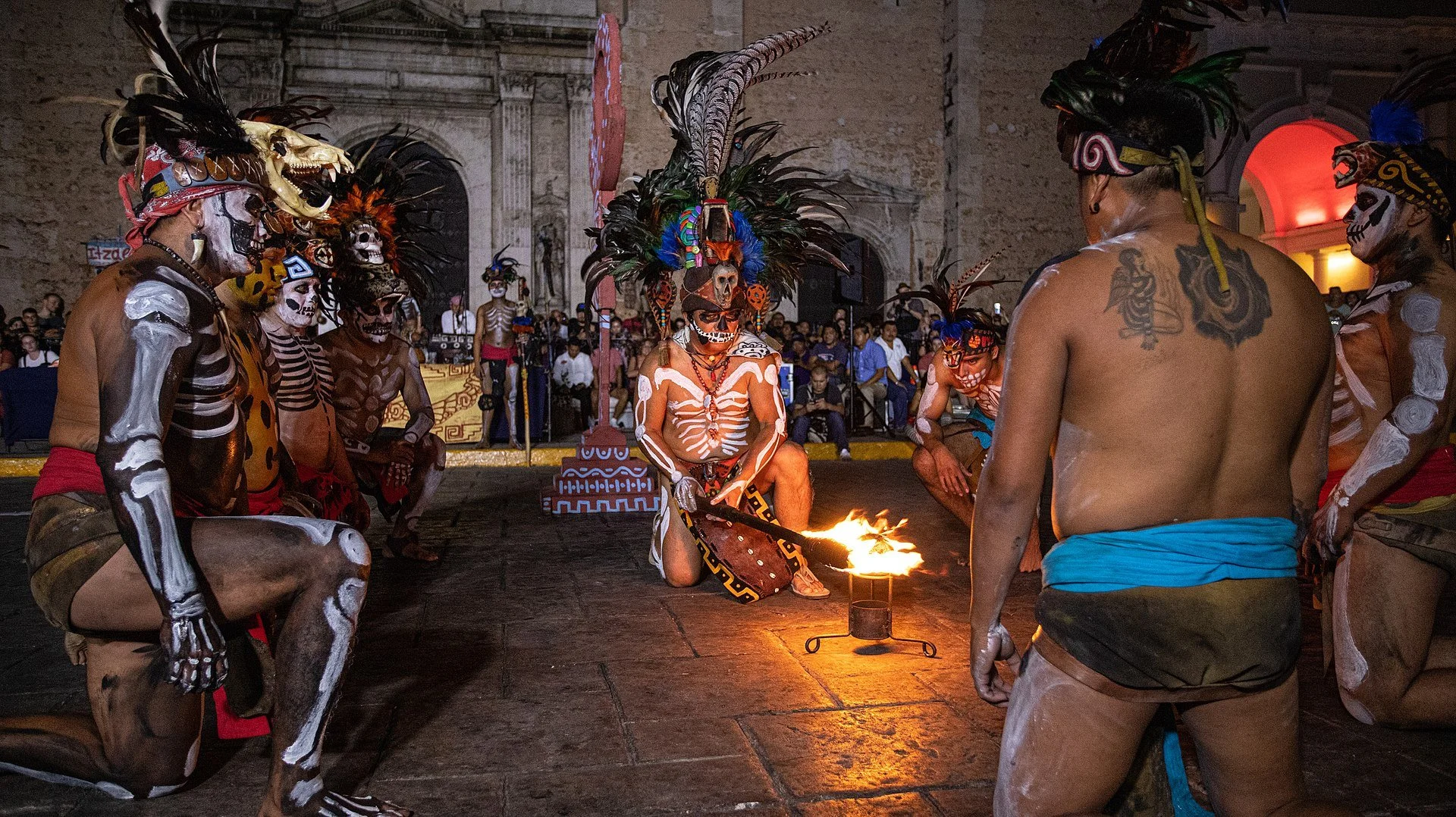
Pok-ta-pok players in Merida’s main square. AramBobba. CC BY-SA 4.0.
The first time I ever watched a game was on a warm night in the main plaza of Merida in the Yucatan Peninsula, where crowds gathered in front of the town’s cathedral to watch from stands. The ceremony commenced with the blowing of a conch shell and dances, before the game took off with players hitting the ball back and forth, smearing the painted patterns on their bodies with each hit.
Hundreds cheered and applauded as the game progressed, and in that moment, the power of this cultural revival hit me. Even in the face of erasure, it has endured thanks to the persistence of communities, making a comeback among younger generations eager to understand their history and Indigenous ancestry. Here it was, being played in front of hundreds of eager spectators, all because a few towns dared not let it go. Today, as more groups form across the continent, the sport continues to grow, carrying on a legacy that started 3,000 years ago.

Kaitlin Siena Murray
Kaitlin Siena Murray is a travel journalist and global storyteller documenting cultures, historical places, and the people and social impact movements helping the world. Raised worldschooling across more than 129 countries with degrees in anthropology and history, her writing is driven by a commitment to global citizenship, capturing the diversity and beauty of the world through the lens of culture, history, and social change.