
By Caleb A. Yamamura
The ongoing protests in the Maldives are part of a longer struggle over press freedom and freedom of expression.
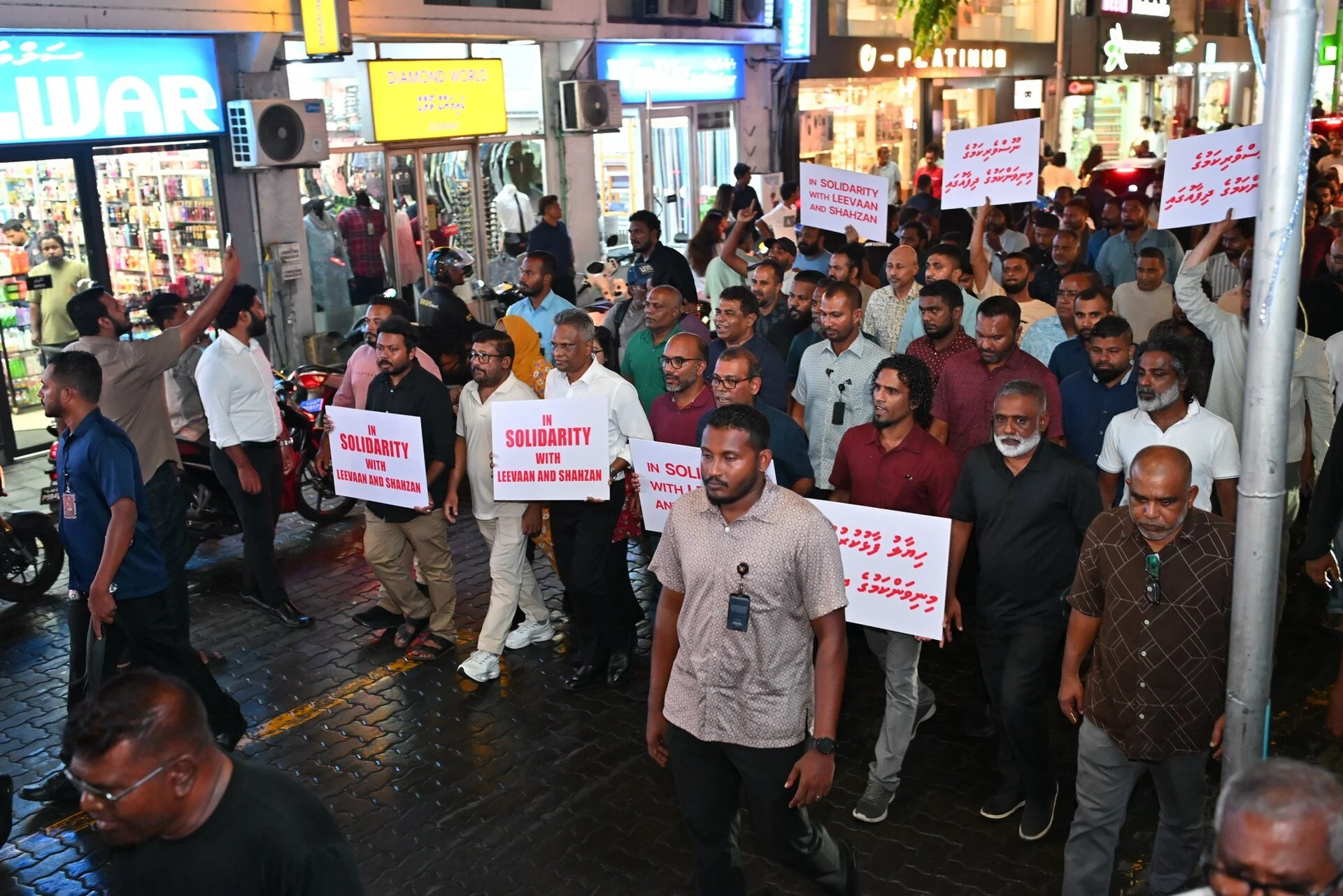
Protests against the arrest of journalists in Male, capital city of the Maldives. Adhadhu Media. CC BY 4.0.
Beginning in April 2026, protests erupted across Male, the capital of the Maldives. By May 2026, an estimated 10 protesters had been arrested. These protests, ongoing as of July 2026, center around freedom of the press. The catalyst for the protests was the arrest of Hassan Mohamed, editor of the outlet Adhadhu, and the later arrests of two Adhadhu journalists, Mohamed Shahzan and Leevan Ali Naseer.
The initial arrest of Mohamed followed the release of an Adhadhu documentary alleging sexual misconduct by President Mohamed Muizzu. Shahzan and Naseer were arrested after questioning the president about the allegations at a press conference, and for contempt related to reporting on the court’s nondisclosure order. According to Adhadhu, their trials were carried out in secret, mere hours after the arrest, leaving little time to find legal counsel or to form a legal defense.
Police also raided Adhadhu’s offices, seizing laptops and other belongings. The raid was carried out with a warrant accusing the outlet’s Aisha documentary of “qazf,” or the false accusation of adultery. While not the first raid on a news outlet in the Maldives, the scale of the raid on Adhadhu’s offices was more extreme.
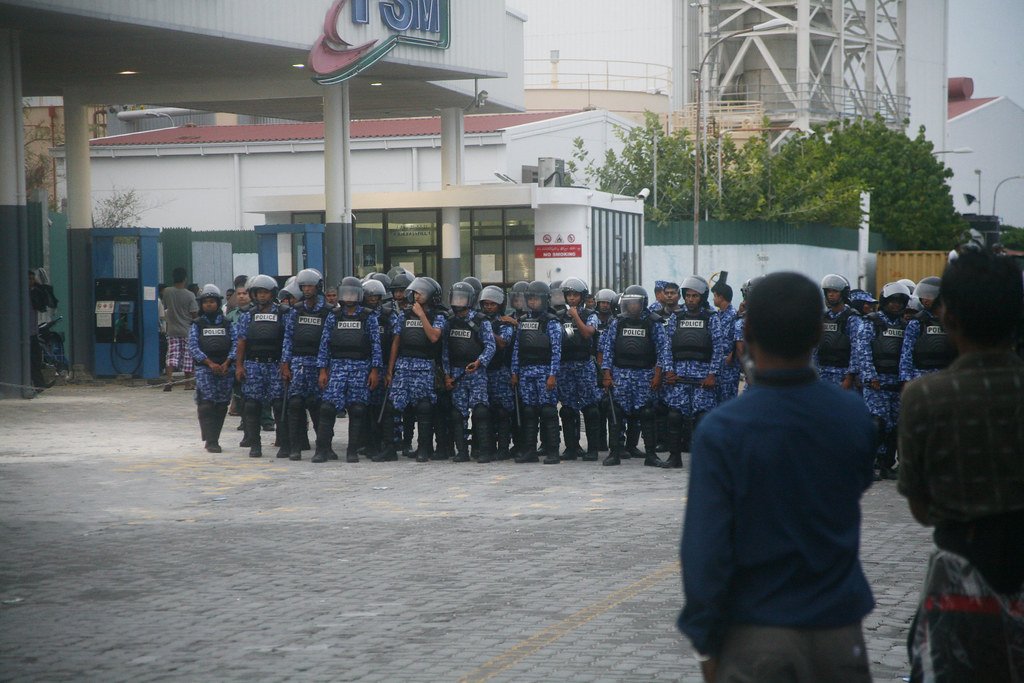
Maldivian Police in riot gear. Dying Regime. CC by 2.0.
Also relevant is the passage of a controversial law in September 2025, the Maldives Media and Broadcasting Regulation Act, which was heavily criticized for severely restricting freedom of the press. It is that same law that has contributed to a broader climate of intimidation toward journalists.
Ahmed Naaif, secretary-general of the Maldives Journalist Association, wrote of the bill, “The Maldivian parliament has passed a draconian bill that seeks to muzzle dissent online and offline, both on traditional media and social media.”
The passage of the law caused protests in late 2025, where eight protesters were arrested. Opposition parties criticized the Maldivian police for using excessive force against peaceful protesters.
After the 2026 arrests, the MJA said, “The government is crossing a clear red line. We demand an immediate end to the intimidation of journalists and the suppression of press freedom.”
These events are part of a long-term struggle the Maldives has had in establishing a stable democracy, ever since a multiparty system replaced autocratic rule in 2008. A recurrent issue in this struggle has been difficulty establishing press freedom. In early 2016, 16 journalists were arrested while protesting a series of government actions and laws that threatened press freedom. The protest, like the one in 2025, was harshly suppressed.
Later in the same year, the news outlet Maldives Independent, a partner to Al Jazeera, was raided following the release of a documentary accusing then-President Abdulla Yameen of corruption. The raid did not seize any property, but two journalists were arrested, while others were forced to flee the country.
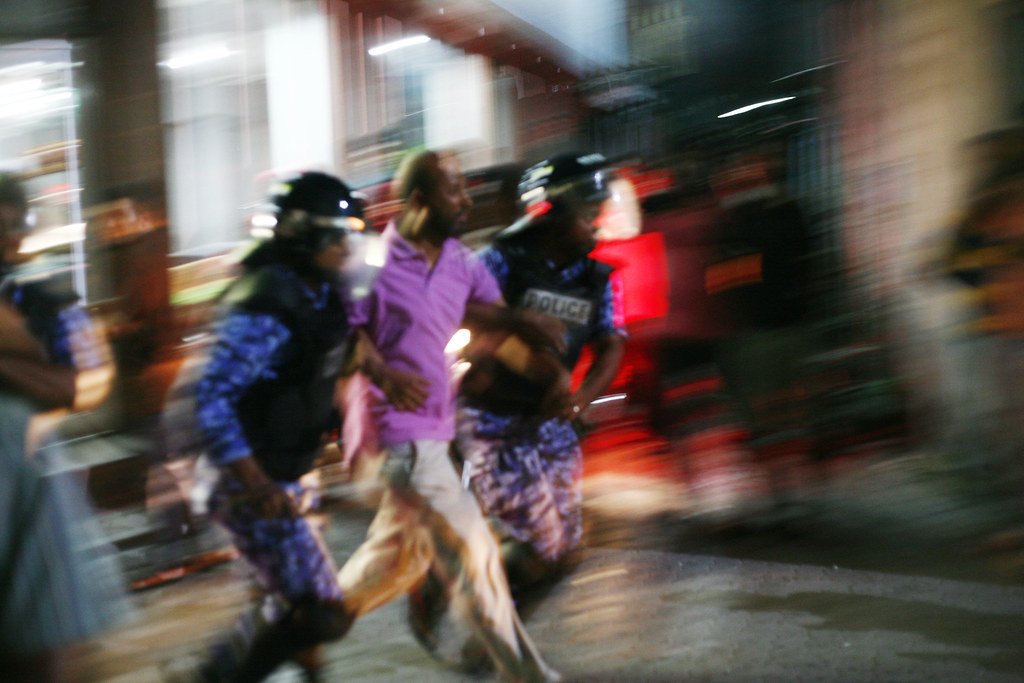
An individual being dragged away by police during protests. Dying Regime. CC by 2.0.
The international reaction to these incidents has been sharply critical. The United Nations, the United States and the United Kingdom have each criticized the Maldivian government’s restrictions on press freedom.
International press freedom groups, civil advocacy organizations and legal experts have chimed in, all bearing the same criticism: the law and related enforcement actions are flagrant violations of press freedom and freedom of expression.
In response to mounting criticism, the Maldivian government defended its actions. Regarding the 2025 law, government officials have downplayed the severity of the bill. The Minister of Youth, Ibrahim Waheed, argued the bill would not restrict social media posts, despite the documentary only being posted on Adhadhu’s social media accounts.
The Maldivian government also issued a statement defending its use of force against protesters, saying that reasonable limits on protesting had been violated.
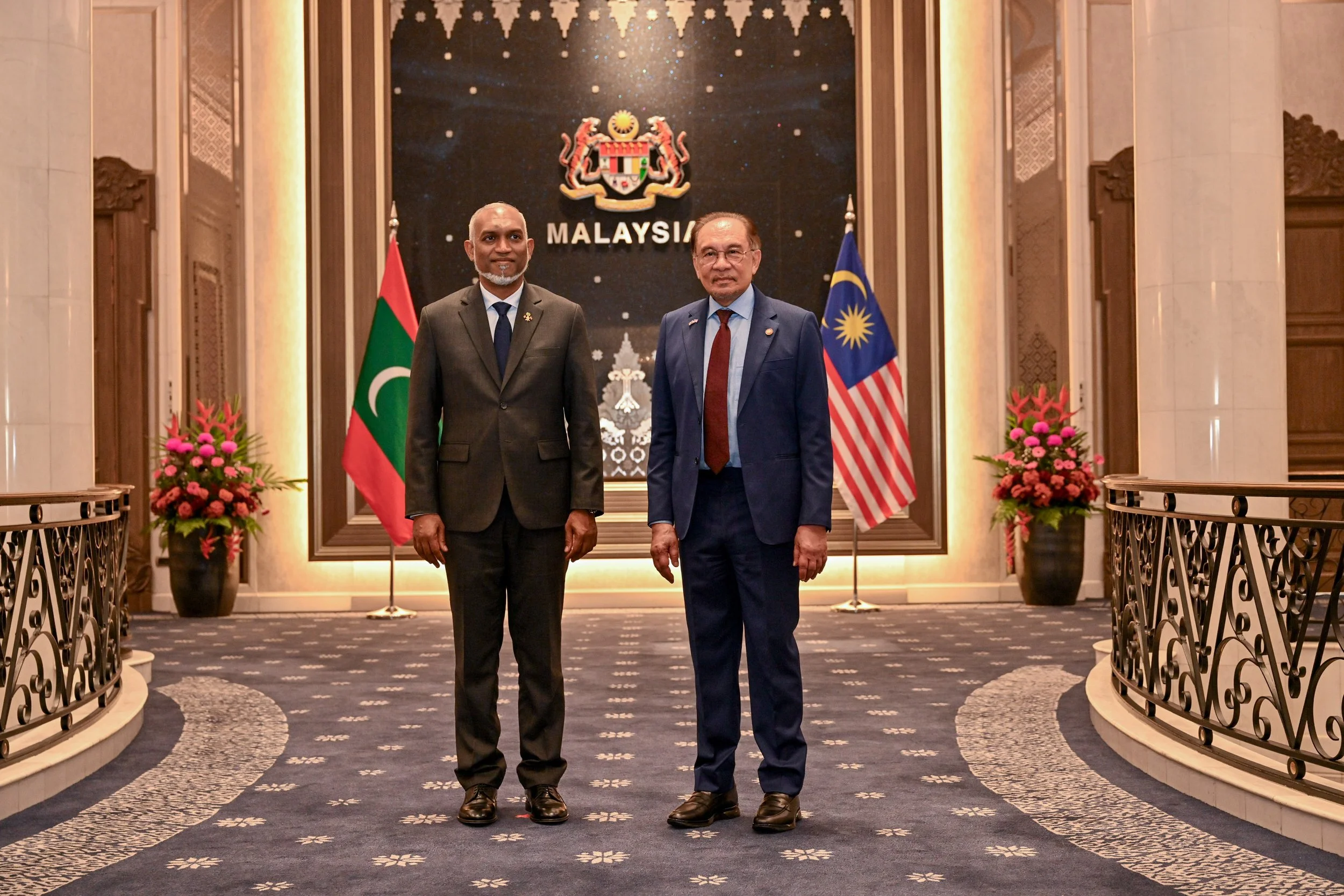
Maldivian President Mohamed Muizzu (left) and Malaysian Prime Minister Anwar Ibrahim (right). The President’s Office, Maldives. CC by 4.0.
What Protesters Demand
Protesters demand the release of the journalists, the repeal of the law and the resignation of the president. These will be difficult to attain with President Muizzu’s party, the PNC, having a supermajority in parliament, and the next election years away. However, if these issues and violations remain part of public debate, and criticism on the global stage continues, perhaps the Maldivian government will be pressured to change its ways, sooner or later. And the pressure may not stop just with the Maldives; it could continue to challenge global restrictions on press freedom everywhere.
This issue may feel distant and isolated, taking place in the small island country of the Maldives, but it is part of a global struggle for freedom of expression. Especially considering the global trend towards restricting journalists’ rights, seen recently in the United States. A healthy democracy is made stronger by accurate and protected reporting, no matter where that democracy is.
Get Involved
Maldives Journalists Association: The LinkedIn page for the MJA, which is the primary journalist union in the Maldives.
Reporters Without Borders: A link to the RSF, World Press Freedom Index page on the Maldives. It also discusses the MJA.
International Federation of Journalists: A link to the IFJ, a global free press advocacy group that links to a key contact for the MJA. The MJA and the IFJ are partner organizations.

Caleb Yamamura
Caleb is from New York City, and is currently an undergrad at Vassar College, majoring in History and Psychology. He is also an avid traveler, having visited countries on each continent with his family (save for Antarctica… of course). He has a profound love for learning about the world, its cultures and people, and is happy to have the opportunity to share what he has learned about.