
By Sofia Stidham
The rare school attack in Austria prompts a reflection on rising violence in the West and debates over firearm policy.
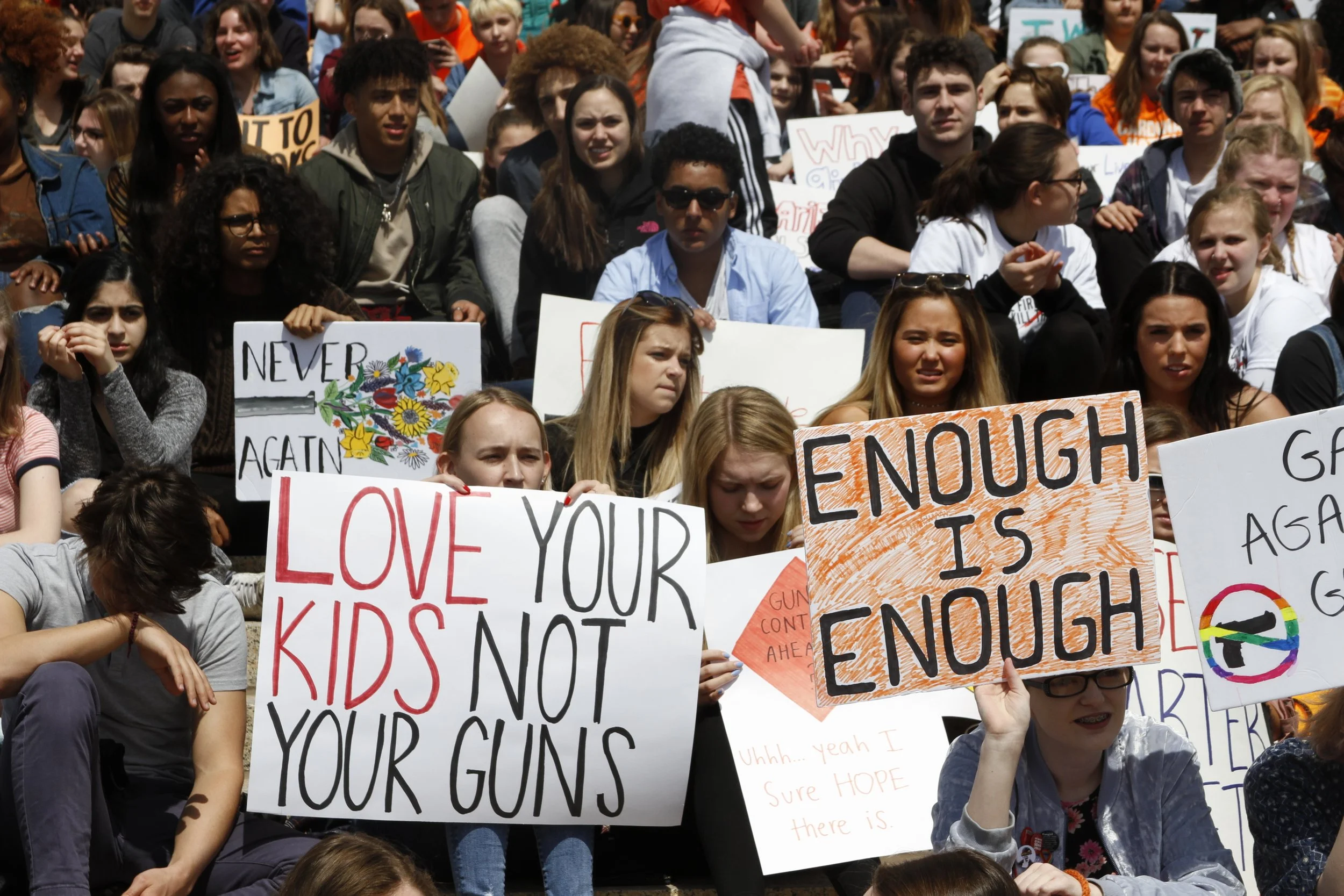
American National School Walkout. MN Senate DFL. CC0.
Just before 10. a.m. local time on June 10, 2025, students heard gunshots as an attacker with two guns entered the Dreierschutzengasse school in Austria and opened fire on classrooms. Austrian news agency APA has reported a death toll of that he killed 11, among whom seven were pupils, and a minimum of 30 injured. The state police director, Gerald Ortner, relayed authorities’ belief that the perpetrator, a 21-year-old Austrian man who was a former student at the school, subsequently took his own life after the shooting. Police have not yet uncovered a motivation for the attack.
The attack, named by extremism expert Julia Ebner as the deadliest school shooting in Austria’s postwar history, has shaken the country. Austria's Chancellor Christian Stocker said that no words can encapsulate “the pain and grief that we all — the whole of Austria — is feeling.” He called it a “national tragedy,” and announced a three-day period of national mourning as well as a minute of silence at 10 a.m. local time on Wednesday, June 11. Ursula von de Leyen, chief of the European Commission, highlighted: “Schools are symbols of youth, hope and the future. It’s hard to bear when schools become places of death and violence.” The community of Graz, the city in which the shooting took place, has especially expressed its horror at the event. Reza, a resident of Graz, told the BBC that the area was “quiet, safe and beautiful,” expressing that she could have never imagined a mass attack would happen there.
Public mass shootings are rare but not unheard of in Austria, which has seen two major incidents since the 1990s: the Jihadist attack on Vienna in 2020 and a shooting in Mauterndorf in 1997. Even though Austria is among the most heavily armed countries in Europe, with about 30 firearms per 100 people, according to the Small Arms Survey, gun possession is still regulated. Citizens require official authorization to own pistols, revolvers and semi-automatic weapons; a specific license for rifles and shotguns; and machine guns are banned. The pistol and shotgun used in the Graz school shooting were legally obtained, a fact which has prompted a debate among critics about whether these regulations are strict enough.
This consideration can be applied beyond Austria, as mass shootings appear to be increasing across Europe. In February 2025, 10 people were shot at an adult learning center in Sweden. Europe experienced no mass shootings between 2016 and 2022, but since 2023 has seen seven, indicating an increase in frequency. The Rockefeller Institute of Government stated that although these instances are rare in Europe, global attacks have doubled from 2000–2010 as compared to 2011–2022, pointing to a need for wider preventative measures on both firearms and other assaultive weapons.
While this rise of mass shootings in Europe is concerning, the Institute for Health Metrics and Evaluation particularly draws attention to the United States as an “outlier” for its significantly higher rates of gun violence compared to similar countries. Their data shows that firearm-related homicide rates are 77 times higher than in Germany. A study published in JAMA Pediatrics found that states with looser gun restrictions have a higher firearm mortality rate for people aged 1 to 17, correlating gun law restrictiveness with shooting rates. Schools are often the site of these attacks in the U.S.; as of May 13, 2025, 25 school shootings have occurred in the country. As a result, young students throughout the U.S. are taught active shooter protocol, guided by the phrase: “run, hide, fight.”
While the scale of gun violence in educational settings is far greater in the U.S., the recent events in Austria show how no country is entirely immune. As Austria mourns its lost children and teachers, Chancellor Stocker encouraged the nation to look out for one another, reminding them that “in these difficult hours, being human is our strongest point.” Thus, the victims of the Dreierschutzengasse school shooting are and will always be remembered.
Sofia Stidham
Sofia is a rising fourth-year English Literature student at the University of Edinburgh, having recently completed a year-long exchange at the University of Virginia. Outside of writing, she enjoys spending time with family and friends, going to concerts, curating her wardrobe, and zoning out on long walks. She hopes to pursue a career that allows her to channel her passion for writing into intersectional feminist advocacy.