
By Barrington Jayden Henry
A decade after the start of the migration crisis in Europe, the outlook for refugees in Lesvos is bleak.
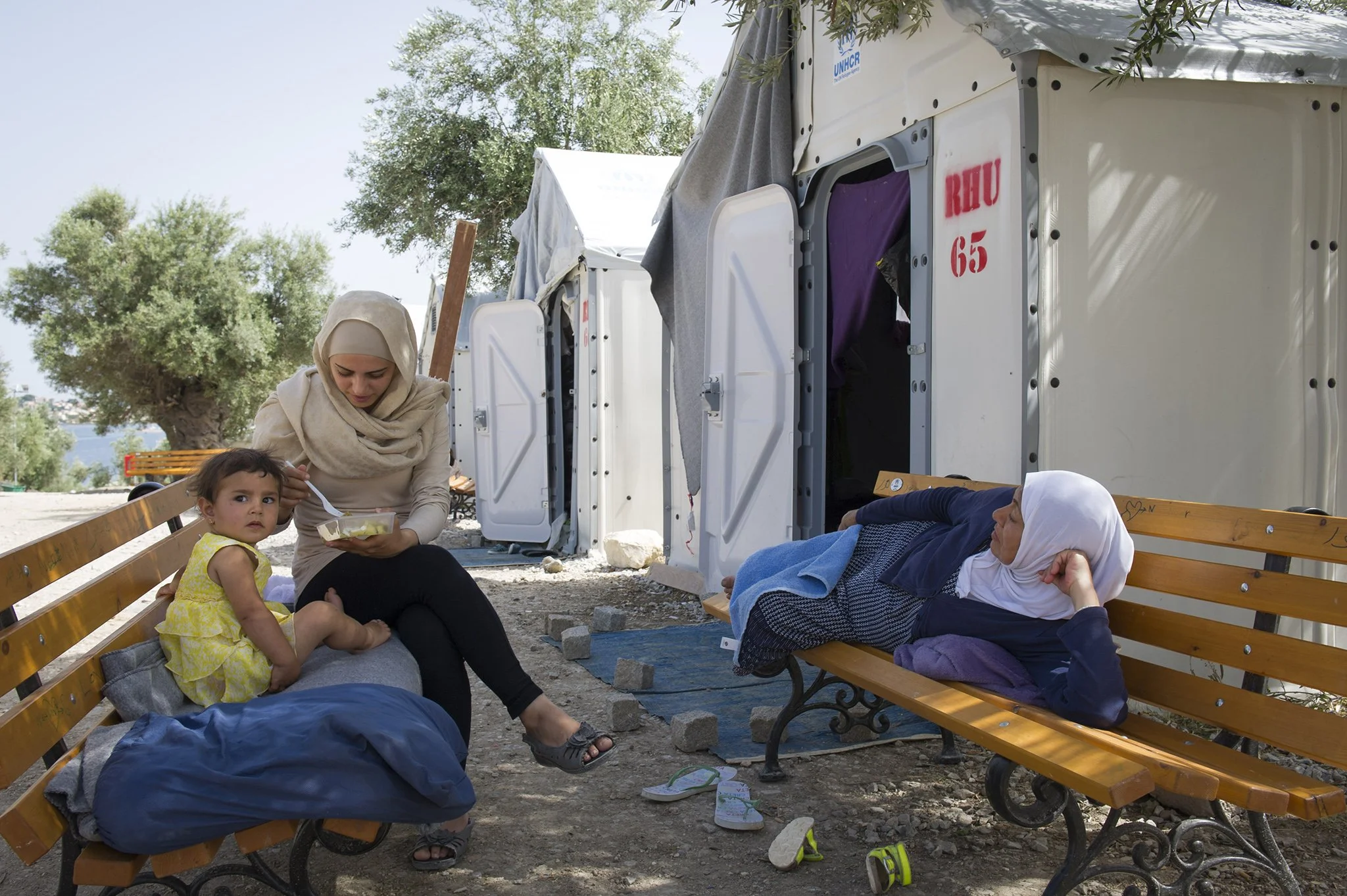
Two women and a girl in Kara Tepe refugee camp. United Nations Photo. CC BY-NC-ND 2.0.
For more than a decade, the island of Lesvos in Greece has been on the frontline of the migration wave from Western Asia to Europe. Greece received a large proportion of refugees fleeing war and famine in the Middle East during the European refugee crisis of 2015 and 2016. For many, Lesvos was the closest safe location after transit through Turkey, with almost half a million people arriving in 2015 alone. After the European Union and Turkey came to an agreement on permissible migration corridors in 2016, the number of refugees entering Europe through Lesvos dropped sharply. But the Greek government's protocols for dissuading illegal migration and accommodating refugees have drawn condemnation from human rights organizations.
Refugees coming to Lesvos often take a dangerous route through the Aegean Sea, and many lose their lives in desperate attempts to land on the island. Assisting migrants in landing safely on shore is illegal, and Greek coast guard officials routinely engage in maritime “pushbacks,” in which they use force to repel people away from Greece’s territory, regardless of risk to life and limb. According to migrant rights attorney Ella Dodd, these pushbacks are not as simple as redirecting vessels toward their origin, but rather, “[t]here is intense violence, torture, sexual violence, rape, people being stripped, theft, beatings while people are naked, drownings, people dying, [and] people having miscarriages.” Eyewitnesses of these pushbacks have even accused coast guard officials of deliberately drowning migrants by throwing them into the sea, though no official has been formally charged and brought to court. Recently, in mid-January 2026, a Lesvos court acquitted 24 aid workers who used radio and online messaging to help migrants reach safety in the Aegean Sea, which the Greek authorities claimed was a conspiracy to illegally traffic them into the country. This prosecutorial process lasted seven years and forced the organization to shut its doors. The aid workers lamented that it took the better part of a decade to prove in court that “providing life-saving humanitarian assistance is an obligation, not a crime.”
If refugees are lucky enough to make it onto the shores of Lesvos, they face more trials from the Greek government. The government has established a number of camps in which refugees reside until they can legally move to their next destination. The most infamous of these camps was the Moria camp in Mytilini, which was built to hold a little over 3,000 refugees, but by 2020, its last year in operation, it was filled with more than 20,000 people, 40% of whom were children. Its medical tents were constantly overwhelmed with ill patients and victims of rampant violence within the camp, and the facility quickly gained a global reputation as a bleak and hopeless place, with Pope Francis referring to it as a “concentration camp” in 2017. In September 2020, the Moria camp was burnt to the ground, for which four men from the camp were tried and convicted for arson, though later forensic analysis shows the fire was likely the result of dry, hot weather.
Refugees have since been shifted to the Kara Tepe camp, where they are under strict surveillance. I personally visited the Kara Tepe camp in May 2024 during a month-long seminar in Greece. Here, the refugees are not as isolated as they were in the Moria camp, as they are permitted to exit the grounds to work during the day and return in the evening. They are still under the watchful eye of the authorities, and within the camp, there are many checkpoints, where refugees are searched for any contraband. The Kara Tepe camp has more doctors and nurses than the Moria camp did, but they still suffer from a shortage of supplies and have many more sick and injured patients than they can effectively manage. Greek officials have hardened toward the refugees’ plight, with a former Minister of Immigration saying that Greece “will never again become the open gateway that [they] were in the past year.” A new camp is nearing completion, despite concerns that its location, deep in a secluded forest with extremely flammable pine trees, will make it even more prone to devastating fires like that of the Moria camp. According to the coordinator of the Legal Centre Lesvos, Lorraine Leete, this is just one more example of a “trend across Europe to build camps ... where refugees don’t have a chance to build a life.” Compassion for Lesvos’ refugees can be found in the work of aid organizations like Europe Cares, a humanitarian organization that operates Parea, a community center where children can play while their parents have a hot meal, receive medical care or simply relax. Still, places like Parea stand as small islands in a wider environment of apathy from the state and its status quo concerning migration. As attitudes toward migration and refugee resettlement in Greece and Europe at large continue to sour, it is uncertain when or how the refugees’ situation in Lesvos will improve.
GET INVOLVED
Those looking to help support refugees in Lesvos can learn more about aid organizations like Europe Cares and Lesvos Solidarity. These groups work to provide refugees with much-needed assistance where the state falls short, and they rely on contributions from everyday people who want to help those in need.

Barrington Jayden Henry
BARRINGTON JAYDEN HENRY is from the Atlanta area and is a senior at Vanderbilt University, studying political science and history. Jayden is also the host of the weekly radio program I Want to Tell You Something on WRVU Nashville. In his free time, he enjoys playing tennis, reading, and going to museums.