
By Barrington Jayden Henry
A look at the kafala system and how it supports the abuse of migrant workers in Gulf states.
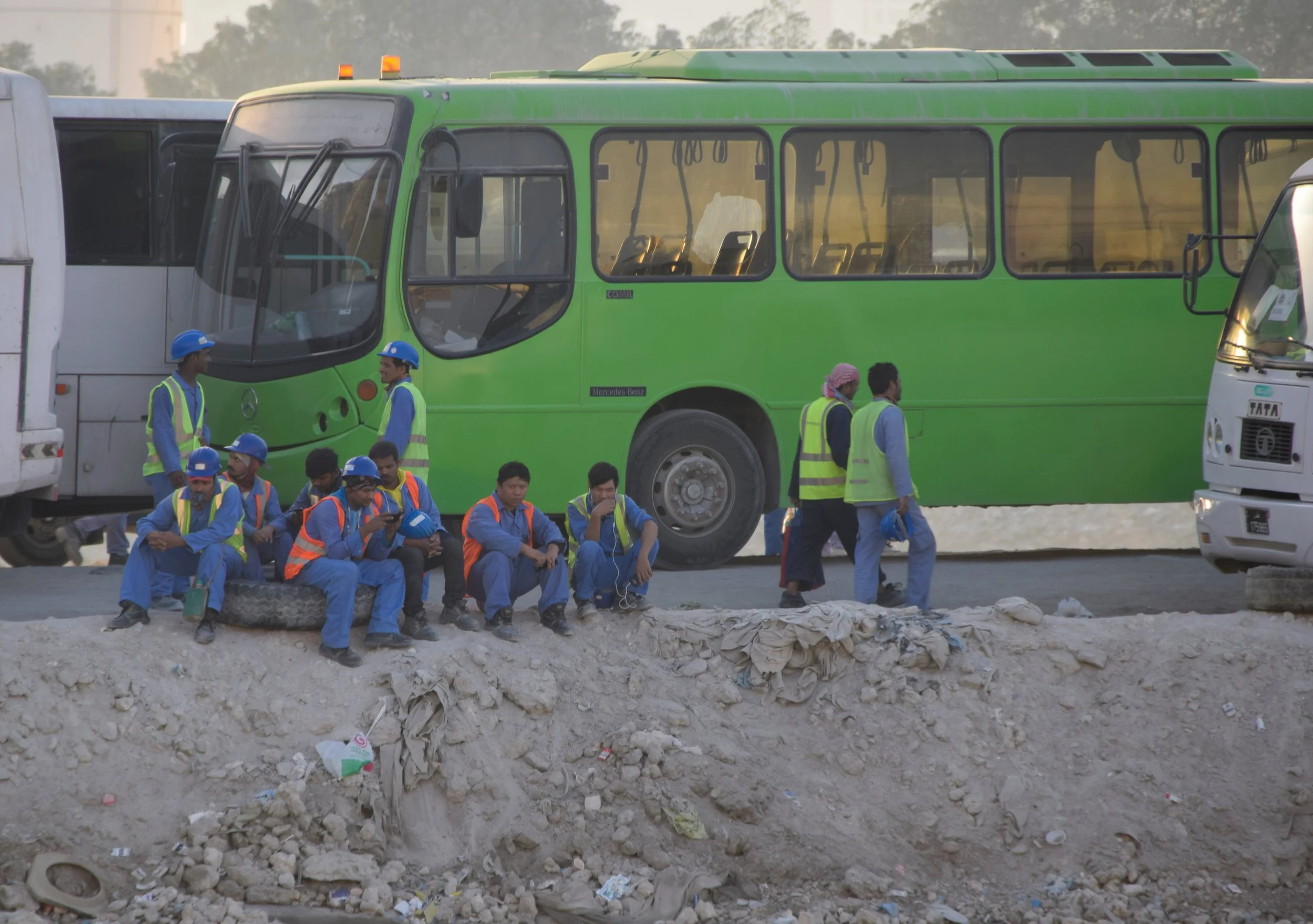
Workers at a construction site in Doha, Qatar. Mosbatho. CC BY 4.0.
The Persian Gulf is enjoying an unprecedented swell of business from tourism as well as a boom in the economy’s service sector. Personal wealth, often flaunted without shame, has continually risen in the Gulf states. Thanks to decades of investment in the region’s oil economy and consumer services, places like Dubai, Doha and Abu Dhabi have become some of the most coveted travel destinations and are promoted as such by a flood of online influencers. What lurks beneath the glamour of the Gulf is an entrenched system of exploitative labor known as the kafala system.
The kafala system, from the Arabic word for sponsorship, functions as a mechanism to attract and retain cheap labor on which Gulf states have come to rely. Although this labor system has roots in British colonial history, its current manifestation is specific to the region’s social norms regarding the dignity of work and belonging within a nation. In the kafala system, an employer, in Arabic, a kafeel, serves as a sponsor who seeks an employee to work for a set employment contract, and during this period is fully responsible for them, thus making the employee dependent upon them. The kafeel holds an immense amount of power over their employee’s mobility, and will often hold their passports and other identifying documents to prevent them from leaving or taking another job, as the employer must agree to any termination or cessation of the employment contract. Migrant workers, numbering approximately 24 million, often coming from lower-income communities in India, Bangladesh and other South Asian countries, have little leverage over their conditions and compensation, especially as there is little opportunity of naturalization to become equal citizens in the country where they work.
Although workers in the kafala system come to the Gulf states freely for the promise of relatively well-paying jobs with which they can provide for themselves and their loved ones, this system ultimately places migrant workers completely at the mercy of their employers, and they are vulnerable to abuse and mistreatment with little to no recourse or justice. Horror stories of exploitation abound across the region. Adama, a young woman from Sierra Leone, who was told she would work in Italy, was instead sent to Oman to work grueling hours as a maid. Later, she was sold for less than $2,000 from one sexually predatory kafeel to another, with no reprieve from the police. As she says, “Africans have no rights here. Even when you go to the police, whatever Omanis say is final.” In Qatar, Jasmine, a Filipino woman desperate to leave her employers, is virtually being held hostage as they demand approximately $3,000 for her passport. She cannot afford such a high sum and says, “I think about killing myself because I’m so stressed. Every day I cry because I feel so hungry and so tired.”
Today, there are contradictory developments in the Gulf states’ kafala system. There have been middling reforms; workers in Qatar will no longer be arrested for leaving their employers, and Saudi Arabia has recently abolished the practice altogether. But millions still suffer in the region, and the system is facing new challenges after the outbreak of the Iran war. Workers under a kafala contract struggle to evacuate the Gulf countries targeted by Iranian missiles and attacks, which is why they are grossly overrepresented in civilian deaths.
Change in the kafala system ultimately will come from a shift towards treating migrant workers with dignity and respect. If the states of the Persian Gulf move towards including migrant workers in their nations, those trapped in miserable situations will be able to move beyond exploitation and abuse.
GET INVOLVED:
Walk Free is an international human rights organization that works to bring awareness to and end modern slavery and human trafficking. Learn more about its mission and research on the kafala system.
Barrington Jayden Henry
BARRINGTON JAYDEN HENRY is from the Atlanta area and is a senior at Vanderbilt University, studying political science and history. Jayden is also the host of the weekly radio program I Want to Tell You Something on WRVU Nashville. In his free time, he enjoys playing tennis, reading, and going to museums.