
Isabella Feraca
As glaciers melt and weather patterns shift, Kashmir and surrounding regions face increasing risks to water, agriculture and peace.
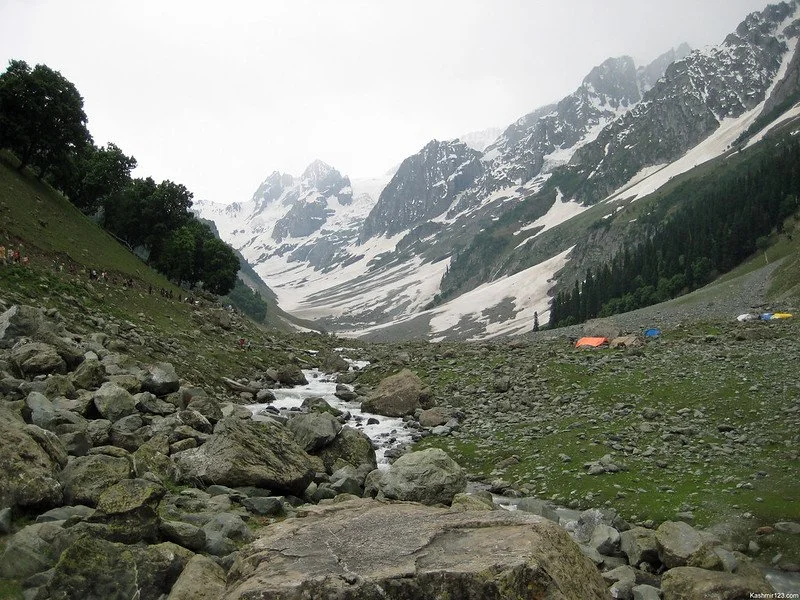
Thajiwas Glacier in Sonamarg, Kashmir. Kashmir Pictures. CC BY 2.0
Kashmir has long been famous for its stunning snow-capped mountains and glaciers, as well as its cool climate and extensive snowfall. The region is indeed defined by its winters; Chillai Kalan, a 40-day period in which the winter is the most severe in Kashmir, literally translates to “the mighty cold.” But more recently, climate change has been disrupting these patterns, bringing shorter winters, record-breaking summer heat and less rain and snowfall, all of which threaten water availability. For a region already grappling with long-standing political instability, these shifts and their effect on harvest yields are compounding local hardships and wider political tension.
At the beginning of July, the city of Srinagar in Kashmir reached temperatures up to 99 degrees Fahrenheit, the highest they’ve seen in over 70 years. In Pahalgam on the same day, the city reached its highest day temperature ever recorded at 89 degrees Fahrenheit. Comprehensively, scientists report that between 1980 and 2020, the maximum temperature of Kashmir rose by about 36 degrees Fahrenheit. At the same time, weather officials say the entire region has seen a deficit of over 80% in rain and snowfall this year.
These extreme changes are causing a crisis for farmers who have long depended on predictable weather patterns for stable crop yields. Sporadic rainfall has disrupted planting and harvesting cycles, while rising temperatures are increasingly accelerating glacial melt, further threatening water availability. Much of the region’s water supply, both for irrigation and the daily needs of locals, comes from such glaciers, making their heightened decline a serious threat to Kashmir.
With water supplies under threat, climate change is amplifying persistent political tensions over shared resources in the region. Indeed, the current situation is intensifying the longstanding dispute over the territory of Kashmir between India and Pakistan, with water becoming an increasingly politicized resource. At the heart of this conflict is the Indus Waters Treaty, an agreement first implemented in 1960 concerning the distribution of river water between India and Pakistan. And while it has largely held unscathed since its implementation, climate change is placing increased strain on it.
Recently, India has been pushing for an updated treaty, calling the current one outdated as a result of both new engineering techniques and climate change’s effect on glacial melting. Then, after India blamed Pakistani militants for a deadly attack in April of this year, tensions escalated even further, with India announcing that it is no longer obligated to abide by the treaty. With over 40% of the Indus River runoff originating from glacial coverage in Kashmir, climate change in the region is only going to further escalate the tension. The Center for Strategic and International Studies even posits that a potential full-scale armed conflict could break out in the coming decades, as they predict up to a 50% deficit in the Indus River Basin by 2030.
Climate change is disrupting everything from weather patterns to glacial melting, which is not only affecting crop yield but also intensifying political tensions and straining resources. Without swift and efficient action, environmental and political costs will only grow heavier in the coming years.
GET INVOLVED
Read more about proposed solutions to Kashmir’s water crisis on the JK Policy Institute website. To aid those in Kashmir whose livelihoods have been affected by the climate crisis, donate to the Islamic Relief Fund. To aid locals affected by conflict in Kashmir, donate to the Kashmir Welfare Foundation.

Isabella Feraca
Isabella is a junior at Carnegie Mellon University studying professional writing and music technology. In her free time, she can be found reading, making music, and playing shows with her band around Pittsburgh.