
Sofia Stidham
A United Nations agency warns that malnutrition in Gaza risks the loss of an entire generation, highlighting the threat it poses to women’s healthcare.
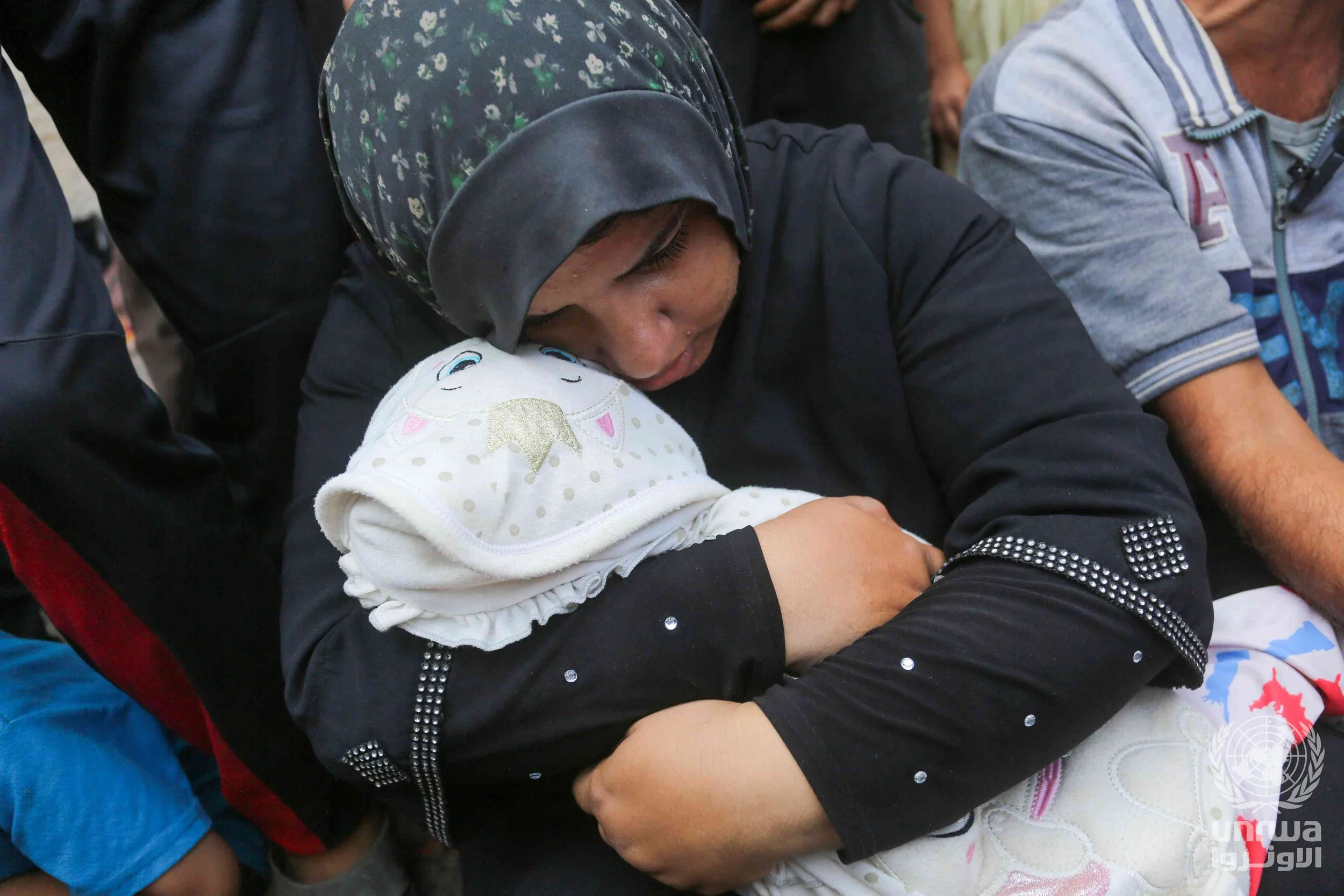
Mother crying for her lost child in Gaza. Ashraf Amra. CC BY-SA 4.0.
Since the war between Israel and Gaza began on Oct. 7, 2023, 154 people, including 89 children, in the occupied Palestinian area have been starved to death. The Integrated Food Security Phase Classification (IPC) scale is a measure of food insecurity, which placed all of Gaza at Emergency Phase 4 between May and September 2025, just one level below full-scale famine. Each day pushes its civilians, humanitarian workers and external freelance journalists closer to a point of no return.
The consequences of this near-famine extend beyond hunger. They are gutting Gaza’s healthcare system, particularly for mothers and their newborns. A UNFPA press release on July 23 showed that Gaza’s birth rate has declined by 41% since 2022, with 33% of babies born premature, underweight or in need of neonatal intensive care. “What we are witnessing is a systematic denial of these fundamental rights, pushing an entire generation to the brink,” said Laila Baker, UNFPA Regional Director for the Arab States.
The “systematic denial” Baker refers to is visible inside Gaza’s collapsing hospitals, where critical newborn care has been slashed by 70% due to Israeli restrictions on border crossings. According to the UN Relief and Works Agency, during 80 consecutive days between early March and mid-May, no aid was allowed into Gaza, including water, baby formula, food and fuel. After this, only minimal supplies have entered the region, while trucks with lifesaving equipment, such as ultrasounds and portable incubators, stay stranded on the border. Furthermore, numerous civilians seeking food and water have been met with gunfire. According to UN News, at least 1,000 people were killed in their attempt to access food, many of whom were in or around sites of the American-run and Israeli-backed Gaza Humanitarian Foundation.
UN Special Rapporteur Reem Alsalem argued that the Israeli authority’s obstruction of Gaza’s medical infrastructure is an act of gender-based violence. “The horrors that Palestinian mothers, in particular, continue to endure — watching their children slowly starve, killed, maimed, and buried alive — is killing them repeatedly in a single day,” she wrote in a July 17 report. The lack of obstetrics and other health equipment has allegedly left 150,000 breastfeeding and pregnant women without access to crucial care. Alsalem argued that Israel is targeting women in particular for their reproductive capabilities to ensure the cessation of the Palestinian lineage, calling it a “femi-genocide.” Of the 57,680 Palestinians who were killed, 67% were women and girls, according to estimates released July 9.
Interviews with mothers in Gaza point to the traumatic impacts of losing children due to starvation and broken reproductive care. Walaa Fathi, who is pregnant with her third child, told the BBC, "I hope that my baby stays in my womb and I don't have to give birth in these difficult circumstances." Meanwhile, Abu Halib recounted to CNN how her five-month-old daughter died in her arms due to malnutrition, while being reduced to only skin over bones. “How many innocent babies like Zeinab should be starved to death so the world wakes up?” she asked. As Gaza sits near the edge of famine, giving birth is no longer a promise of life; it’s a risk.
HOW TO HELP:
Due to the ongoing blockade, charities report they are unable to deliver aid to those in Gaza for the time being. As a result, some families are turning to direct online fundraisers to meet urgent needs. Those looking to help can donate to mutual aid efforts. For example, one initiative donates to Hajar’s extended family in Gaza, including 11 babies, while another supports Asmaa’s displaced family, and a third helps Naim’s family survive after losing access to food. In addition, Amnesty International USA enables people to send a letter to Congress, urging a ceasefire.
Sofia Stidham
Sofia is a rising fourth-year English Literature student at the University of Edinburgh, having recently completed a year-long exchange at the University of Virginia. Outside of writing, she enjoys spending time with family and friends, going to concerts, curating her wardrobe, and zoning out on long walks. She hopes to pursue a career that allows her to channel her passion for writing into intersectional feminist advocacy.