
Julia Kelley
Magnifying crises already facing the country, political struggles between Houthi rebels and foreign countries, including Israel, the U.S. and Saudi Arabia, contribute to Yemen’s rapid devastation.
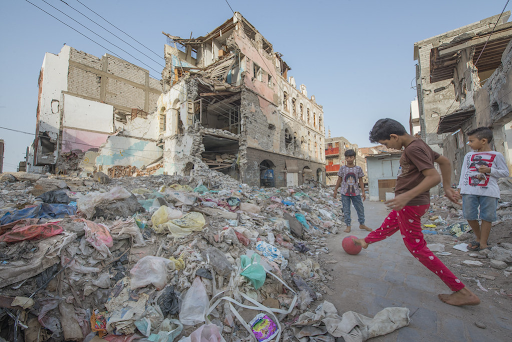
Destruction in Yemen. Peter Biro. CC BY-NC-ND 2.0.
On Aug. 24, 2025, airstrikes sent by the Israeli government hit Yemen’s capital, Sanaa, in response to missiles fired by Houthi rebels targeted toward Israel days earlier. The attack, which hit significant power plants and a military site that contains the presidential palace, comes after a long-standing feud between the two groups that began in 2023. Backed by Iran for years, the Houthis, known also as Ansar Allah, are an armed Shiite Yemeni group that controls much of the country, such as the capital and areas near Saudi Arabia, after rebelling against the Sunni government in 2014. Since Hamas, an armed Islamic Palestinian group, launched an attack against Israel in October 2023 resulting from the Israeli-Palestinian conflict, the Houthis have been strong supporters of the organization due to a self-perceived religious and moral responsibility to defend them. The Houthis began targeting commercial vessels in the Red Sea that they claim are connected to Israel.
However, these military actions, described as defensive, have simultaneously drawn Yemen deeper into several humanitarian crises and increasingly put citizens at risk under international political tensions. The Yemen civil war finds its roots in 2014 with the Houthis' insurgency. With U.S. support, Saudi Arabia responded to the rebellion by targeting Houthis with airstrikes and isolating the country economically, including a naval blockade that has prevented Iran from bringing supplies to the group. In addition to the U.S. Navy seizing weapons bound for Yemen, the militarization of Yemen’s surrounding waters has raised issues for the people living there. Years of military campaigns, drone attacks and fights between the Houthis, Saudi Arabia and the United Arab Emirates have resulted in thousands of civilian casualties and debilitating living conditions.
Compounded with their devastated economy and military dangers, Yemen has also been impacted by severe weather conditions that have led to worsened water and food scarcity, caused by flash floods and strong droughts. In 2024 alone, over 100,000 families were affected by unprecedented flooding that exacerbated already dire infrastructure and protection needs. Moreover, more than 80% of the population currently lives under the poverty line, and 18.2 million people need humanitarian assistance. However, even the international help that was directed toward this distressing situation has recently been impacted. For years, the United States has been the largest source of support for Yemen, but with the recent transition into the Trump administration, the U.S. halted all its foreign humanitarian aid in March 2025. The president also redesignated the Houthis as a foreign terrorist group, and aid support was never reinstated for Yemen over concerns that it was being diverted to the rebels, leaving the country further destabilized and suffering.
In addition to the termination of imperative humanitarian aid, the U.S., often with help from the United Kingdom, has also taken part in air strikes on the Houthis. Although the Houthis claim their attacks on commercial ships are due to their link with Israel, many of these vessels have been found with no connection to the Israeli government. During these offensive campaigns, the group has also targeted U.S. and U.K. ships, which has stirred retaliatory bombings from both countries beginning in 2024. President Joe Biden was the first to begin these air strikes, but President Trump has continued them since then. These recent political developments have put Yemen into international awareness, not only demonstrating the people’s harrowing need for aid in the face of humanitarian crises but also separating them further due to continuing Houthi actions. The rebel group has not only impacted the Yemeni population directly through their civil war and domestic attacks, but their targets on commercial ships have disrupted global trade routes and negatively impacted international relations and peace talks.
GET INVOLVED:
Those looking to help support those in Yemen against several humanitarian crises can do so by checking out different organizations that raise funds to send support, including Humanity & Inclusion, which helps those injured by Yemen’s regional conflict, and Islamic Relief USA, a group providing immediate emergency relief and development assistance. Yemen Aid additionally provides humanitarian support, Save the Children aids health care facilities and assistance for children and Doctors Without Borders provides lifesaving medical care to those affected by the conflict and instability in Yemen.

Julia Kelley
Julia is a recent graduate from UC San Diego majoring in Sociocultural Anthropology with a minor in Art History. She is passionate about cultural studies and social justice, and one day hopes to obtain a postgraduate degree expanding on these subjects. In her free time, she enjoys reading, traveling, and spending time with her friends and family.