
Paige Geiser
Amidst rising temperatures and climate shifts, understanding their impact on people and the environment is crucial.
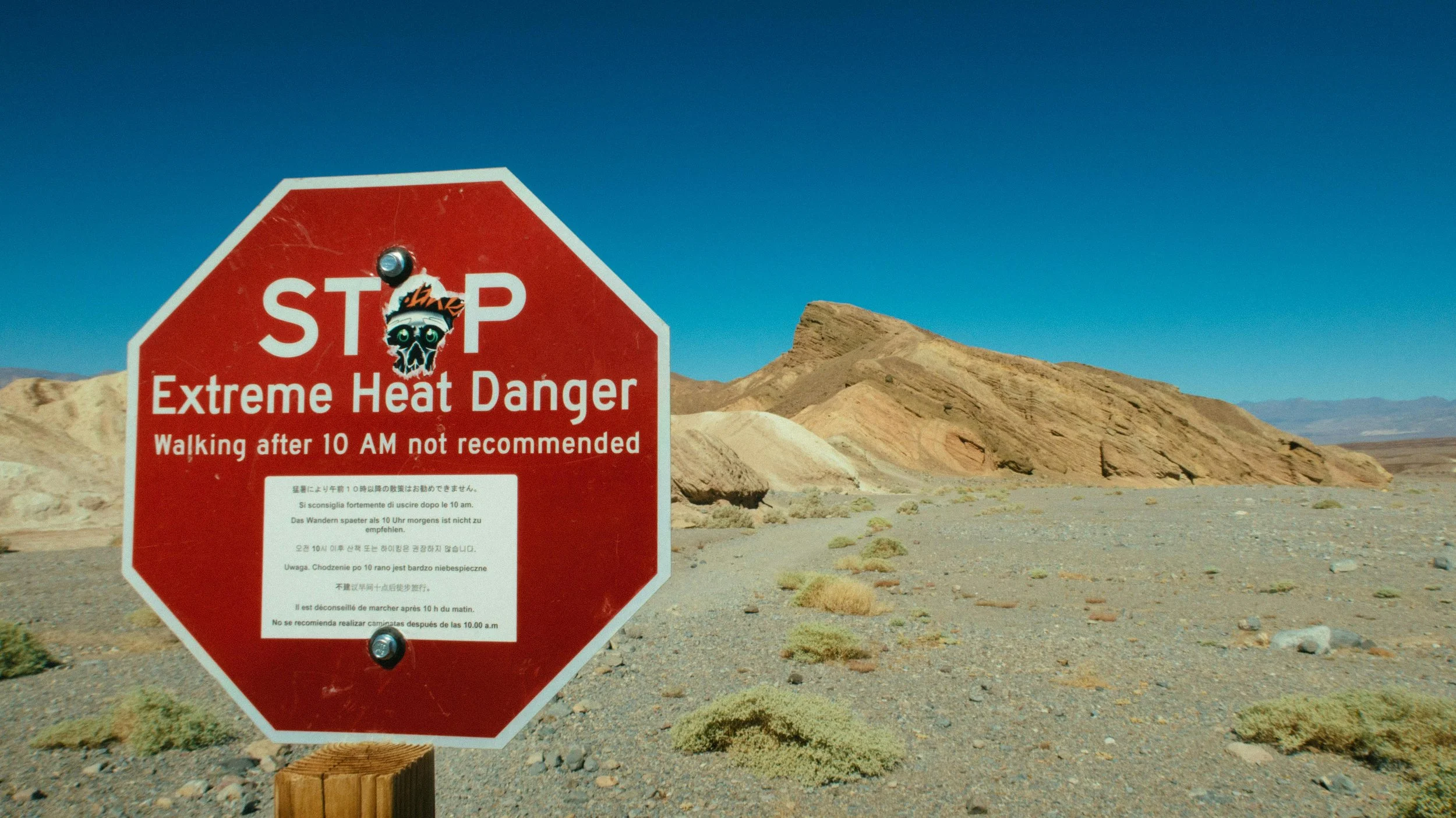
Extreme heat danger sign. Athena Sandrini. Pexels.
The 2025 summer season officially started on June 20, but scorching temperatures across the world make it feel like summer has been here much longer. According to the National Integrated Heat Health Information System, every continent has experienced above-average temperatures this year. In fact, May 2025 was the second warmest globally recorded May, and virtually every part of the world was affected by widespread warming.
In certain parts of India, temperatures are already averaging 105 degrees Fahrenheit (41 degrees Celsius) with peaking around 122 degrees Fahrenheit (50 degrees Celsius). City officials in Ahmedabad, India, are taking to their heat action plan, which involves painting tin roof houses with reflective paint and using overhead sprinklers at bus stops. In Japan, temperatures have been flirting with 100 degrees Fahrenheit (38 degrees Celsius), which has led to over 3,833 individuals hospitalized for heat stroke nationwide. In the U.S., countless states reached triple-digit numbers, with Phoenix, Arizona, having a record-breaking streak of 36 consecutive days over 110 degrees Fahrenheit (43.3 degrees Celsius).
The recent stretch of brutally hot days can be attributed to the El Nino and La Nina climate cycles. They are a system of changes, collectively referred to as the El Nino-Southern Oscillation, or ENSO, in the tropical Pacific Ocean and atmosphere that affect weather patterns around the world. Normally, El Nino causes temperatures to rise, while La Niña brings a cooling effect, creating a natural up-and-down rhythm in global temperatures. However, in recent years, the cooling phase hasn't been strong enough to offset the warming. As a result, each rise in temperature sets a new baseline, slowly making record heat the new normal.
On top of ENSO, heat domes are applying smothering heat to those in the northern areas of the U.S. and Europe. Heat domes are high-pressure systems in the upper parts of the atmosphere that “park” over a region for a few days, letting the heat underneath it build up. "It almost acts like a lid on a pot," Alex Lamers from the National Weather Service said to NPR. The reason heat domes increase temperatures so fast is that when they sit over a region, they form feedback loops. Dry air adds to the pressure in the atmosphere, which only drives the heat higher. This phenomenon explains why U.S. states like New York and Wisconsin are already seeing unseasonably high temperatures during the early months of summer. It is also the reason for the warm nighttime temperatures that make it difficult for people to cool down when they finally get a break from the sun.
These increasingly worrying weather developments have heated the globe so much that in 2024, the world passed the 1.5 degrees threshold set by countries worldwide in the Paris Agreement. The 1.5 degrees Celsius threshold refers to a decadal time scale, not a single year's data, since there is a big difference in day-to-day temperatures and long-term change in climate. Although Earth has only surpassed this threshold for one year so far, it is still a serious warning sign. Current trends suggest the planet could exceed the 30-year average threshold within the next decade.
The rising heat has more implications than just “a hot summer.” For young children, older adults, outdoor workers and other populations vulnerable to heat, the risk of heatstroke and other heat-related illnesses increases. Conditions for people in lower-income neighborhoods who might not be able to afford air conditioning will become progressively more dangerous. Increased temperatures can also lead to blackouts from overloading electric systems. Excessive heat negatively affects the environment as well. “Higher global mean temperatures may sound abstract, but it translates in real life to a higher chance of extreme weather: stronger hurricanes, stronger precipitation, droughts,” said climate scientist Natalie Mahowald of Cornell University in an interview with AP News.
All of these shifts in the environment are a ripple effect of climate change. As human activities release more greenhouse gases, they build up in the atmosphere, leading to a rise in global temperatures. The burning of fossil fuels, agricultural practices, transportation via trucks, cars and planes, and constant deforestation are some of the main contributors to the increase of greenhouse gases. Until emissions decrease, the climate problems the world is currently facing are only going to get worse.
While heat is creating an uncertain future for our planet, there are ongoing efforts to try and reverse the damage. Countries involved in the Paris Agreement are working toward their individual climate goals, each aiming to reduce emissions through targeted actions. New technologies, such as networked geothermal systems, are helping to cut reliance on fossil fuels. However, it will ultimately take a combination of strong government policies, corporate climate initiatives and public demand for change to steer the world away from this growing crisis.
GET INVOLVED:
The most prominent ways to make change in the growing climate crisis are to lobby local politicians and businesses to reduce emissions. Yale Climate Connections has helpful tips on how civilians can help move the needle in climate politics. For those who might not have the time or resources for lobbying, changing your mode of transportation is a great way to help slow greenhouse gases. Taking public transportation, walking and reducing how often you fly are all small steps that add up in the long run. Similarly, reigning in power use by turning off lights and appliances when they are not in use saves both electricity and money. For those interested in understanding their impact on the climate, taking a carbon footprint test can reveal which areas require the most improvement. Staying conscious of energy use in all facets of life is one of the best ways to help the planet.

Paige Geiser
Paige is currently pursuing a bachelor’s degree in English with a minor in Criminal Justice at the University of Wisconsin-La Crosse. She grew up in West Bloomfield, MI, and has been fortunate enough to travel all throughout the country. She is an active member of the university’s volleyball team and works as the sports reporter for The Racquet Press, UWL’s campus newspaper. Paige is dedicated to using her writing skills to amplify the voices of underrepresented individuals and aspires to foster connections with people globally.