
Paige Geiser
With waste-to-energy plants booming, the nation faces an unexpected garbage shortage.
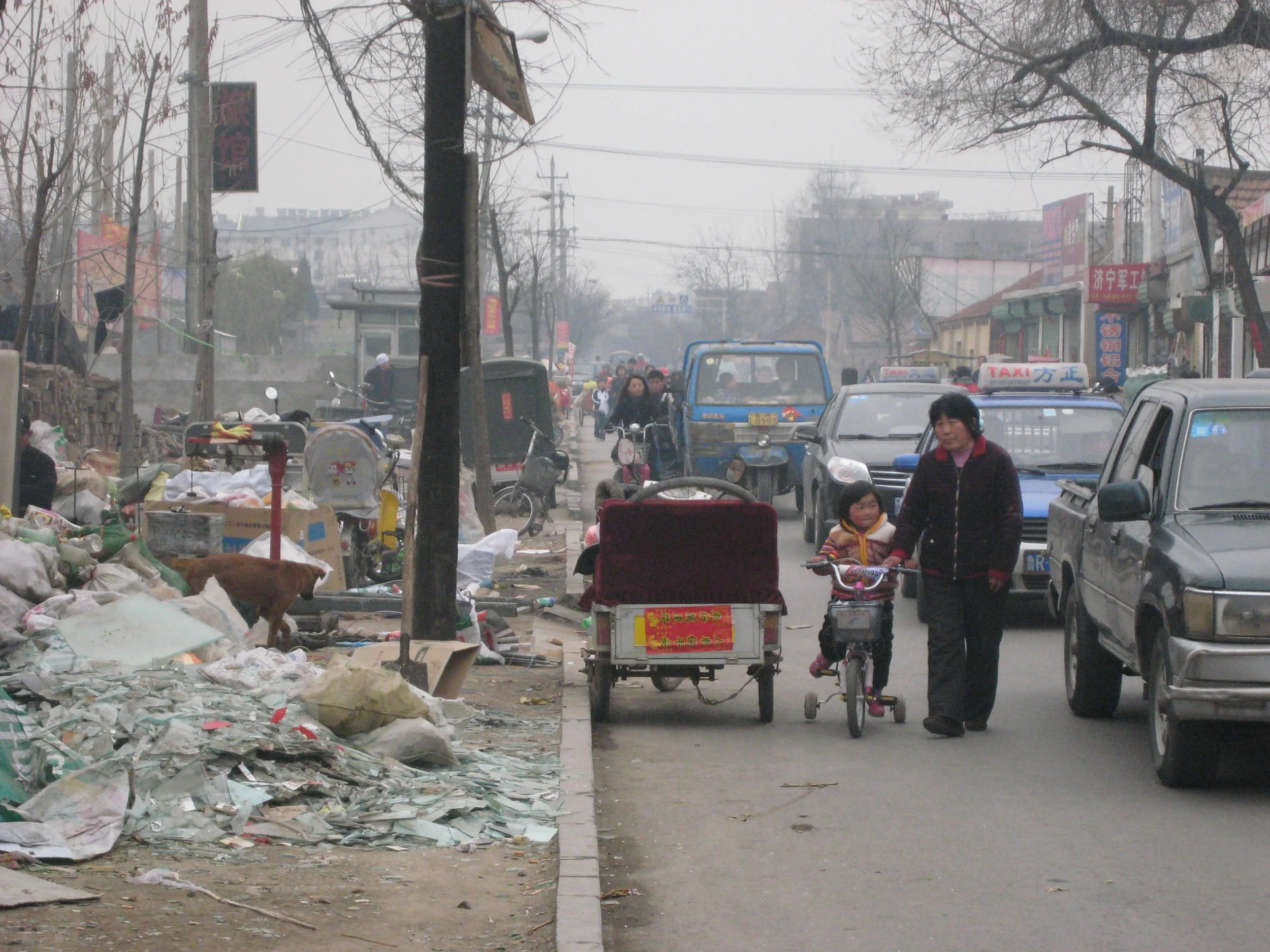
Trash on the sidewalk in Heze, China. Ann Forsyth. CC BY 2.0.
With a population of 1.37 billion and counting, China is one of the world’s largest producers of trash, churning out nearly 175 million tons of waste each year. Only a decade ago, piles of garbage surrounded city streets, spilling onto sidewalks and roads. But with the rapid development of waste-to-energy (WtE) plants, China now faces a surprising new challenge: there's not enough trash to go around.
WtE plants work by incinerating energy-rich materials, like paper, plastics, yard waste and wood-based products. As this waste burns, it releases heat that converts water into steam inside a boiler. The steam creates enough pressure to spin the blades of a turbine generator, turning trash into electricity. As of October 2024, China has reached 1,010 WtE plants, which is more than half of the world’s total. Each plant can process around 750 tons of waste per day, meaning on average the country is incinerating about 1.1 million tons of trash daily. With such a high capacity of garbage to burn, China’s waste incinerators are finding that there is not enough trash to fuel their plants. According to the Science and Technology Daily, these WtE plants are currently only operating at around 60% capacity.
To optimize efficiency, companies such as Beikong Environmental Technology Development have introduced advanced combustion control systems that adjust grate speed and airflow based on the composition of the waste. This consistently keeps thermal efficiency at 85%, which allows the company to generate an extra 15 million kilowatt-hours of electricity annually, the equivalent of saving 1,220 tons of coal.
Unfortunately, burning waste comes with environmental drawbacks. The process emits nitrogen oxides and sulfur dioxide, which are pollutants that pose health risks and harm the environment. To address this, China’s Ministry of Ecology and Environment (MEE) has rolled out initiatives to supervise WtE operations, tracking emissions and their local impact. For public accountability, in January of 2020, the MEE launched a platform to share the data on average emissions from each plant. While China’s first WtE plant was built back in the 1980s, the sector didn’t take off until the early 2000s. Since 2004, emissions have dropped 100-fold, a major leap toward cleaner energy. However, despite these gains, the average Chinese WtE plant still falls behind European standards, which are roughly 10 times stricter.
These waste-burning efforts are part of the country’s broader campaign to create a “Beautiful China.” Less garbage on the streets means better public health and safety. The constant demand for waste has also led to more frequent street cleaning and improved waste management systems, which deters disease-carrying pests, such as cockroaches and rodents. Beyond sanitation, researchers have found that a cleaner environment fosters civic pride, encouraging people to feel connected to their local communities.
In an effort to help other countries manage their growing waste problems, China has taken part in 79 overseas incineration projects. Nations across Asia, Africa, Europe, Oceania, South America and North America are now working with China to confront the global trash crisis. While burning garbage comes with its own set of environmental concerns, so does letting it sit and rot in landfills. The truth is, there’s no perfect way to get rid of trash. Reducing, reusing, and recycling remain the most effective actions people can take to protect the planet. But at the very least, incineration generates energy, offering a partial solution and easing some of the pressure off fossil fuels.

Paige Geiser
Paige is currently pursuing a bachelor’s degree in English with a minor in Criminal Justice at the University of Wisconsin-La Crosse. She grew up in West Bloomfield, MI, and has been fortunate enough to travel all throughout the country. She is an active member of the university’s volleyball team and works as the sports reporter for The Racquet Press, UWL’s campus newspaper. Paige is dedicated to using her writing skills to amplify the voices of underrepresented individuals and aspires to foster connections with people globally.