
Julia Kelley
Benefitting from infrastructure built by governmental support, valued social welfare and important traditions, Finland maintains its rank as the world’s happiest country.
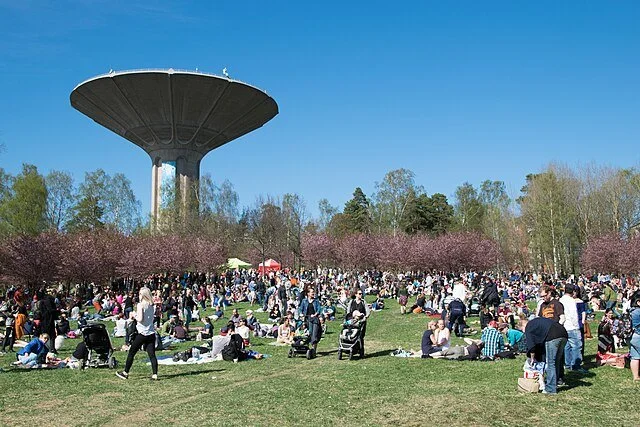
Finnish park crowded with people. Pohjolanpoluilla. CC BY-SA 2.0.
For eight consecutive years, Finland has been named the happiest country in the world by the World Happiness Report, ranked above fellow Nordic countries, such as Denmark, Iceland and Sweden. The report, a measure of a country’s quality of life, assesses data from several quantifiable variables, including social support, freedom to make life choices and freedom from corruption. For 2025, the index focused on how acts of caring and sharing influence others’ happiness, and based on data used from the Gallup World Poll surveys from 2022 to 2023, top-rated countries hold high values that support a citizen’s general well-being. Prominent degrees of benevolence, trust and generosity set these nations apart. Moreover, countries that comprise these spots tend to maintain their levels of happiness. Scientists explain this phenomenon with research indicating that individuals who engage in their local community and help others are happier, meaning that a nation’s overall satisfaction is a collective effort. The country with the highest degree of happiness, Finland, continues to reflect these ideals year after year through the nation’s self-proclaimed “infrastructure of happiness”.
The northernmost country in the world, Finland, is renowned for its vast forests, remote landscapes and extreme climate conditions. As a European nation, the country borders Sweden in the west, as well as Russia in the east, also acting as a border between two continents. Sitting in an influential location, Finland developed positive trade and cultural relations during World War II and maintained a neutral political position during the Cold War, ultimately achieving a prominent position in the United Nations. Since the mid-20th century, the country has not only held a globally respected reputation but also nurtured internal development. Throughout the 21st century, Finland’s national policies have centered on increasing employment rates, expanding access to healthcare services and promoting equality. In addition to this, the country has invested efforts into its social policy, such as providing abundant pension schemes, easy access to healthcare and unemployment and family benefits. Federal authorities are also key in fostering cultural growth as part of the country’s national identity. Artists are allocated monthly tax-free grants, art is publicly available through hundreds of museums, libraries are avidly funded and utilized and cultural events are held year-round.
With universal health, education and sustaining institutions that build social connections, this infrastructure of happiness is reflected in the country’s citizens. As part of the polls conducted for the 2025 World Happiness Report, Finnish individuals noted high degrees of benevolent acts, including returning a lost wallet, volunteering and helping a stranger, indicating a close community in which people trust each other. National traditions can also shape the population’s overall well-being, such as with Finland’s sauna culture; home to about 3.3 million saunas, Finland’s heated rooms provide opportunities for people to come together and cleanse their bodies and minds. This emphasis on nourishing one’s inner peace is also seen in citizens’ connection to nature. In a survey commissioned by Sitra, a Finnish innovation fund, 87% of Finns stated that nature was important to them in providing peace of mind, a place for recreation or in helping them recuperate. Altogether, support from government institutions and a sense of personal fulfillment create opportunities for a balanced life within Finland. Further, having basic needs taken care of, Finns’ appreciation for simplistic ways of life and trust allows them to foster a community where individuals work together to ensure happiness.
Julia Kelley
Julia is a recent graduate from UC San Diego majoring in Sociocultural Anthropology with a minor in Art History. She is passionate about cultural studies and social justice, and one day hopes to obtain a postgraduate degree expanding on these subjects. In her free time, she enjoys reading, traveling, and spending time with her friends and family.