
Ashley McDermott
The Aral Sea has all but disappeared, spawning a new desert full of toxic sand; however, locals hope to emphasize the history, art and culture of the region as they work to redefine their future.
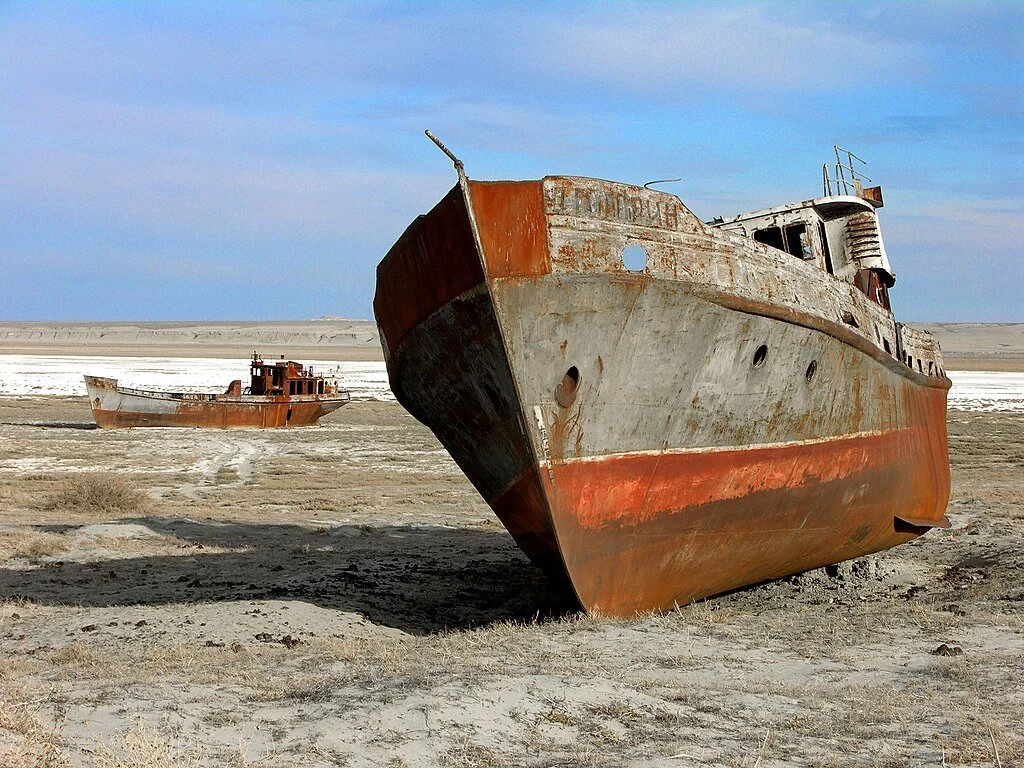
Ship graveyard in Moynaq, Uzbekistan. Zhanat Kulenov. CC BY-SA 3.0
The Aral Sea once spanned 26,300 square miles between Kazakhstan and Uzbekistan in Central Asia, making it the former fourth-largest lake in the world. Now the sea encompasses only 10%of its original size and is split into two. The lake's disappearance disrupted local economies reliant on fishing and tourism along the lake shore and damaged local ecosystems. The exposed lakebed is now considered the "youngest desert" in the world and spawns dust storms that unleash toxic chemicals from years of agricultural runoff and Soviet weapons testing into the air. Disaster tourists frequent sites, such as the infamous "ship graveyard" in Moynaq, Uzbekistan, to take pictures of the abandoned ships that used to sail the Aral Sea's waters.
The Republic of Karakalpakstan, an autonomous region of Uzbekistan, is hoping to shift the narrative of the Aral Sea disaster to one centered on the area's significant history, vibrant culture and plans for a sustainable future. One way they are doing so is through the Aral Culture Summit, an event launched at the 2025 Samarkand Climate Forum and set to take place every 18 months. The first summit took place in April inside the world's largest yurt to honor the heritage of the Karakalpakstan's nomadic peoples.
Representatives from the governments of five Central Asian countries, as well as the European Union, met to discuss the Aral region at the summit alongside artists, architects, poets, activists and scientists. One emphasis was Central Asia's vulnerability to climate change, as well as the steps that have been taken to mitigate the effects. Uzbekistan's government-sponsored Yashil Makon (Green Nation) project carried out a large-scale greening initiative in the Aral Desert, covering 2 million hectares with drought-resistant plants. Kazakh ecologists, as part of the Aral Sea Environmental Restoration Project, are also combating desertification in the lakebed by planting black saxaul trees.
Uzbekistan and the Republic of Karakalpakstan hope to inspire tourism to the area's myriad archeological sites. The "Desert castles of ancient Khorezm" are fortresses, or qala, built in the first century B.C., and today they are UNESCO World Heritage Sites. The ruins of many of the fortresses are still standing and open to the public. Karakalpakstan is also known for its Zoroastrian "Towers of Silence," or dakhma, which are wide towers that played a role in one of the world's oldest known funerary traditions.

Kyzyl Qala (Red Fortress) in Karakalpakstan. Bruce Allardice, CC BY-SA 2.0
Ecotourism is developing around Sudochie Lake, part of the Aral Basin. Visitors can stay at yurt camps, learn traditional yurt-making and have lunch. Overall, the aim of travelers’ visitation to the Aral Desert is shifting away from interest in the disaster. “There’s a small focus on disaster tourism,” said Sophie Ibbotson, Uzbekistan’s Tourism Ambassador, at the summit. “Many people want to visit the Aral Sea and what’s left of it—like the ship graveyard in Moynaq. But the aim is shifting—not to look at destruction, but to learn from environmental mistakes and understand the broader issues of climate change.”. Though the Aral Sea is forever lost, as a result of the ongoing conversations and international cooperation, Central Asia remains hopeful that it can redefine the region's legacy.
Ashley McDermott
Ashley is a PhD candidate in Linguistic Anthropology at the University of Michigan. She is committed to making her research useful for the communities she works with. Her work explores how families navigate language use and language shift in Bishkek, Kyrgyzstan. When she’s not working on her research, you’ll find her adventuring with her toddler daughter, whose commentary keeps every day interesting.