
Zoe Lodge
Global water crises are often worsened and perpetuated by strategic political maneuvers.
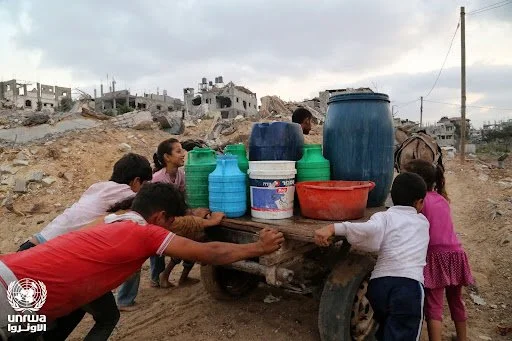
Water transport through rubble in Gaza. Fadi Thabet. CC BY-SA 4.0.
For most citizens and travelers in Western cultures, water is a given, from the glasses poured at dinner to the showers after long days. However, in conflict zones around the world, water is anything but ordinary. Increasingly, it is being wielded as a weapon, getting withheld, diverted or manipulated to control populations. From conflicts involving the Euphrates River in Syria and Iraq to rationing regimes in Africa and Latin America, access to clean water has become not just a humanitarian necessity but a powerful tool of oppression.
The Euphrates River, which flows through Turkey, Syria and Iraq, has long served as a lifeline for the region. Yet, during the Syrian civil war, water infrastructure became a strategic target. Dam reservoirs were seized by armed groups, towns were cut off from supplies and residents were forced to migrate when the taps ran dry. In Iraq, similar tactics have been used, with infrastructure deliberately diverting water flows to weaken resistance in contested areas. In Yemen, being in a scarcity zone, piled upon years of war, has left water infrastructure shattered, with cholera outbreaks becoming endemic. In the Gaza region, water access has been heavily restricted, with reports of residents relying on brackish or contaminated water to survive. In each of these instances, the water crisis isn’t solely a result of war, but it is actively engineered to pressure communities, shrink populations and shift political power.
In some countries, water rationing policies disproportionately affect marginalized communities, who are the first to face shutoffs when infrastructure is strained. Across parts of Sub-Saharan Africa, urban residents often receive consistent supplies, while rural or politically marginalized groups are left to walk hours for a single container of well water, one that is not as safe or clean as those available in urban hubs. Even in Latin America, where water is not scarce, which should theoretically ease pressure, conflicts erupt over who controls the flow from rivers and reservoirs. In Chile, one of the few countries that has fully privatized its water supply, Indigenous groups argue that corporate water rights have displaced their communities and stripped them of ancestral access to rivers and springs. Additionally, lithium mining for renewable energy sources in Chile saps up considerable amounts of water that would otherwise be directed to Indigenous populations.
In some corners of the globe, control of water has become inseparable from questions of land rights, political identity and survival. The United Nations has declared access to clean water a fundamental human right, but enforcement remains weak. Humanitarian groups on the ground in Syria, Yemen and Gaza work tirelessly to restore water infrastructure and truck in supplies, though they often face blockades or violence. In Latin America, Indigenous organizations have taken water battles to the courts, fighting the capitalistic takeover of their countries’ water supplies. Grassroots movements have sprung up in South Africa, India and the United States, uniting around the principle that water should never be treated as a weapon or commodity but as a shared human right.
The future of water security will be one of the defining issues of the 21st century. Climate change has already intensified droughts, storms and flooding, placing added pressure on fragile regions. Where scarcity exists, so does the temptation for those in power to manipulate the existing supply. International watchdogs are continuing to document abuses, legal scholars are pushing for stronger global frameworks and local communities are demanding that governments enshrine protections for water access. For travelers, journalists and global citizens, recognizing the political dimensions of water is critical. It’s not only about conservation at home or avoiding plastic bottles abroad; it’s about acknowledging that something as simple as turning on a tap is a privilege denied to millions, not by accident, but often by design.
GET INVOLVED:
There are numerous global NGOs and charities that take donations and volunteers for projects and initiatives designed to help with varying water crises.
Charity: Water focuses on providing clean water access, primarily in Sub-Saharan Africa.
Water.org is focused on water sanitation on a global scale.
Water for People operates largely in Central and South America, providing clean water infrastructure for marginalized communities.
Project Waterfall is specifically focused on bringing clean water to those in the coffee industry, an often overlooked sector in Sub-Saharan Africa.
The Maia Project is focused on bringing clean and safe water to children in the Gaza region.

Zoe lodge
Zoe is a student at the University of California, Berkeley, where she is studying English and Politics, Philosophy, & Law. She combines her passion for writing with her love for travel, interest in combating climate change, and concern for social justice issues.