
By Julia Sassaman
Originating in the Ottoman Empire and traveling across Europe, the doner kebab has become a symbol of migration amid EU policies that are reshaping the region
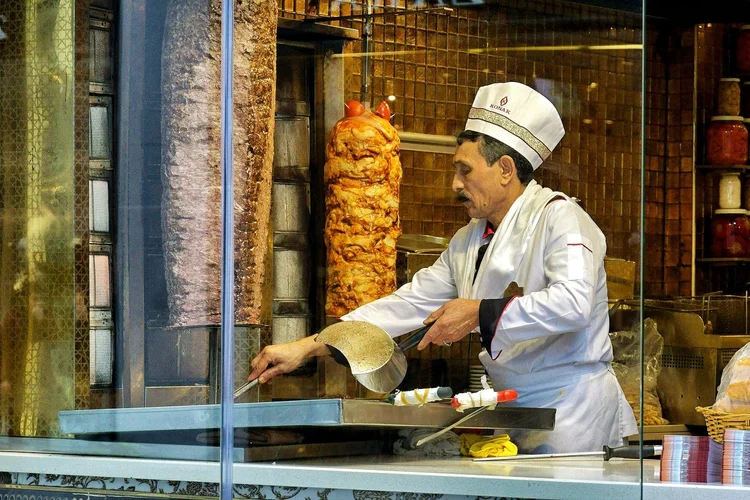
Preparation of a Turkish Doner Kebab in Istanbul. Philippe Vieux-Jeanton. CC BY-NC-ND 2.0.
In cities across Western Europe, doner kebab shops are a common sight, particularly in France, Germany and the United Kingdom. Its origins are often traced back to the Ottoman Empire, where the food was documented in an Istanbul artist’s paintings from the early 17th century. Before then, in 1433, the French voyager Bertrandon de la Broquiere wrote about his encounter with Turkish travelers near Bursa who sliced sheep meat as it roasted on an iron kebab spit, suggesting even earlier beginnings for the modern doner kebab.
Traditionally, Turkish doner preparation begins with a stack of seasoned meat, such as lamb, chicken or beef, cooked upright on a rotating vertical spit. As the outside layers crisp, the chef cuts thin slices and pairs the meat with pita, salad and sauce. In its earliest form, the doner was typically only a lamb dish and was cooked horizontally. Over the last 50 years, it has been reimagined across European cities, most notably in Berlin, where it can be found in forms ranging from pizza toppings to burger fillings.
In 2024, Turkey applied to have the doner kebab formally recognized by the EU. This would restrict businesses from using the doner name if their products do not meet specific parameters regarding the meat’s thickness, origin and marination. Germany and its food industry strongly contest this proposal, arguing that the country largely influenced the dish’s modern form. If enacted, more than 1,000 doner shops in Berlin alone could be banned from selling their adaptations of the dish.
Germany’s connection to the modern doner began in 1961, when the country signed a labor recruitment agreement with Turkey to help stimulate its postwar economy. Nearly 1 million Turkish guest workers migrated to Germany under this treaty, and from their labor and cultural exchange emerged the portable, street-food-friendly Berlin doner. Today, Germany’s doner industry generates nearly $2.6 billion annually and almost $3.9 billion across the rest of Europe. The United Kingdom’s kebab industry has seen similar success, employing about 200,000 people and supporting thousands of businesses.
Regardless of its origins, the doner kebab’s success is inseparable from immigrants’ contributions of culture, cuisine and labor across Europe.
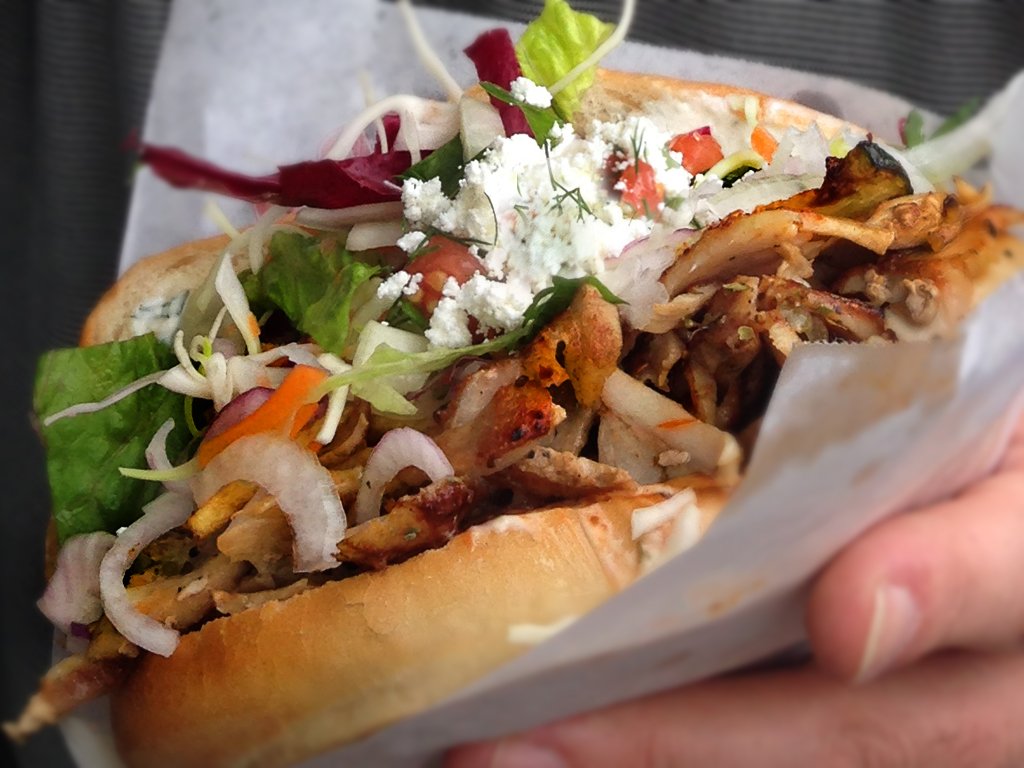
Berlin’s portable doner kebabs. FrugalGlutton.com. CC BY 2.0.
Across the EU, immigration is reaching record levels, fueled in part by displacement from conflict regions, including Ukraine. As of January 2025, an estimated 46.7 million people born outside the EU were living in EU member states, representing just over 10% of its total population.
The EU’s response has prioritized stricter immigration enforcement. On June 12, 2026, the EU’s Pact on Migration and Asylum, a package of laws covering border management and asylum policy, took effect. Human Rights Watch raised concerns that the pact risks undermining the right to asylum, as it fast-tracks the assessment of asylum claims and increases detention. Additionally, it could enable member states to shirk their obligations to refugees in crisis.
On June 17, the European Parliament approved the Return Regulation, which aims to accelerate the removal of individuals without the legal right to remain in the EU. The regulation permits detention in some cases and allows for the transfer of individuals to non-EU countries in arrangements referred to as “return hubs.” UN High Commissioner for Human Rights Volker Turk criticized the law, arguing that “EU States cannot simply outsource their human rights obligations to third States” and warning that detaining and returning vulnerable populations carries high risks of human rights violations.
As these policies take effect, their full impact on immigrant communities across Europe continues to unfold. The doner kebab’s popularity across European cities stands as a tangible result of migration, producing economic opportunities for both local citizens and immigrants alike. Without the cultural exchange enabled by movement across borders, it is unclear whether the doner kebab would exist at its current scale across the region.

Julia Sassaman
Julia is a fourth-year student at the University of Michigan studying political science and international studies. She recently studied abroad in Geneva, Switzerland, researching post-conflict tourism and international human rights law. After graduation, she hopes to move to Europe to pursue a career centered on global human rights. In her free time, she enjoys painting, baking, journaling, and reading.