When the poet John Donne was struck down by a sudden infection in 1623 he immediately found himself alone – even his doctors deserted him. The experience, which only lasted a week, was intolerable. He later wrote: “As sickness is the greatest misery, so the greatest misery of sickness is solitude.”
It’s hard to believe now, but until relatively recently, solitude – or the experience of being alone for significant periods of time – was treated with a mixture of fear and respect. It tended to be restricted to enclosed religious orders and was thus a privileged experience of a male elite. Change was only set in motion by the Reformation and the Enlightenment, when the ideologies of humanism and realism took hold and solitude slowly became something that anyone could acceptably seek from time to time. Most people in the West are now used to some regular form of solitude – but the reality of lockdown is making this experience far more extreme.
I have spent the last few years researching the history of solitude, looking into how people in the past managed to balance community ties and solitary behaviours. This has never seemed more relevant.
Take the example of my own community. I live – and now work – in an old house in an ancient Shropshire village in England. In the 11th-century Domesday Book it was recorded as a viable community, on a bluff of land above the River Severn. Over the centuries, its self-sufficiency has declined. Now it has no services beyond the church on Sunday.
But it has long displayed a collective spirit, mostly for seasonal entertainment and the maintenance of a village green, which contains the ruins of a castle built to keep the Welsh in Wales. Planning was taking place for a formal ball in a marquee on the green this autumn, which has yet to be cancelled. In the meantime, the Neighbourhood Watch group, in place to deal with very rare criminal activity, has delivered a card to all residents, offering to help with “picking up shopping, posting mail, collecting newspapers, or with urgent supplies”. There is a WhatsApp group where many locals are offering support.
For the first time in generations, the attention of the inhabitants is not focused on the resources of the region’s urban centres. The nearby A5, the trunk road from London to Holyhead and thence to Ireland, no longer goes anywhere important. Instead, the community has turned inwards, to local needs, and the capacity of local resources to meet them.
This experience of a small British settlement reflects the condition of many in Western societies. The COVID-19 crisis has led us to embrace new technologies to revitalise old social networks. As we begin to come to terms with the lockdown, it is important to understand the resources at our disposal for coping with enforced isolation.
History can assist with that task. It can give a sense of perspective on the experience of being alone. Solitude has only become a widespread and valued condition in the recent past. This gives some support to our capacity to endure the COVID-19 lockdown. At the same time, loneliness, which can be seen as failed solitude, may become a more serious threat to physical and mental well-being. That failure can be a state of mind, but more often is a consequence of social or institutional malfunctions over which the individual has little or no control.
Desert fathers
At the beginning of the modern era, solitude was treated with a mixture of exaggerated respect and deep apprehension. Those who withdrew from society imitated the example of the fourth-century desert fathers who sought spiritual communion in the wilderness.
St Anthony the Great, for example, who was made famous in a biography by St Athanasius around the year 360 CE, gave away his inheritance and retreated into isolation near the the River Nile, where he lived a long life subsisting on a meagre diet and devoting his days to prayer. Whether they sought a literal or metaphorical desert, the solitude of St Anthony and his successors appealed to those seeking a peace of mind that they could no longer locate in the commercial fray.
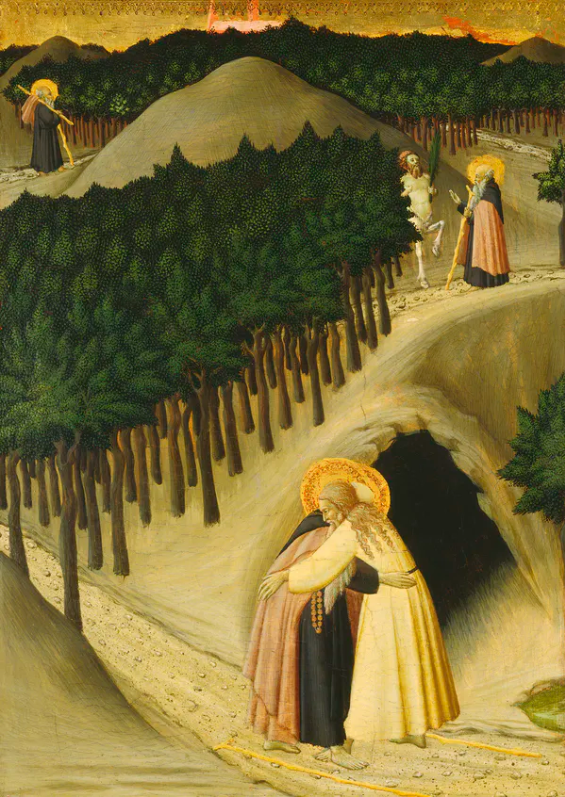
The Meeting of St Anthony and St Paul, Master of the Osservanza, c. 1430-1435. Wikimedia Commons
As such, solitude was conceived within the frame of a particular Christian tradition. The desert fathers had a profound influence on the early church. They conducted a wordless communion with a silent God, separating themselves from the noise and corruption of urban society. Their example was institutionalised in monasteries which sought to combine individual meditation with a structure of routine and authority that would protect practitioners from mental collapse or spiritual deviation.
In society more broadly, the practice of retreat was considered suitable only for educated men who sought a refuge from the corrupting pressures of an urbanising civilisation. Solitude was an opportunity, as the Swiss doctor and writer Johann Zimmermann, put it, for “self-collection and freedom”.
Women and the less well-born, however, could not be trusted with their own company. They were seen to be vulnerable to unproductive idleness or destructive forms of melancholy. (Nuns were an exception to this rule, but so disregarded that the 1829 Catholic Emancipation Act, which specifically criminalised monks and monasteries, did not mention convents at all.)
But over time, the risk register of solitude has altered. What was once the practice of enclosed religious orders and the privileged experience of a male elite has become accessible to almost everyone at some stage in their lives. This was set in motion by the twin events of the Reformation and the Enlightenment.
A social god
Attitudes were changing by the time Donne, poet and Dean of St Paul’s Cathedral, was struck down by that sudden infection and deserted by all and sundry. He wrote that the instinctive response of the healthy to the afflicted did nothing except increase his suffering: “When I am but sick, and might infect, they have no remedy but their absence and my solitude.” But he found solace in a particularly Protestant conception of God. He saw the supreme being as fundamentally social:
There is a plurality of persons in God, though there be but one God; and all his external actions testify a love of society, and communion. In heaven there are orders of angels, and armies of martyrs, and in that house many mansions; in earth, families, cities, churches, colleges, all plural things.
This sense of the importance of community was at the heart of Donne’s philosophy. In Meditation 17, he went on to write the most famous statement of man’s social identity in the English language: “No man is an island, entire of itself; every man is a piece of the continent, a part of the main.”
In the Catholic church, the tradition of monastic seclusion was still the subject of periodic renewals, most notably in this era with the founding of the Order of Cistercians of the Strict Observance, more commonly known as the Trappists, in 1664 France. Within the walls of the monastery, speech was reduced to an absolute minimum to allow the penitent monks the greatest opportunity for silent prayer.An elaborate sign language was deployed to enable the monks to go about their daily business.
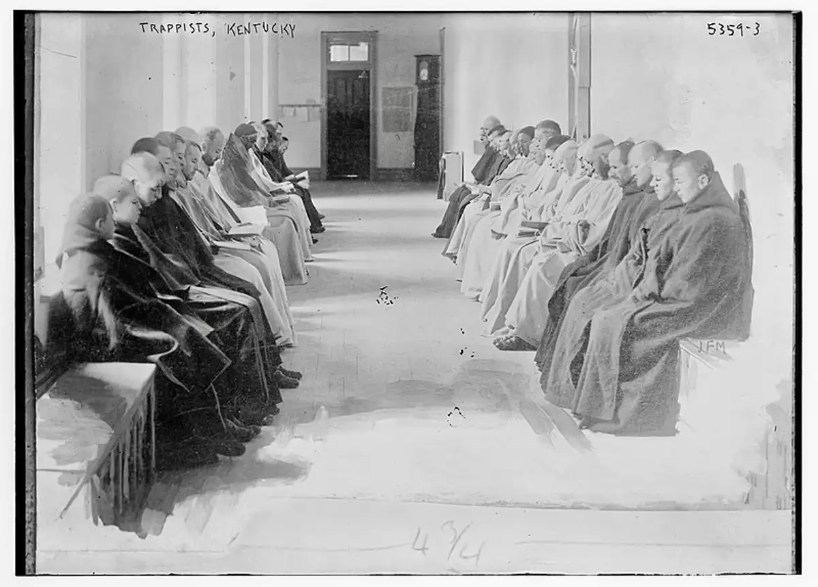
Trappists in Kentucky. Library of Congress, CC BY-SA
But in Britain, the work of Thomas Cromwell had devastated the enclosed orders, and the tradition of spiritual withdrawal was pushed to the margins of religious observance.
In the era following Donne’s time of anguish, the Enlightenment further emphasised the value of sociability. Personal interaction was held to be the key to innovation and creativity. Conversation, correspondence and exchanges within and between centres of population, challenged structures of inherited superstition and ignorance and drove forward inquiry and material progress.
There might be a need for withdrawal to the closet for spiritual meditation or sustained intellectual endeavour, but only as a means of better preparing the individual for participation in the progress of society. Prolonged, irreversible solitude began to be seen essentially as a pathology, a cause or a consequence of melancholy.
The spread of solitude
Towards the end of the 18th century, a reaction to this sociability set in. More attention began to be paid, even in Protestant societies, to the hermit tradition within Christianity.
The Romantic movement placed emphasis on the restorative powers of nature, which were best encountered on solitary walks. The writer Thomas De Quincey calculated that in his lifetime William Wordsworth strode 180,000 miles across England and Europe on indifferent legs. Amidst the noise and pollution of urbanising societies, periodic retreat and isolation became more attractive. Solitude, providing it was embraced freely, could restore spiritual energies and revive a moral perspective corrupted by unbridled capitalism.
At a more everyday level, improvements in housing conditions, domestic consumption and mass communication widened access to solitary activities. Improved postal services, followed by electronic and eventually digital systems, enabled men and women to be physically alone, yet in company.
Increasing surplus income was devoted to a widening range of pastimes and hobbies which might be practised apart from others. Handicrafts, needlework, stamp-collecting, DIY, reading, animal and bird breeding, and, in the open air, gardening and angling, absorbed time, attention and money. Specialised rooms in middle-class homes multiplied, allowing family members to spend more of their time going about their private business.

Increased incomes gave rise to more time for hobbies, such as building collections. Manfred Heyde/Wikimedia Commons, CC BY-SA
And although monasteries had been explicitly excluded from the epochal Catholic Emancipation Act of 1829, Britain subsequently witnessed a bitterly contested revival of enclosed orders of both men and women.
By the early 20th century, declining family size combined with council houses began to supply working-class parents and children with domestic spaces of their own. Electric light and central heating meant that it was no longer necessary to crowd around the only source of warmth in the home. Slum clearances emptied the streets of jostling crowds, and adolescent children began to enjoy the privilege of their own bedroom.
In middle-class homes, domestic appliances replaced live-in servants, leaving the housewife, for good or ill, with her own society for much of the day. The motor car, the aspiration of the middle class between the wars, and increasingly the whole of the population in the second half of the 20th century, provided personalised transport, accompanied by privately-chosen radio and later musical entertainment.
Self-isolating society
After 1945, society more broadly began to self-isolate. Single-person households, a rare occurrence in earlier centuries, became both feasible and desirable. In our own times, nearly a third of UK residential units have only one occupant. The proportion is higher in parts of the US and even more so in Sweden and Japan.
The widowed elderly, equipped for the first time with adequate pensions, can now enjoy domestic independence instead of moving in with children. Younger cohorts can escape unsatisfactory relationships by finding their own accommodation. Around them a set of expectations and resources have developed, making solitary living both a practical and a practised way of life.
Living by yourself, for shorter or longer periods, is itself no longer seen as a threat to physical or psychological well-being. Instead, concern is increasingly centred on the experience of loneliness, which in Britain led to the appointment of the world’s first loneliness minister in 2018, and the subsequent publication of an ambitious government strategy to combat the condition. The problem is not being without company itself, but rather, as writer and social activist Stephanie Dowrick puts it, being “uncomfortably alone without someone”.

More and more people live alone. Chuttersnap/Unsplash, FAL
In late modernity, loneliness has been less of a problem than campaigners have often claimed. Given the rapid rise both of single-person households and the numbers of elderly people, the question is not why the incidence has been so great but rather, in terms of official statistics, why it has been so small.
Nonetheless, the official injunction to withdraw from social gatherings in response to the escalating threat of the COVID-19 pandemic throws renewed attention on the often fragile boundary between life-enhancing and soul-destroying forms of solitary behaviour. This is not the first time governments have attempted to impose social isolation in a medical crisis – quarantines were also introduced in response to the medieval plague outbreaks – but it may be the first time they fully succeed. No one can be sure of the consequences.
The threat of isolation
So we should take comfort from the recent history of solitude. It is certain that modern societies are much better equipped than those in the past to meet such a challenge. Long before the current crisis, society in much of the West moved indoors.
In normal times, walk down any suburban street outside the commute to work or school, and the overriding impression is the absence of people. The post-war growth of single-person households has normalised a host of conventions and activities associated with the absence of company. Homes have more heated and lighted space; food, whether as raw materials or takeaway meals, can be ordered and delivered without leaving the front door; digital devices provide entertainment and enable contact with family and friends; gardens supply enclosed fresh air to those who have one (now made still fresher by the temporary absence of traffic).
By contrast, the pattern of living in Victorian and early 20th-century Britain would have made such isolation impossible for much of the population. In working-class homes, parents and children passed their days in a single living room and shared beds at night. Lack of space continually forced occupants out into the street where they mixed with neighbours, tradesmen and passers-by. In more prosperous households, there were more specialised rooms, but servants moved constantly between family members, ran errands to the shops, dealt with deliveries of goods and services.
The history of solitude should also encourage us to consider the boundary between solitude and loneliness – because it is partly a matter of free will. Single-person households have expanded in recent times because a range of material changes made it possible for young and old to choose how they lived. At the opposite end of the spectrum, the most extreme form of modern solitude, penal solitary confinement wreaks destruction on almost everyone exposed to it.
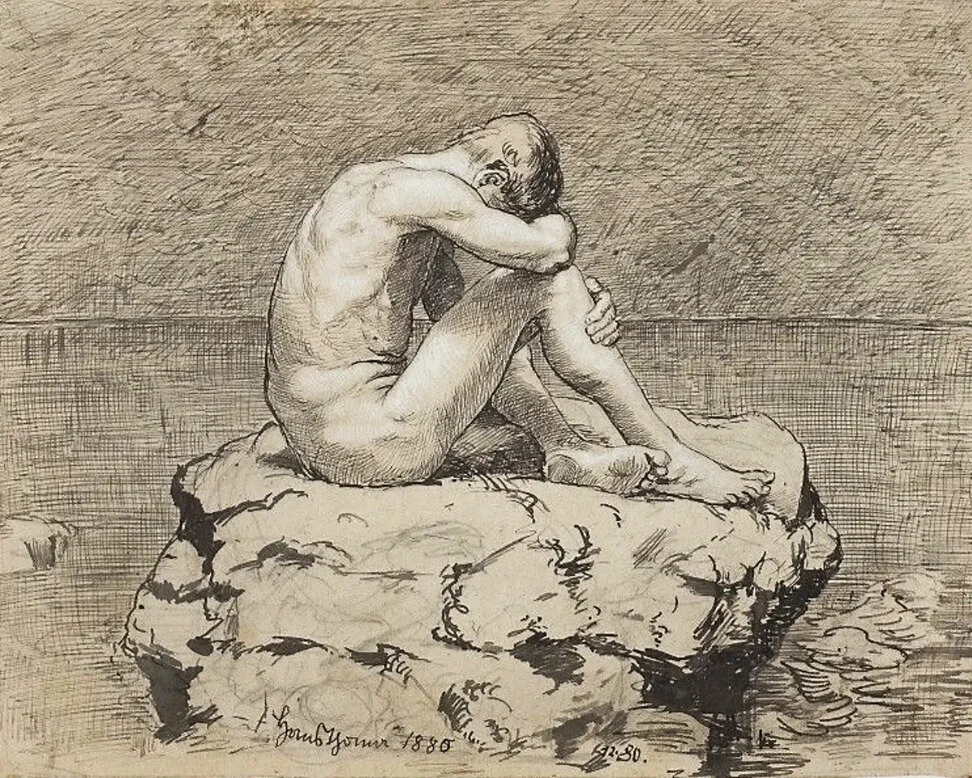
Loneliness, Hans Thoma, 1880. National Museum in Warsaw, Wikimedia Commons
Much will now depend on whether the state engenders a spirit of enlightened consent, whereby citizens agree to disrupt their patterns of living for the sake of their own and the common good. Trust and communication police the boundary of acceptable and unacceptable isolation.
It is a matter of time. Many of the forms of solitude which are now embraced are framed moments before social intercourse is resumed. Walking the dog for half an hour, engaging in mindful meditation in a lunch break, digging the garden in the evening, or withdrawing from the noise of the household to read a book or text a friend are all critical but transient forms of escape.
Those living alone experience longer periods of silence, but until lockdown was imposed, were free to leave their home to seek company, even if only in the form of work colleagues. Loneliness can be viewed as solitude that lasts too long. For all the science driving current government policy, we have no way of knowing the cost to people’s peace of mind of isolation that continues for months on end.
We must remember that loneliness is not caused by living alone itself, but the inability to make contact when the need arises. Small acts of kindness between neighbours and support from local charities will make a great difference.
There is an expectation that, for good or ill, the experience of the COVID-19 epidemic will be standardised. Outside the lottery of infection, most will endure the same constraints on movement, and, through quasi-wartime financial measures, enjoy at least the same basic standard of living. But by circumstance or temperament, some will flourish better than others.
More broadly, poverty and declining public services have made it much more difficult to gain access to collective facilities. Last-minute funding changes by government will struggle to compensate for underinvestment in medical and social support over the last decade. Not everyone has the capacity or income to withdraw from places of work or the competence to deploy the digital devices which will now be critical for linking need with delivery. The more prosperous will suffer the cancellation of cruises and overseas holidays. The less so are in danger of becoming isolated in the full and most destructive meaning of the term.
Some may suffer like Donne. Others may enjoy the benefits of a change of pace, as Samuel Pepys did during another bout of plague-induced quarantine a few years after Donne. On the last day of December 1665, he reviewed the past year: “I have never lived so merrily (besides that I never got so much) as I have done this plague-time.”
David Vincent Professor of Social History, The Open University. His book A History of Solitude will be published by Polity on April 24
THIS ARTICLE WAS ORIGINALLY PUBLISHED ON THE CONVERSATION.