
Zoe Lodge
This ultra-modern city has become Asia’s most sustainable oasis.
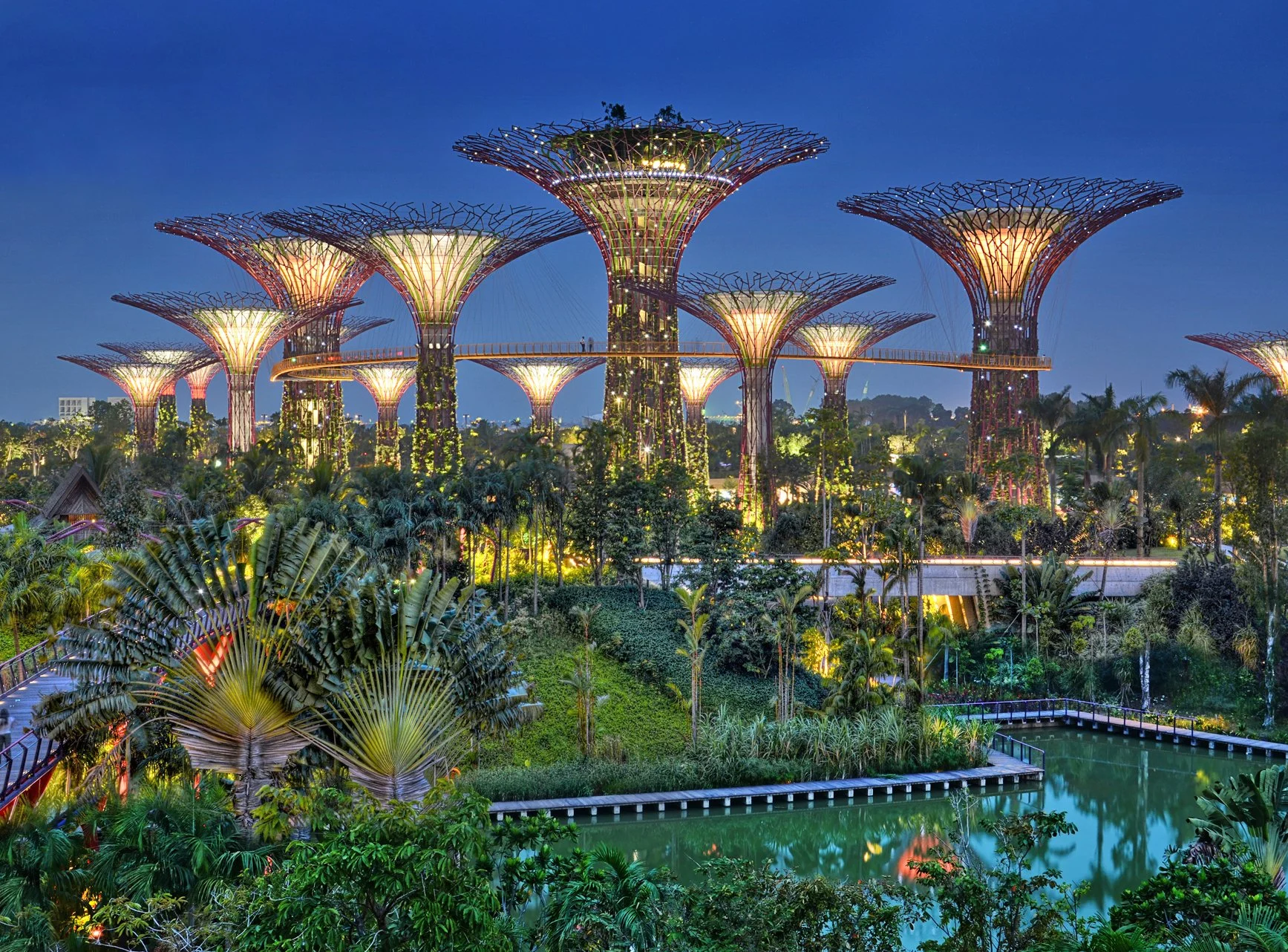
The SuperTree Grove in Marina Bay. William Cho. CC BY-NC-SA 2.0.
When imagining candidates for Southeast Asia’s greenest destination, one’s mind might drift to Bali’s rice terraces or Borneo’s rainforests. However, one of the most surprising recent contenders is Singapore, having transformed from a metropolitan concrete jungle to a hyper-modern city-state known for both its towering skyline and its environmental innovation. Over the last few decades, Singapore has transformed from a dense, industrialized hub into a “green metropolis,” seamlessly blending urban life with nature.
Singapore’s green transformation is no accident. Since gaining independence from Malaysia in 1965, the country has lacked natural resources and land, forcing it to rethink growth. This led to the founding vision of a "Garden City," a plan laid out by then-Prime Minister Lee Kuan Yew. The goal: create a city where nature and infrastructure coexist. Today, this vision has blossomed into a celebrated national strategy. According to the Singapore Green Plan 2030, the country aims to increase green spaces, reduce carbon emissions and enhance urban biodiversity. The plan includes expanding nature parks by 50%, adding 130 hectares of rooftop greenery and ensuring that all new public housing projects are eco-friendly.
One of Singapore’s most popular green innovations is the Parkroyal Collection Pickering, a hotel wrapped in lush vertical gardens that reduce urban heat and support biodiversity. It's part of a broader trend known as biophilic design, which incorporates natural elements into modern architecture to promote well-being and environmental sustainability. Another landmark is the Oasia Hotel Downtown, a red-and-green tower covered with 21 species of climbers and plants. This “living tower” also reduces energy consumption by naturally cooling the building and improving air quality. These projects are supported by the Skyrise Greenery Incentive Scheme, which helps developers offset the cost of adding rooftop or vertical greenery to their buildings.
One of the crowning achievements of Singapore’s green revolution is Gardens by the Bay, a futuristic nature park spanning 250 acres in Marina Bay. It’s home to the famous Supertree Grove, which blends solar power, rainwater harvesting and vertical planting into towering, tree-like structures that light up the night sky. The indoor Cloud Forest Dome simulates a high-altitude rainforest, powered in part by sustainable energy. These attractions both draw in tourists and serve as public education tools, showcasing how nature, innovation and tourism can coexist.
Singapore also leads the way in water sustainability. With limited freshwater sources, the city-state created NEWater, a high-grade reclaimed water program that now meets 40% of its water demand. Rainwater is collected through an extensive drainage system and reused, an essential step in combating climate change and drought. The city-state’s model proves that sustainability doesn’t require sacrificing comfort or progress, but true innovation. As cities around the globe search for climate solutions, Singapore could serve as a blueprint for a greener future.

Zoe Lodge
Zoe is a student at the University of California, Berkeley, where she is studying English and Politics, Philosophy, & Law. She combines her passion for writing with her love for travel, interest in combating climate change, and concern for social justice issues.