
Ashley McDermott
The Hanford Nuclear Reservation houses nuclear waste tanks that are leaking into the desert near the Columbia River, threatening to expose hundreds of thousands of people to radiation.
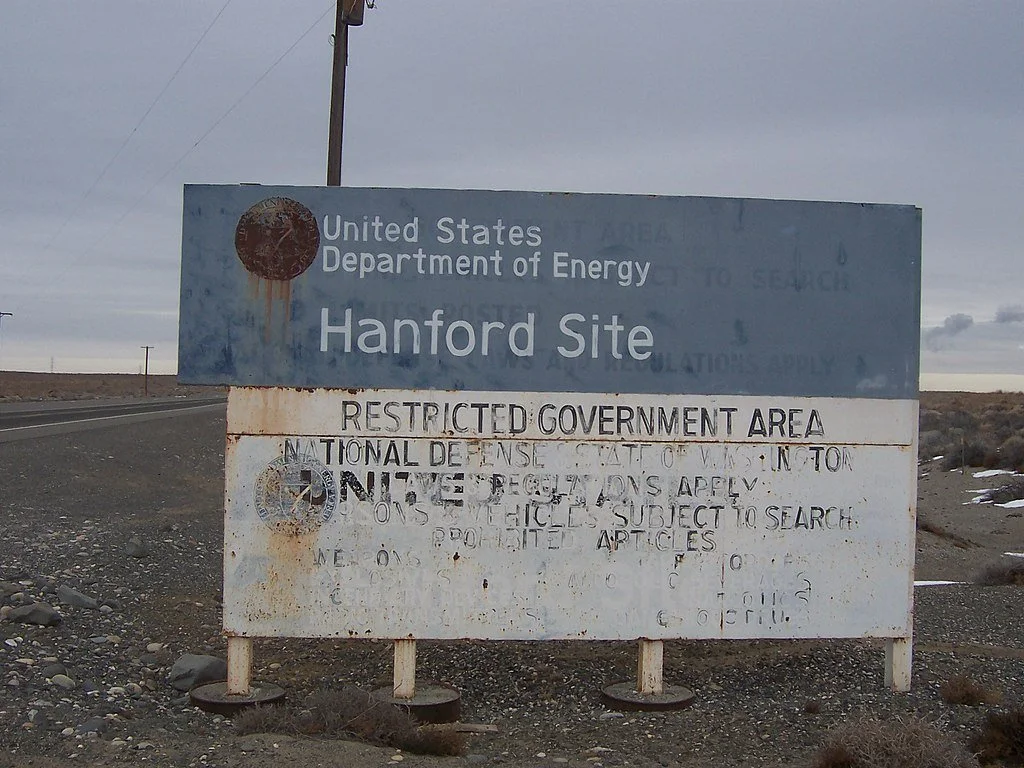
Welcome sign at Hanford Site. Tobin Fricke. CC BY-SA 2.0.
The plutonium manufactured at the Hanford Nuclear Reservation near Richland, Washington, led to some of the United States' first atomic bombs, including those used in the Trinity nuclear test and the "Fat Man" used in the bombing of Nagasaki. Established in 1943 as part of the Manhattan Project, what was once a full-scale plutonium reactor would grow to encompass nine reactors and five large plutonium processing complexes, which produced plutonium for 60,000 nuclear weapons. The reactors were shut down by 1971, but the site still houses radioactive waste. The containment facilities built to hold the waste are slowly leaking into the desert near the Columbia River.
"There's 56 million gallons of radioactive waste at Hanford. It's kind of this witch's brew of 1,800 chemicals and many, many radioactive constituents, in the form of sludge, salts, and liquids," reports Anna King, a senior correspondent at Northwest Public Broadcasting. The waste is contained in 177 “house-sized” tanks stored underground, with the site leaking around 300 gallons of waste per year.
Those living around the site report higher rates of thyroid disorders and certain types of cancers, and the workers at Hanford are especially at risk due to their close exposure. The Department of Energy (DOE) reports that the dangers cannot be controlled, but the employees are not given sufficient warning. Neuropsychologist Dr. Brian Campbell found unexpectedly high levels of dementia in 29 people evaluated for respiratory and cognitive symptoms after exposure at Hanford. Critics say that the DOE is reluctant to act on its own findings. Estimates of how many people are currently at risk from the site are undefined, but during the nearly 30 years of Hanford’s operation, approximately 2 million people living on the shores of the Columbia River were exposed to radiation from the leaking containment facilities.
After decades of unremitted leaking, steps are finally underway to try to contain the waste. As of October 2025, Hanford opened up a vitrification plant. In vitrification, low-level nuclear waste is mixed with molten silicate to create inert logs of glass. The plant cost more than $10 billion to build and is part of a clean-up effort expected to cost between an additional $200 billion and $350 billion. Over the next 40 years, it is expected that the plant will process around 90% of the total waste at Hanford.
While vitrification is now underway, the question of what to do with the high-level waste remains. Original plans were to remove this waste off-site to Yucca Mountain, a proposed nuclear waste repository in Nevada, but this site is now defunct. A new site has yet to be found. Delays in cleaning up the site’s most radioactive waste mean that Hanford may remain one of the most polluted sites in the U.S. for decades to come.
GET INVOLVED:
Downwinders, or those living "downwind" of the U.S.'s various nuclear projects, have long campaigned for public and government recognition of the harms they've experienced due to exposure to fission products. Since the 1980s, several court cases have been brought by Downwinder-activists from areas near the Hanford Nuclear Reservation, and cases have largely been settled before many Downwinders could share their stories.
In response to the ongoing lack of recognition of the site's effect on public health, epidemiologist Dr. Elizabeth McClure, a member of the Union of Concerned Scientists, is leading a community-engaged research project to investigate the ongoing effects of the Hanford Nuclear Site. Dr. McClure's project seeks to address gaps in data collection, make the research process more transparent and give a platform to locals experiencing the adverse effects of living near the Hanford Site. Those wanting to share experiences or suggestions can contact Dr. McClure at emcclure@ucs.org.
The non-profit Columbia Riverkeeper's Clean-Up Hanford program also seeks to educate the public about the pollution caused by the Hanford Nuclear Reservation and advocate for clean up.
Ashley McDermott
Ashley is a PhD candidate in Linguistic Anthropology at the University of Michigan. She is committed to making her research useful for the communities she works with. Her work explores how families navigate language use and language shift in Bishkek, Kyrgyzstan. When she’s not working on her research, you’ll find her adventuring with her toddler daughter, whose commentary keeps every day interesting.