
Zoe Lodge
The Hell’s Kitchen Project is underway to extract lithium from California’s Salton Sea, raising social, environmental and economic questions
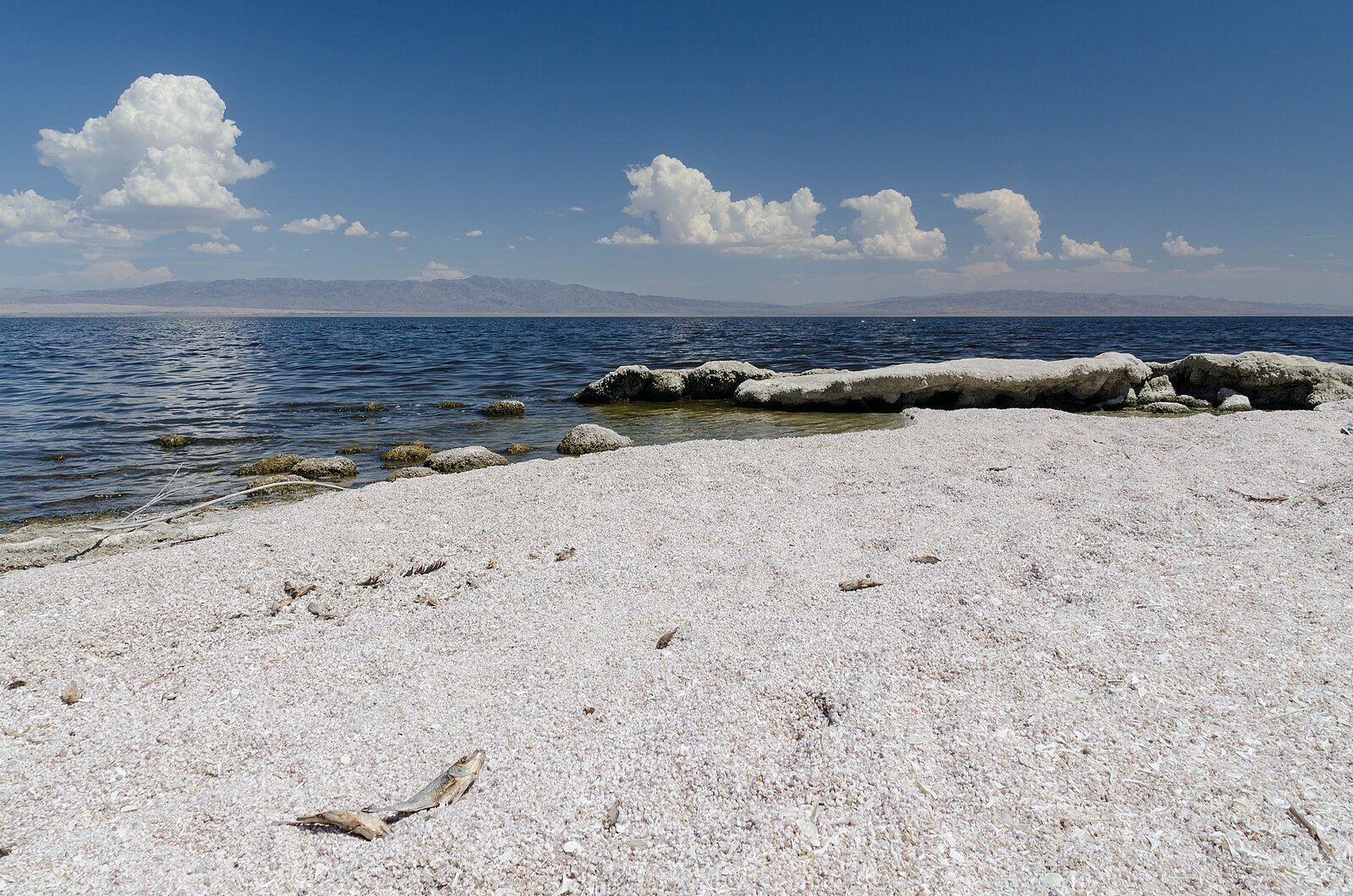
Shore of the Salton Sea. Tuxyso. CC BY-SA 3.0.
Beneath California’s Salton Sea, a massive saltwater lake located south of Palm Springs, lies an untapped reserve of lithium. Lithium has been nicknamed “white gold” due to its scarcity, hailing primarily from mines in Australia and Chile. Lithium is a critical component in the green energy movement, serving as a source of the compounds required to make electric vehicle batteries.
Governed primarily by Controlled Thermal Resources (CTR), the approved Hell’s Kitchen lithium project near the Salton Sea aims to extract lithium from deep geothermal brines, as opposed to traditional open-pit mining by integrating lithium separation with existing geothermal power plants. The University of California finds that the Salton Sea’s geothermal field holds enough lithium to meet roughly one-third of current global demand, powering electric vehicles for years. The project appears promising and relatively clean, but it still raises concerns for the local community and environment.
Though the extraction method is less invasive than typical hard-rock mines, it still demands fresh water and draws from a region that is already stressed for freshwater resources. For example, a plan outlined by the California Natural Resources Agency estimates large annual freshwater consumption tied to integrated lithium-geothermal operations. Critics argue that diverting water or accelerating evaporation in the Salton Basin could worsen existing environmental harm caused by a lack of water access and prior drought in the region. The area surrounding the Salton Sea is already known for serious air-quality and dust-related issues, as the lake shrinks and creates dusty residue from the drying lake bed, and experts are concerned that construction in the area would only exacerbate existing problems. The nonprofit Earthworks took part in a lawsuit to address alleged negligence in steps to move forward with the project, claiming that CTR didn’t consult with local Indigenous tribes or adequately address the project’s projected effects on water consumption and air quality. The lawsuit was ultimately dismissed in early 2025, clearing the way for the project to begin.
Conversely, for California, the project could help boost domestic battery manufacturing, which provides key support to electric vehicles and renewable-energy industries in both the U.S. and global markets. 77% of the world’s lithium comes from Australia and Chile and is processed in China, so this reserve could strip back U.S. reliance on foreign lithium. On a more local level, Imperial and Riverside counties, which house the Salton Sea, are among California’s least affluent. Lithium industry development presents chances for jobs, infrastructure investment and renewed local economies. The way the project chooses to address equity, environmental justice and community involvement could set a model for similar efforts worldwide.
Even outside California, this project is important to anyone concerned with electric vehicles or renewable energies. The scale of lithium recovery has global implications for battery supply chains and hence for the speed of the low-carbon transition. As consumers of devices and vehicles powered by lithium-ion batteries, our clarity and ethics of lithium sourcing affect supply-chain transparency and sustainability.
The Salton Sea lithium project, however contentious, raises questions from both sides of climate urgency, economic opportunity and technological development. For Californians, it could deliver cleaner energy, jobs and potential revitalization of a long-underinvested region. For global citizens, it's a test case in responsibly sourcing critical materials for further renewable energy developments.
GET INVOLVED:
There are a number of organizations concerned with the lithium mining project, the overall prosperity of the Salton Sea area and general environmental concerns in California. The Salton Sea Authority is a local Joint Powers Authority focused on providing and maintaining a healthy environment around the Salton Sea and revitalizing the local economy. Organizations like Earthworks, Smart Growth California and the Sunflower Alliance have a broader focus on environmental justice and clean energy that includes the Salton Sea project.

Zoe Lodge
Zoe is a student at the University of California, Berkeley, where she is studying English and Politics, Philosophy, & Law. She combines her passion for writing with her love for travel, interest in combating climate change, and concern for social justice issues.