
Kennedy Kiser
In the wake of Canada’s residential school system, Indigenous writers like Gregory Scofield and Lindsay Nixon are reclaiming culture through ancestral language and storytelling.
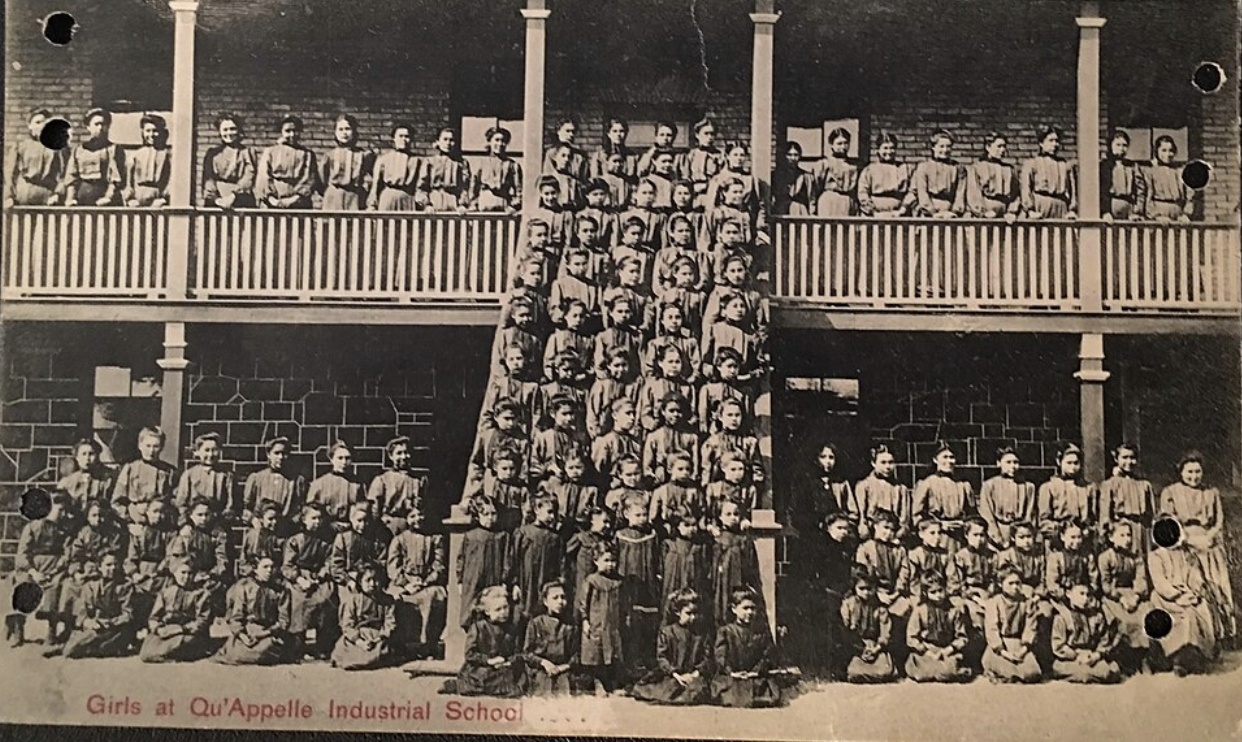
Historic postcard showing children at Qu’Appelle Indian Residential School in Saskatchewan. OneCanadiansJourney. CC BY-SA 4.0.
For over a century, Canada’s residential school system forcibly removed Indigenous children from their communities to attend schools far from home in an effort that contributed to a cultural genocide. These institutions, many operated by Christian churches and backed by government policy, punished the use of Indigenous languages, severed familial ties and left intergenerational scars. The final school closed as recently as 1996, but its effects on culture, identity and language continue to ripple through indigenous communities today.

Gregory Scofield at the Eden Mills Writers’ Festival in 2017. Dan Harasymchuk. CC BY-SA 4.0.
In response, a literary movement is growing among Indigenous writers determined to reclaim their ancestral tongues. Gregory Scofield, a Métis poet and professor at the University of Victoria, has spent his career weaving Cree into English-language verse. For Scofield, language is inseparable from identity. Raised in Manitoba, Saskatchewan and the Yukon, Scofield’s work intricately combines English and Cree. This combination serves both personal expression and public testimony.
In his poem “I’ll Teach You Cree,” Scofield writes:
with the tip of my spring tongue, ayîki frog
your mouth will be the web
catching apihkêsis words, spider
a crawling-out ceremony
that cannot be translated.
These lines center Cree as a living, intimate force where language is a ceremony and cultural recovery. Teaching and speaking Cree becomes an act of resistance, breathing life back into something long suppressed.
Lindsay Nixon, a Cree-Métis-Saulteaux writer and editor, echoes this sentiment in their memoir and critical essays. Nixon writes from lived experience, integrating language, family history and queerness into a multifaceted storytelling practice. In an interview with This Magazine, they explained, “We can’t be so reductive as thinkers and makers that we don’t recognize generational distinctions.” For Nixon, reclaiming language is not only about personal identity but also about challenging the colonial power structures that once deemed those languages unworthy.
Nixon’s writing moves between forms and genres, drawing on personal memory and community experience. As a queer Indigenous writer, they don’t try to fit into neat categories. Instead, Nixon embraces mix and mess: jumping between languages, splicing Cree into English and breaking structure when it feels too confining. Often, they include Cree words without translating them, not as a barrier, but as an invitation to readers who share that heritage, and a reminder to others that not everything is meant to be easily consumed.
Today, Indigenous authors like Scofield and Nixon are part of a broader resurgence. Schools, publishers and grassroots initiatives across Canada are reviving languages like Cree, Inuktitut and Anishinaabemowin in literature and everyday life. Programs like Children’s Ground produce bilingual children’s books and community-based curricula to reconnect younger generations with the languages once forbidden to their ancestors.
The work of Nixon and Scofield reminds us that revitalizing language is more than preservation but rather a refusal to be erased. Their voices carry forward stories once silenced, offering a future in which Indigenous language is not just remembered but lived.
GET INVOLVED:
Support Indigenous language revitalization by engaging with organizations dedicated to this cause. Your participation can make a meaningful difference.
National Centre for Truth and Reconciliation: Preserves the history of residential schools by providing public education, events and archives to support truth-telling and healing.
ImagineNATIVE’s Storyteller Programming: Supports Indigenous writers and media creators through mentorships, festivals and funding for new projects.
Children’s Ground: Works with Indigenous communities to deliver child-centered, bilingual education that includes different languages, knowledge systems and cultural practices.
Kennedy Kiser
Kennedy is an English and Comparative Literature major at UNC Chapel Hill. She’s interested in storytelling, digital media, and narrative design. Outside of class, she writes fiction and explores visual culture through film and games. She hopes to pursue a PhD and eventually teach literature!