
Alex Jung
Ecotourism policies in Bhutan promote sustainable travel and protect the beauty of its diverse landscapes and natural environment.
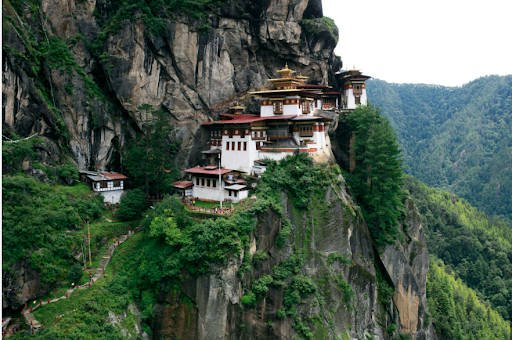
Bhutan Mountains. Han Minh Chu. CC BY 2.0.
Bhutan, a small landlocked nation nestled in the Eastern Himalayas, is known for its beautiful landscapes, including mountain peaks and valleys, and its local Buddhist culture. Bhutan is currently the only independent nation officially recognised as a Buddhist kingdom. The country is less explored by travelers each year; in 2023, there were only 103,000 travelers to the nation. This is significantly less than its bordering nations, India and China, as well as Nepal, which has over 1 million travelers each year. However, as tourism only makes up 5% of Bhutan's GDP, the nation has a unique approach to developing its tourism industry: “high-value, low-impact.”
High-value, low-impact is an approach to attract only a small number of travelers who will spend more money but also have very minimal effects on the environment and local culture. Bhutan has also put into place various environmental policies and taxes for travelers to minimise the impacts of environmental degradation caused by tourism. Abdoulaye Seck, the Country Director for Bhutan in the World Bank, claims, "Bhutan has proved to the world that economic growth is possible without hampering the environment."
Bhutan's high-value, low-impact model is not desirable for travelers interested in budget tourism; this is reflected in the accommodation options and availability, which are intended to regulate the number of visitors. Bhutan has very few backpacker hostels, which are commonly found in many other South Asian and Southeast Asian countries. Instead, there are many boutique hotels and eco-lodges designed to align with Bhutan's sustainable development goals. For example, Six Senses Bhutan is a luxury resort and hotel franchise with five locations in Bhutan's capital, Thimphu. This hotel has a strong emphasis on sustainability. For example, all food products are sourced by local farmers from organic gardens. Furthermore, the resort accepts guest donations that support monks of the Chorten Nyingpo monastery in Punakha. Some of the projects included building a classroom and renovating dining areas for the monks. Travelers can stay at the Six Senses for $1450 per night. Though there are few budget hotels in Bhutan, smaller boutique hotels can range from $50 to $200 per night. A family of four should expect to budget around $300 per day for a mid-range travel experience, including the sustainable development fee, accommodation and activities. This contrasts greatly with neighboring countries, such as Nepal, where travelers can expect to budget $100 per day, or India, where travelers can budget around $50 per day.
Travelers to Bhutan must be made aware of the Sustainable Development Fee (SDF). Following the post-COVID reopening of Bhutan's borders, travelers have to pay an SDF of $100 per person per night in the country. If there are young children aged between 6 and 12, the SDF is $50 per person per night, and the SDF does not apply to those under the age of 5. The SDF for the duration of stay can be paid for when applying for a travel visa or on arrival at any port of entry. The funds raised from this SDF are used to enhance sustainability in Bhutan, as well as support the health and education sectors to promote free healthcare and education.
Bhutan is the first and one of only three carbon-negative countries in the world. This means that the nation absorbs more carbon dioxide than it emits. This is largely due to the country’s various environmental policies and conservation programs. More than 70% of Bhutan is forest. Significantly, the Bhutanese constitution includes a clause that ensures the percentage of forest in the nation can never be below 60%. One of Bhutan's largest exports is hydroelectricity. Domestically, 99% of the country's energy source is hydroelectric, making it a nation with one of the highest rates of renewable energy use in the world. Travelers should also be aware that all forms of single-use plastic have been banned and are subject to fines. Though the nation has a large variety of meat-based foods, due to the large Buddhist population, its cuisine is very accommodating for vegetarian and vegan diets, making it a desirable place for travelers with all forms of dietary requirements.
Overall, Bhutan's tourism industry has a strong emphasis on sustainability and ecotourism. Travelers into the country should also be mindful and aware of the nation's conservation efforts and have a deep appreciation for the nature that Bhutan has to offer.
Alex Jung
Alex is from New Zealand and South Korea, and is currently a student at the University of Chicago. He is majoring in Political Science and International Relations, and minoring in Middle Eastern Studies. He is passionate about social justice for minorities and indigenous communities. In his free time, he enjoys learning languages (Korean, English, Mandarin, and Persian) and writing novels and short stories.