
Cristina Slattery
Get to know the Dutch island with a unique culture, artistic heritage and a restorative atmosphere.
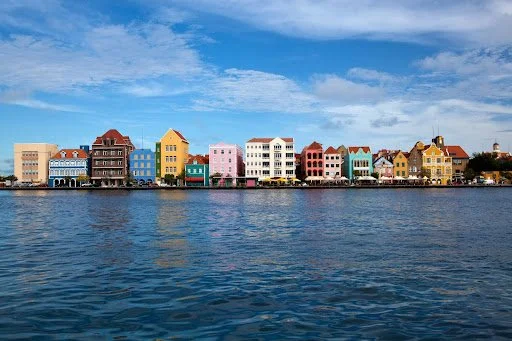
Willemstad’s waterfront. Courtesy of Diamond PR.
Turquoise, cobalt and royal blue all merge in the waters of the Caribbean Sea surrounding the island of Curacao, a constituent country of the Kingdom of the Netherlands. On land, I hear phrases in Papiamento spoken amid Dutch and English, the language surprising me with its presence and how similar it sounds to Spanish. Even Latin rhythms can be heard in the evenings in Willemstad, Curacao’s capital. Here, in the Pietermaai District, I listen to a singer belt out the lyrics to popular favorites as a multi-ethnic crowd, made up mainly of pairs of dancers twirling and tapping their feet to salsa rhythms, glistens in the reddish light of a pulsing room. Curacao is certainly colorful.
Shades of pastels and vibrant primary colors can be spotted on building exteriors throughout Willemstad, with murals by local artists covering walls in alleyways and elsewhere throughout the city’s four districts. But the island’s history is not entirely vibrant. Curacao was discovered in 1499 by Alonso de Ojeda of Spain and later conquered by the Dutch in the early 1600s. From the 16th century through the mid-19th century, it was a hub for the Transatlantic slave trade. The Dutch West India Company was responsible for this transformation, transporting individuals from the West Coast of Africa to Curacao and igniting the island’s economic prosperity. Though this is an unfortunate legacy shared with many other nations, acknowledging the past allows the country to document its history and work toward reshaping its modern identity.
Today, more than 150,000 people inhabit the island, which is approximately 40 miles long and varies in width from two to eight miles. What really immerses me in the island’s spirit are conversations with locals. “Dushi,” a Papiamento phrase, means both “sweetheart” and “delicious”; it’s bandied about in almost every conversation by the friendly and approachable island residents. I enjoy getting to know their favorite spots, such as a dive bar in Willemstad called Netto Bar, a place where green rum is the specialty and the King and Queen of the Netherlands have even frequented, and the hilly northern coast, where mountain bikers and hikers love to connect to nature, fitting for the many travelers who I know come to Curacao for the sea and sun. What I’m not expecting, though, is how rich the cultural life on Curacao is, the unique blend of cultures influencing everything from communication to art, and especially the food. The culinary results of this mixing of traditions are savory dishes like keshi yena, a baked or steamed ball of cheese stuffed with meat, vegetables, raisins and olives, as well as substantial stews (stoba) that include goat, beef or fish and are served with rice. One of my favorite finds on Curacao is an innovative concept called Vittle Art. The owners and chefs who run the restaurant showcase Curacao’s unique ingredients in “storytelling dinners,” after which travelers will come away understanding the flavors and components that make the local cuisine unique. The Dutch, Spanish and Indigenous heritage of those who lived on Curacao for centuries coalesce in many of the island’s signature dishes. Some of them were also created by enslaved peoples, another notable element of the island’s intriguing heritage.
At the Kas di Pal’i Maishi, a UNESCO-recognized community museum, a guide named Nadira moves along a plot of land, where a cactus fence frames a white house with a thatched roof. She gyrates her hips as she walks with a bucket on her head, demonstrating how her ancestors carried water to the fascinated tourists who watch her intently. Afterward, she sings songs from bygone times in a clear and melodic voice, then describes to us how they were passed down through generations from the times when slavery dominated the island.
Although the past is ever-present on Curacao, those who live there, another guide explains, are definitely not obsessed with their origins. In Papiamento, a person doesn’t just “come from” the island; one is a “child of Curacao,” emphasizing that anyone who is born on the island belongs to it. Most people currently living there have deep-rooted ties to the land. They often share heritage with those who were enslaved persons, with the Indigenous who originally inhabited the island and even with white enslavers. Still, the focus is on today—on the beauty of the place they inhabit and its charms, not on dissecting their DNA or exploring their regions of origin.
Many Jewish settlers arrived on the island centuries ago after the Spanish Inquisition forced them to flee to the Netherlands from Spain. When the Netherlands offered these refugees the opportunity to settle on Curacao, many did. In fact, the synagogue in downtown Willemstad, Mikve Israel-Emanuel, was consecrated in 1732, making it the oldest continuously functioning synagogue in the Americas.
Just a few miles away from the synagogue is the Landhuis Bloemhof, home to May Henriquez, a prominent 20th-century artist who came from a Jewish family. It can be visited by travelers who would like to discover more about “landhuis,” or former water plantations. Here, guests will learn about Henriquez’s art as well as be able to see the artwork of contemporary creators. I am even able to meet one of Henriquez’s daughters, who carries her mother’s legacy by curating the art displayed and keeping the culture accessible to the public. The Landhuis Bloemhof is also where the artist Herman van Bergen erected his famous artwork, the Cathedral of Thorns. He designed and built this structure, still unfinished, in 2020, and the works of other artists are nestled within its maze of 92 million thorns. Van Bergen tells me that “we are guests on earth,” noting how he left the top section of the structure open because the “universe” is our true roof.
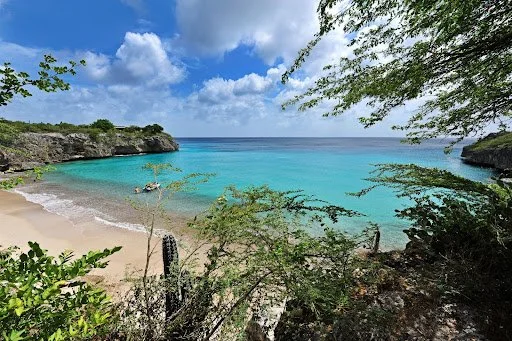
Curacao has 34 beaches, of which about 20 are easily accessible. Ways to visit the offshore underwater world include snorkeling, scuba diving and machines called seabobs. Seabobs can be rented for short periods of time, enabling individuals to speed through the water and get up close and personal with turtles, various types of fish, corals and other creatures that inhabit the warm waters. Although I am happy to relax on the beach when the opportunity to rent a seabob is presented to me, I enjoy hearing about others’ experiences. Those I speak with who take the opportunity to try them report back that they loved the adventures they facilitated.
Scuba diving in Curacao. Courtesy of Diamond PR.
Curacao’s waters are also curative, according to residents. In the past, enslaved people being brought to the island were thrown overboard from ships near Curacao upon getting sick, and it was said that those who had thrown them into the sea later were surprised to see these same people walking around Willemstad, looking stronger and healthier than before. This legacy of healing and spirituality still lingers in the present day. It’s possible to book an aromatherapy session or even a reading with oracle cards on the beach, such as through the establishment Universal Alchemist, whose owner, Elly Sambo, offers her thoughtful services.
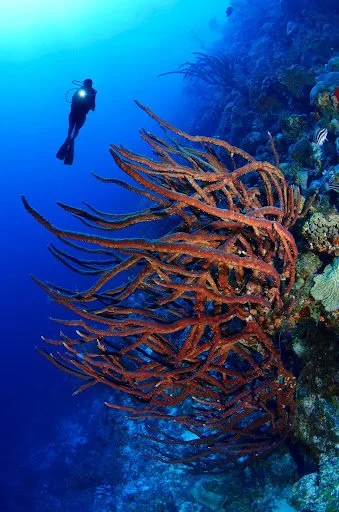
Scuba diving in Curacao. Courtesy of Diamond PR.
The rhythm and relaxed lifestyle on Curacao, from the elements of the sea to the hues of nature in the interior island, should both calm and nourish those who choose to spend time here. An oasis of tranquility in some areas and a hub of activity in others, Curacao has a vibe that appeals to those who will appreciate its historical legacy, welcoming population, creative spirit and natural beauty. It’s just … “dushi!”
Cristina Slattery
Cristina Slattery is a New York–based writer whose work has appeared in The New York Times, The Wall Street Journal, AFAR, Travel + Leisure, and other national and international publications. A former expat in Barcelona and longtime educator, she brings a globally minded, observant lens to both her nonfiction and creative work.