
Zoe Lodge
Wealthier, high-emitting countries have attempted to push climate responsibility onto developing nations in the Global South.
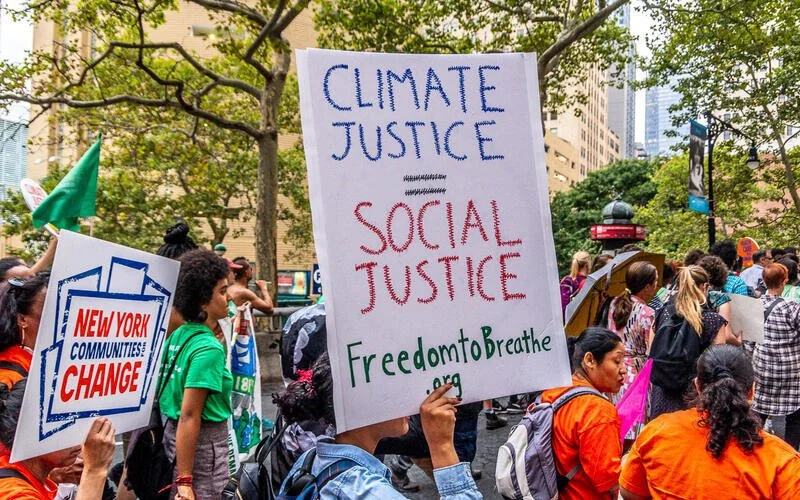
Protestors fight climate racism in the United States. Fred Murphy. CC BY-ND-NC 1.0.
As global temperatures continue to rise and the climate crisis worsens, it is becoming increasingly impossible to ignore that the countries most responsible for global emissions are often the least affected by their consequences. While wealthy nations, namely the Global North, present themselves as pioneers of green innovation and environmental responsibility, much of the actual burden of pollution, extraction and ecological degradation is continually shifted onto poorer regions, more broadly known as the Global South. For the most part, the Global North refers to countries in North America and Europe, whereas the Global South refers to countries in Africa, Latin America and most of Asia. Between a Global North that constantly consumes and a Global South that faces the repercussions, this growing imbalance has become one of the clearest injustices of the climate crisis era.
A prominent example lies in the rise of European carbon offset programs. These schemes allow corporations and governments to “neutralize” their emissions by funding environmental projects outside of their country, most commonly in Africa and Latin America. On paper, it sounds like a win-win. But in practice, many offset initiatives displace communities, restrict access to ancestral lands and prioritize European carbon accounting over local livelihoods. Projects in Kenya, Malaysia and the Amazon region have been found to have devastating local impacts, primarily on Indigenous populations, who have reported being forcibly removed from ancestral lands to make way for these programs. Despite being marketed as sustainable development, the projects often replicate colonial land dynamics, with the Global North dictating how land in the Global South should be used, while locals reap no benefits.
This pattern extends beyond carbon markets. Resource extraction has intensified in the world’s poorest regions, particularly for minerals essential to renewable energy technology. Cobalt mines in the Democratic Republic of the Congo fuel electric vehicle batteries in Europe and the United States, yet Congolese miners endure dangerous conditions, low wages and severe environmental contamination. The same self-proclaimed progressive nations that promote “clean energy” rarely acknowledge that its green foundations remain soiled by the exploited labor and landscapes in the Global South.
Wealthy nations have historically emitted far more carbon than the rest of the world, yet many refuse to meaningfully contribute to climate efforts that would help vulnerable nations adapt. Pledges made at global climate summits often fall short or go unfulfilled. Meanwhile, regions worldwide, though concentrated in the Global South, are already confronting rising sea levels, droughts and crop failures. Countries in the Global South are among the most vulnerable to the damages of climate change, yet they are left grasping for straws when trying to protect themselves and the planet.
GET INVOLVED:
Environmental justice movements across the Global South are demanding accountability and calling for models rooted in land rights, community governance and localized sustainability. There are several organizations focused on closing the North-South gap that individuals can support or seek involvement with. The Climate Justice Alliance is based in the United States and prioritizes regenerative projects that benefit all groups involved. 350 is an international climate advocacy organization that fights the fossil fuel industry and promotes renewable energy worldwide. The Basel Action Network prioritizes fighting toxic waste exports and “waste trades” to poorer countries.

Zoe Lodge
Zoe is a student at the University of California, Berkeley, where she is studying English and Politics, Philosophy, & Law. She combines her passion for writing with her love for travel, interest in combating climate change, and concern for social justice issues.