
Ashley McDermott
The Great Lakes are clearer now than ever before, but this clarity comes with a cost to local ecosystems.
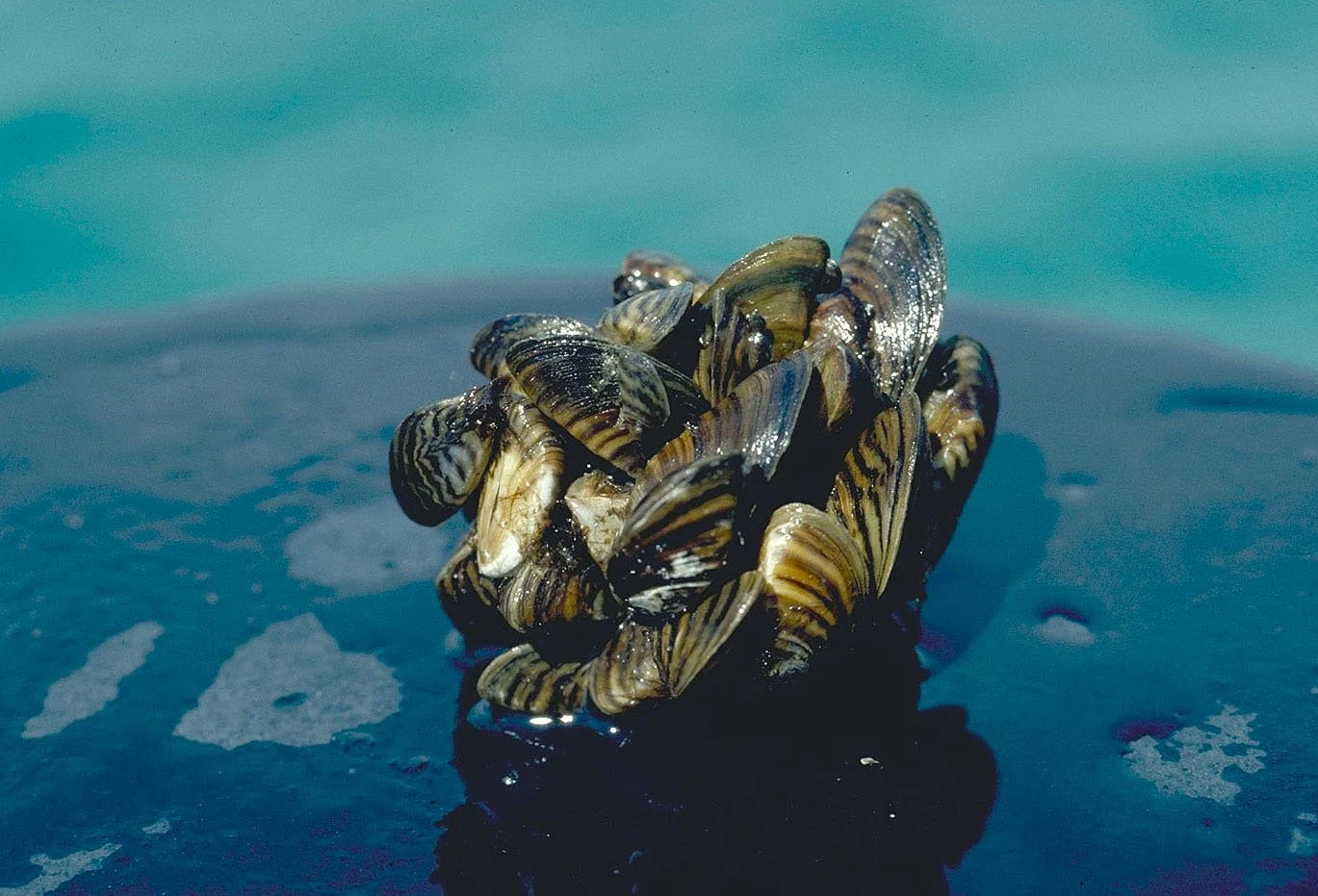
Zebra mussels cluster. D. Jude. CC BY-SA 2.0.
In the last three decades, the waters of the Great Lakes have become three times clearer. While the clarity has made the lake water stunningly blue, its cause, the invasive quagga mussel, is disrupting the marine ecosystem in unprecedented ways.
Mussels eat by filtering water and microorganisms through an inhalant aperture, also called a siphon. "There's quadrillions of quagga mussels in the Great Lakes. In a week's time, every gallon of water in Lake Michigan could have passed through a mussel," states Dr. Ashley Elgin, a research ecologist from the NOAA Great Lakes Environmental Research Laboratory. Quagga mussels breed very quickly; of the biomass on all but one of the Great Lakes’ lakebed now consists of invasive mussels. The quadrillions of mussels have filtered away the microorganisms that are essential to the survival of native aquatic life. A side effect of this is the increase in water clarity.
Quagga, and closely related zebra mussels, are invasive species that originated in Eastern Europe, specifically the Dnieper River drainage basin and the Black and Caspian Seas. They are named for a distinctive striping on their shells, and they grow to be the size of a fingernail. It is believed that discharged ballast water from transoceanic ships has led to their spread worldwide. The mussels are considered invasive over a large geographic range, including Great Britain, the Netherlands, Sweden, Italy, California and the Great Lakes. They were first found in the Great Lakes in 1989.
The dearth of microorganisms is leading to the collapse of whitefish populations. Whitefish, a staple food of Great Lakes communities, has declined by up to 80% since the 1990s. Researchers believe that the loss of lake whitefish is due to a combination of factors caused by climate change and the quagga. As the Great Lakes region experiences warmer weather late into fall, the whitefish spawning season has shifted. Tribal biologists from The Little Traverse Bay Bands of Odawa Indians report that increases in UV light late in the season are causing whitefish hatchlings to emerge almost one month earlier than in previous years. After hatching, there are not enough microorganisms for the whitefish to eat.
The water clarity leads to increased predation. The round goby, another invasive species, is able to easily catch larval lake whitefish. Double-crested cormorants, a water bird that hunts by sight, can now hunt fish more than 40 feet below the water's surface, almost double their usual height. The large populations of walleye and other carnivorous fish are also consuming the juvenile whitefish.
Scientists are pursuing several avenues to stop the spread of the mussels. One experimental method undertaken by Dr. Harvey Bootsma from the University of Wisconsin-Milwaukee is to drag a tarp over the lakebed in an attempt to scrape off the quagga. Other scientists are beginning to breed whitefish and release them into the lakes when they are adults and thus less susceptible to predation. Some scientists are even trying to engineer a contagious blood cancer to control quagga populations.
Lawmakers are also taking steps to stop the mussels' spread, introducing bipartisan legislation in November 2025 that would allocate $500 million for mussel control and research. The hope is that with additional funds and collaboration between government agencies and tribal nations, they can replicate the success of previous efforts to control invasive aquatic species.

Ashley McDermott
Ashley is a PhD candidate in Linguistic Anthropology at the University of Michigan. She is committed to making her research useful for the communities she works with. Her work explores how families navigate language use and language shift in Bishkek, Kyrgyzstan. When she’s not working on her research, you’ll find her adventuring with her toddler daughter, whose commentary keeps every day interesting.