
Ashley McDermott
After 54 years alight, the Darvasa gas crater in Turkmenistan finally shows signs of slowing, and visitors report signs of arachnid life at the crater's edge.
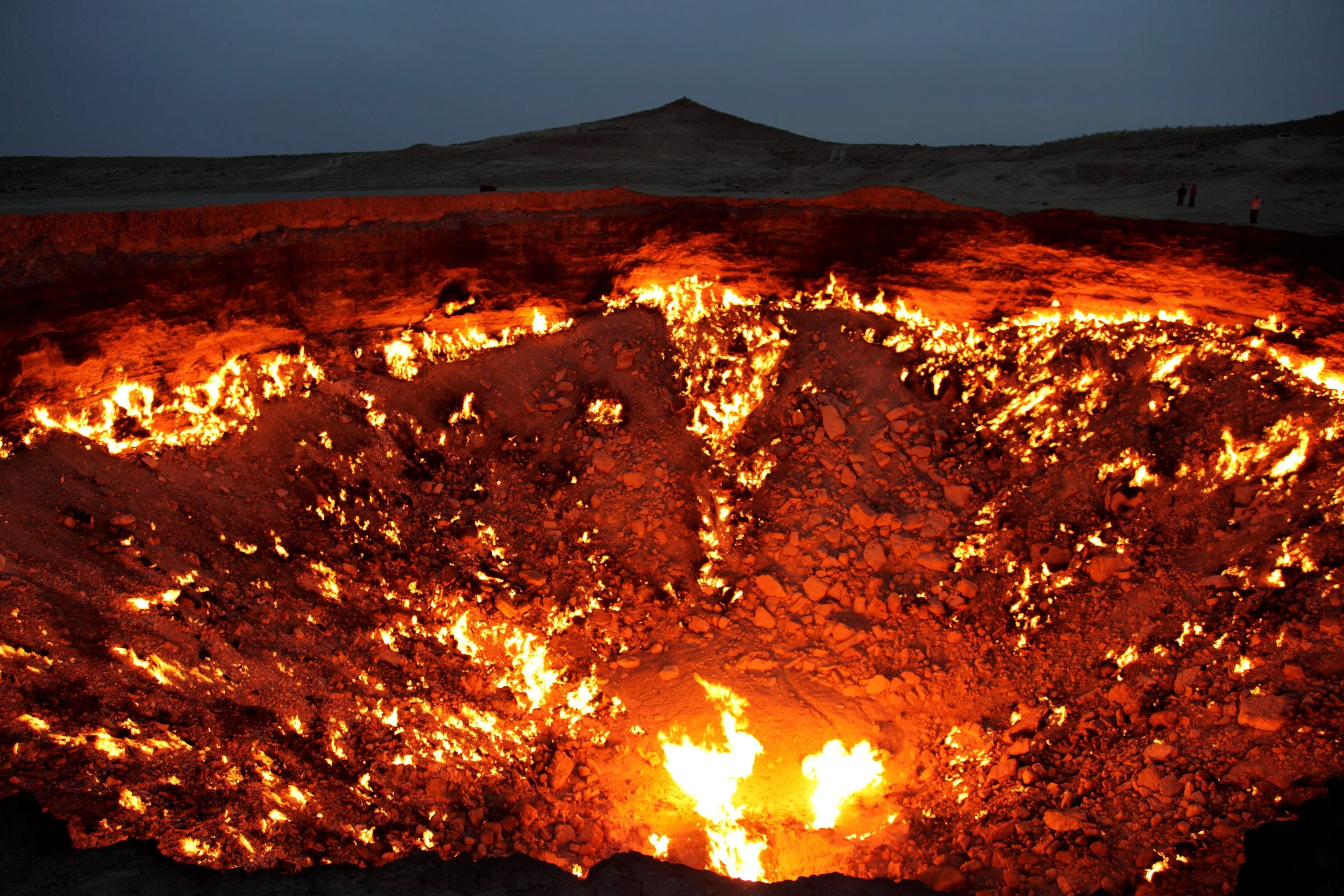
Darvaza gas crater. flydime. CC BY-SA 2.0.
In the Karakum Desert of Turkmenistan, 160 miles north of the capital Ashgabat, lies the "Door to Hell," a gas crater that has been burning continuously since 1971. The Darvaza gas crater, as it is officially known, is the remnant of a natural gas mining operation, now a burning sinkhole approximately 230 feet wide and 100 feet deep. With the air inside warmed by the burning gas, the pit’s temperature can reach 1,800 degrees Fahrenheit. The hundreds of fires lining the pit have illuminated the desert for more than 50 years, but scientists say it is finally showing signs of slowing. The receding flames offer an opportunity to examine the crater more thoroughly, and some report surprising signs of life amid the heat and sulphurous fumes: traces of spiders.
Though there is no official recorded cause for the fire, the accepted story is that Soviet geologists accidentally collapsed a natural gas chamber while drilling. They lit the chamber to control the spread of poisonous methane gas, expecting the flames to die out quickly. But instead, it's been burning for decades. Lighting gas is a common practice in natural gas extraction, used when excess accumulation has the potential to cause uncontrolled and unpredictable explosions.
"It's hard to get the story straight as to exactly what happened," states explorer George Kourounis, who led a 2013 expedition to Darvaza for National Geographic. While the 1971 explanation is most prevalent in online sources, Kourounis reports that Turkmen geologists suspect that the crater was actually created in the late 1960s and wasn't lit until the 1980s. The ignition was likely kept secret due to pressure from the central government to only report successes and the top-secret nature of natural resource reserves during the Soviet era.
Finally, as of 2025, the fires seem to be slowing. "The reduction [in fires] is nearly threefold," says Irina Luryeva, director of the gas company Turkmengaz. While the flames were once visible for miles, now they are only apparent at the crater's rim.
As the fires die down, visitors have started reporting sightings of camel spiders living on the edge of the crater. Camel spiders are a separate arachnid order from spiders and scorpions, but they bear a resemblance to both. Growing to approximately 6 inches long, they have eight legs like spiders, but they also have chelicerae, or fangs, that resemble a scorpion. Anecdotes regarding camel spiders suggest that they sometimes venture too close to the crater and fall in. While scientists have yet to verify these accounts, spiders are known to be relatively heat-tolerant. It may be that they are using the crater's light and heat as a natural lure for insects. Whatever the case, the activity is an enticing change. Scientists are warranted to increase their attention on the Door to Hell, and the opportunity for research is more available than ever.
Ashley McDermott
Ashley is a PhD candidate in Linguistic Anthropology at the University of Michigan. She is committed to making her research useful for the communities she works with. Her work explores how families navigate language use and language shift in Bishkek, Kyrgyzstan. When she’s not working on her research, you’ll find her adventuring with her toddler daughter, whose commentary keeps every day interesting.