
Paige Geiser
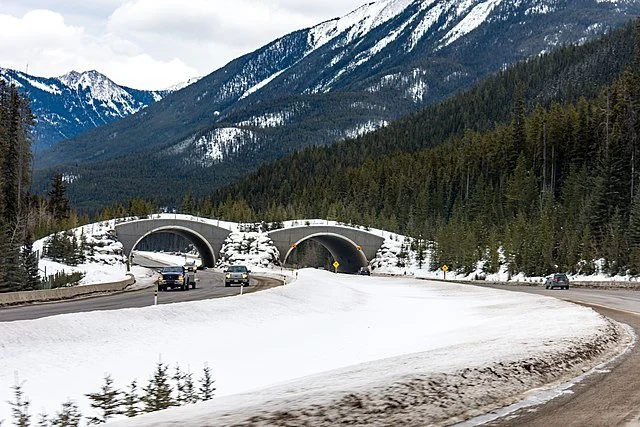
Animal crossing overpass in Banff National Park, Canada. CC BY-SA 2.0.
Western Canada is known for its many natural beauties, such as the Banff and Yoho National Parks. However, as the population of humans continues to grow, so does the infrastructure that supports them. Specifically, as high-speed collisions persistently threaten to kill wildlife and endanger travelers, the Canadian government has found a solution to protect its native animals: crossing structures.
In response to the rising number of visitors to the Banff and Yoho National Parks, the Canadian government decided to expand the surrounding highway from two lanes to four. While this $400 million upgrade helped reduce congestion on the roads, many wildlife researchers feared what this expansion would do to the local animals. Because of this apprehension, a quarter of the budget for this new Trans-Canada Highway went to projects that would reduce wildlife collisions. The first two crossing structures were built in Banff in 1996 at the cost of $1.5 million each. Today, across over 55 miles of highway, there are 48 crossing structures in these national parks. This includes 41 underpasses, seven overpasses and accompanying highway fencing throughout to keep wildlife off the road.
Wildlife crossings are overpasses and underpasses used solely for the travel of animals. Similar to overpasses for motor vehicles, overhead animal crossings are man-made bridges used to help animals travel safely across the highway. After the bridge is built, dirt, grass, trees and other native plants are placed on the crossing, making the overpass more inviting to local animals as it blends in with its surroundings. These overpasses are built wide and short in length, as researchers have noticed that grizzly bears, elk, wolves and moose prefer crossings of that size. In contrast, black bears and cougars prefer underpasses that tunnel beneath the highway because of their long and narrow nature.
The placement of these wildlife crossings is determined using radio telemetry monitoring, animal tracks in the snow, wildlife observations and roadkill hot spots. Using mapping software, researchers are able to track wildlife movement and predict travel routes of animals, specifically that of the five primary focus species: the black and grizzly bears, elk, moose and wolves. After looking at habitat data and topography, researchers choose the placement of an animal crossing.
Not only do roads put wildlife at risk through vehicle collisions, but they also fragment habitats and cut off important migration routes. According to Canada’s National Park website, animal crossings and highway fencing have helped decrease animal-vehicle collisions by 80%. Furthermore, deer and elk motor deaths have dropped by an astounding 96%. These crossings don’t just prevent accidents, but they also help make sure species aren’t genetically isolated from one another. Grizzly bears, for example, are now crossing roads often enough to mingle with other grizzlies on the other side.
Currently, a research team at Banff is testing a new way of keeping animals off the road using electro-mats. These electro-mats will provide a mild sting to the paw or hoof of the animal when touched. The shock is designed not to hurt the animal, but to steer it away from the danger of the highway. With breaks in highway fencing, this deterrent is another way to keep both animals and humans safe.
With Banff having the world’s longest year-round animal monitoring program and largest data set on wildlife mitigation, Canada is at the forefront of this newfound road ecology mission. Other countries, including the United States, Argentina and China, have sent researchers to visit these Canadian crossings in hopes of implementing them for their own projects.
In Australia, scientists have created their own versions of animal crossings, known as fauna crossings. These include rope bridges, koala crossings, glider poles and tunnels, each of which is designed to help a wide range of species navigate busy roads safely. In China, 33 overpasses and underpasses have been built along the Qinghai-Tibet Railway to support migrating antelopes. Following that lead, Mongolia recently approved new policy standards requiring developers to provide safe passage for wild animals along roads and railways in the eastern steppe and Gobi Desert.
Banff’s success in transportation ecology has, quite literally, paved the way for how to protect wildlife within rapid infrastructure growth. Canada’s continued wildlife research has made it a world leader in road ecology. With many other countries following Canada’s blueprints, the world could be looking at a more wildlife-friendly place.
GET INVOLVED:
While wildlife crossing structures are typically government initiatives, supporting national parks can be a great way to get involved in the wildlife community. Donations to Canada’s continued road ecology research or Australia’s mission to protect animals can help the fight towards keeping wildlife safe. Other organizations, such as The Nature Conservancy, work with scientists and local communities in 80 different countries to influence legislation and protect biodiversity.

Paige Geiser
Paige is currently pursuing a bachelor’s degree in English with a minor in Criminal Justice at the University of Wisconsin-La Crosse. She grew up in West Bloomfield, MI, and has been fortunate enough to travel all throughout the country. She is an active member of the university’s volleyball team and works as the sports reporter for The Racquet Press, UWL’s campus newspaper. Paige is dedicated to using her writing skills to amplify the voices of underrepresented individuals and aspires to foster connections with people globally.