
Ashley McDermott
Some reports warn that we may be the last generation to see fireflies, but what do we really know about their decline?
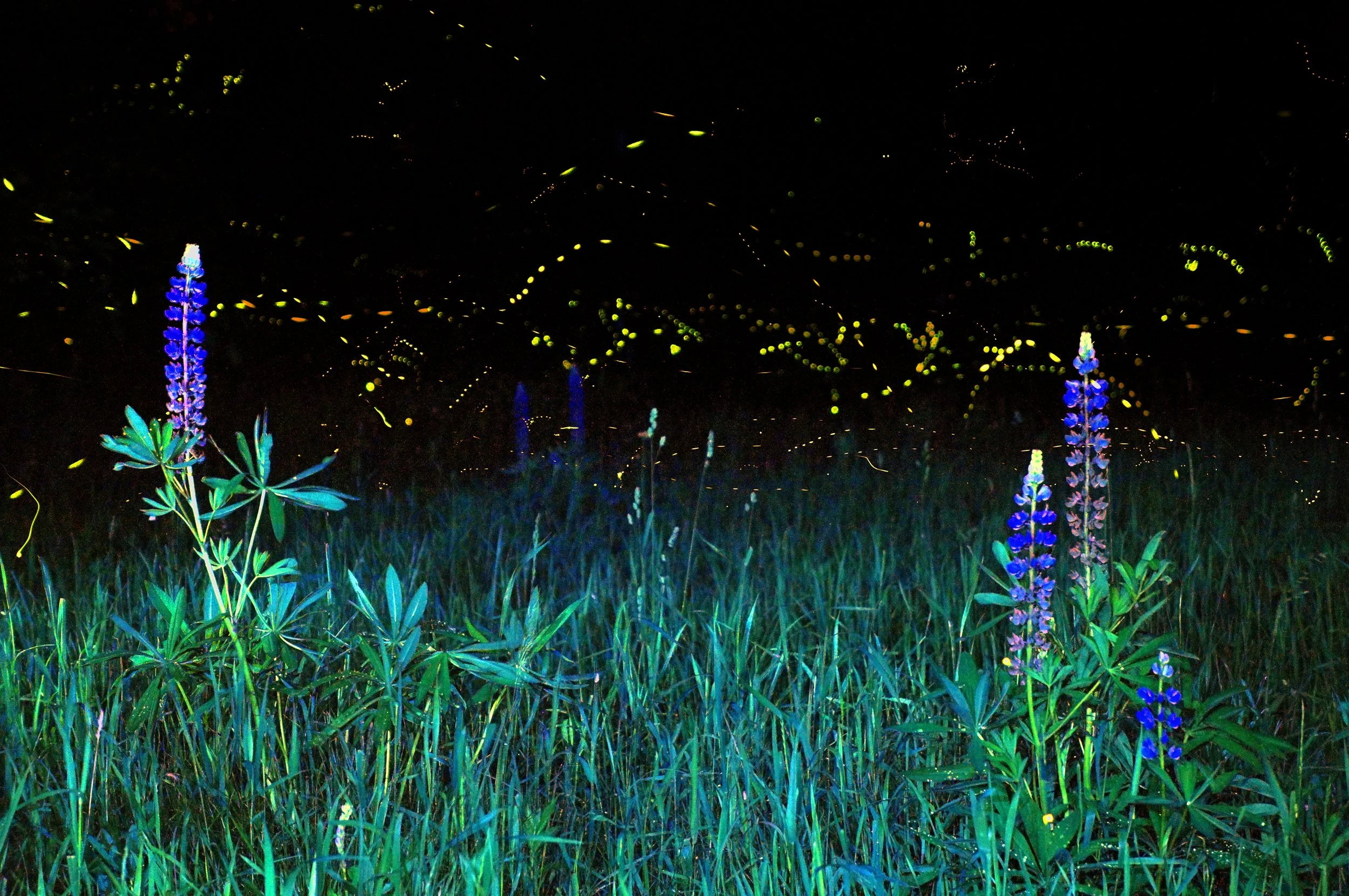
Fireflies and lupines. Mike Lewinski. CC BY 2.0
There are more than 2,600 species of fireflies found across every continent except Antarctica. Despite their broad range and diversity, many people report seeing far fewer fireflies today than they remember from their childhoods. Scientists say this perception is likely based on fact, though the reality is complex. "I don’t think it’s the last generation that will see fireflies, but we definitely need to start taking action now to ensure that doesn’t happen," says Candace Fallon, a conservation biologist who leads the firefly conservation program at the Xerces Society, a non-profit focused on protecting and conserving invertebrates
Out of the thousands of known firefly species, scientists have assessed the conservation status of only about 150. Of those, around 20% are considered threatened with extinction. This suggests that fireflies are declining, but the lack of information about the majority of species makes it difficult to know how serious the situation is. For most fireflies, basic facts like their diet, habitat and typical behavior remain unknown, and new species are still being discovered. These knowledge gaps make it challenging to design effective conservation strategies.
Another difficulty is that there are relatively few long-term studies of firefly populations. Firefly monitoring in North and South America only began recently, while Southeast Asia and Europe have slightly longer data sets. Scientists are uncertain when the declines started or just how steep they have been.
The potential loss of fireflies is concerning due to the important role they play in ecosystems. As both predators and prey, fireflies help stabilize local food webs. Their sensitivity to environmental changes, such as light pollution and water degradation, also makes them valuable bioindicators, providing clues about the overall health of their habitats. In the scientific world, the enzyme luciferase, found in fireflies, has become crucial for medical research.
Researchers point to several reasons for firefly declines. Light pollution interferes with how fireflies find mates, habitat loss reduces places for them to live and breed and pesticide use can kill both adults and larvae. Another threat comes from tourism; when people flock to see fireflies, they can trample leaf litter, compact soil and disturb habitats, especially if new infrastructure is built for visitors or bright lighting is installed.
Despite these challenges, individuals can take some practical steps to help address the population concern. Turning off outside lights at night, planting native species, avoiding pesticide use and leaving dead wood, long grass and leaf litter in your yard can support fireflies. When visiting popular firefly sites, be careful not to venture off trails or disturb habitats. Recent research shows that even red outdoor lights, once thought to be safe, can still disrupt fireflies, so using as little artificial light as possible is best. With more research and simple changes to how we care for our landscapes, it’s possible to give these insects a better chance at a future.

Ashley McDermott
Ashley is a PhD candidate in Linguistic Anthropology at the University of Michigan. She is committed to making her research useful for the communities she works with. Her work explores how families navigate language use and language shift in Bishkek, Kyrgyzstan. When she’s not working on her research, you’ll find her adventuring with her toddler daughter, whose commentary keeps every day interesting.