
Ashley McDermott
Wolves in coastal Alaska are turning sea otters as a source of food, dying of mercury poisoning as a result.
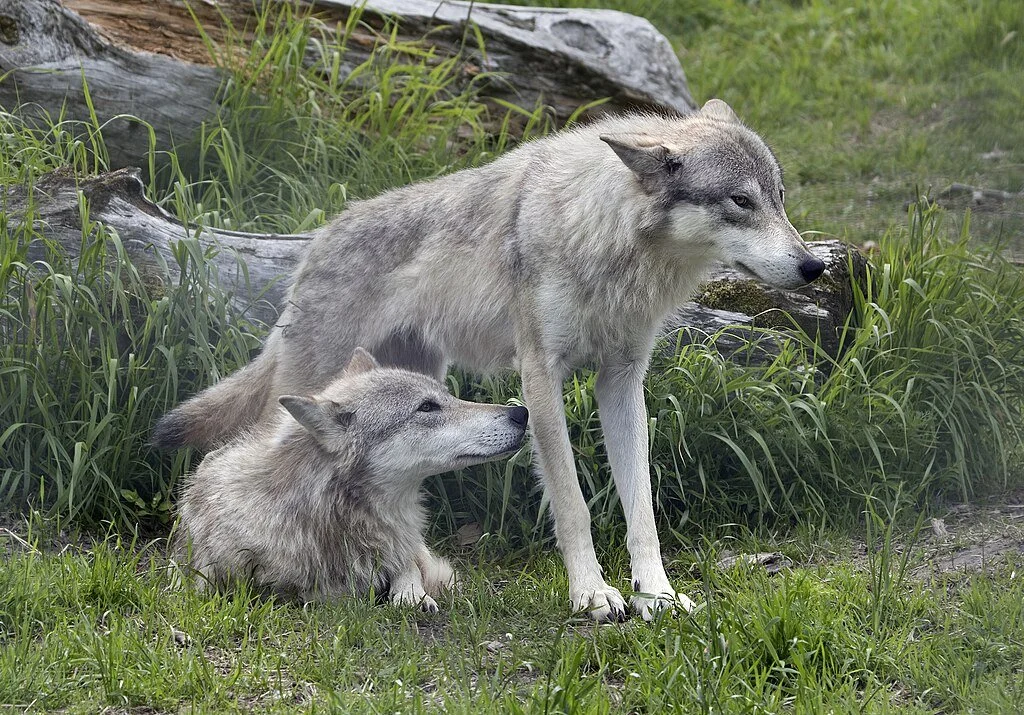
Alaskan wolves. C Watts. CC BY 2.0.
The death of a coastal wolf on Pleasant Island in southeast Alaska sparked a scientific investigation that uncovered an alarming discovery: Coastal wolves have mercury concentrations 278 times higher than inland wolves, and they could be dying as a result. Though coastal wolves are adapted to consuming some marine life, such as salmon, waterfowl and invertebrates, the higher concentration of mercury is caused by the consumption of sea otters. Sea otters are apex predators, and they contain much higher concentrations of mercury due to their high position in marine food webs. Now scientists are investigating the causes of the wolves' dietary shift and the implications of this for species recovery and the rewilding of human-altered ecosystems.
Wolves did not populate Pleasant Island until 2013, when one pack swam there for over a mile from mainland Alaska. While at that time the island had a robust population of Sitka black-tailed deer, recent counts have not shown any signs of deer. Based on evidence from wolf scat, biologists believe the growing wolf population consumed them. In 2015, the wolf scat contained 98% deer DNA, but this number was 0% by 2018. In similar circumstances, such as on nearby Coronation Island, the decimation of deer led the wolves to cannibalism and eventually the collapse of the entire pack. On Pleasant Island, researchers were surprised to find wolves still thriving years later despite the loss of deer. Another analysis of wolf scat revealed they had turned to sea otters instead.
Sea otters, once hunted nearly to extinction during the 19th-century fur trade, have rebounded on the Pacific Coast. When Britain, Japan, the U.S. and Russia signed the fur seal treaty in 1911, only 1,000 sea otters remained in the Aleutian Islands and the Central Coast of California. Now, the population has grown to over 125,000.
Some locals worry that increased predation of sea otters may mean that the area's otters are not healthy. Wolves hunt otters when they "haul out" or come ashore to rest. Residents report seeing many more haul-outs than usual, and some speculate that this could mean the area is above carrying capacity or that the otter population is sickly.
The way locals remember the ecosystem, however, reflects how areas have already been transformed by human activities and species loss. For example, in areas on the California coast where otters are increasing, residents complain about declining numbers of abalone, a type of sea snail. But the piles of abalone lining the rocky beaches in locals’ memories were themselves a result of overpopulation due to the loss of the abalone's primary predator. The beginning of the decline in abalone also coincides with the height of unregulated commercial fishing. Researchers studying the relationship between the otter and abalone have found the opposite of popular belief, with abalone being more abundant in areas with otters. In the case of the otters on Pleasant Island, locals may be remembering fewer haul-outs due to drastically fewer otters in the recent past.
While the wolves have decimated the deer population and may be becoming ill due to an over-consumption of mercury-rich otters, researchers point to evidence that this may be part of a natural process, or the "reconnecting [of] an ancient food web," as journalist Jack Tamisiea puts it. With deer gone, wolves may be causing a trophic cascade, where a top predator has indirect impacts on other levels of the food chain. In this case, the wolves may indirectly cause a recovery in Pleasant Island's vegetation and thus a shift in the ecosystem. Dr. Gretchen Roffler, a wildlife research biologist studying the Pleasant Island wolves, believes that the wolves may survive despite the shift in diet. “Wolves have shown incredible plasticity and the ability to survive all kinds of calamities in the past,” she said. “This might be just another one.”

Ashley McDermott
Ashley is a PhD candidate in Linguistic Anthropology at the University of Michigan. She is committed to making her research useful for the communities she works with. Her work explores how families navigate language use and language shift in Bishkek, Kyrgyzstan. When she’s not working on her research, you’ll find her adventuring with her toddler daughter, whose commentary keeps every day interesting.