

How experts of the Indian Digital Heritage Project went the 3D way to preserve sculptures at the UNESCO World Heritage Site
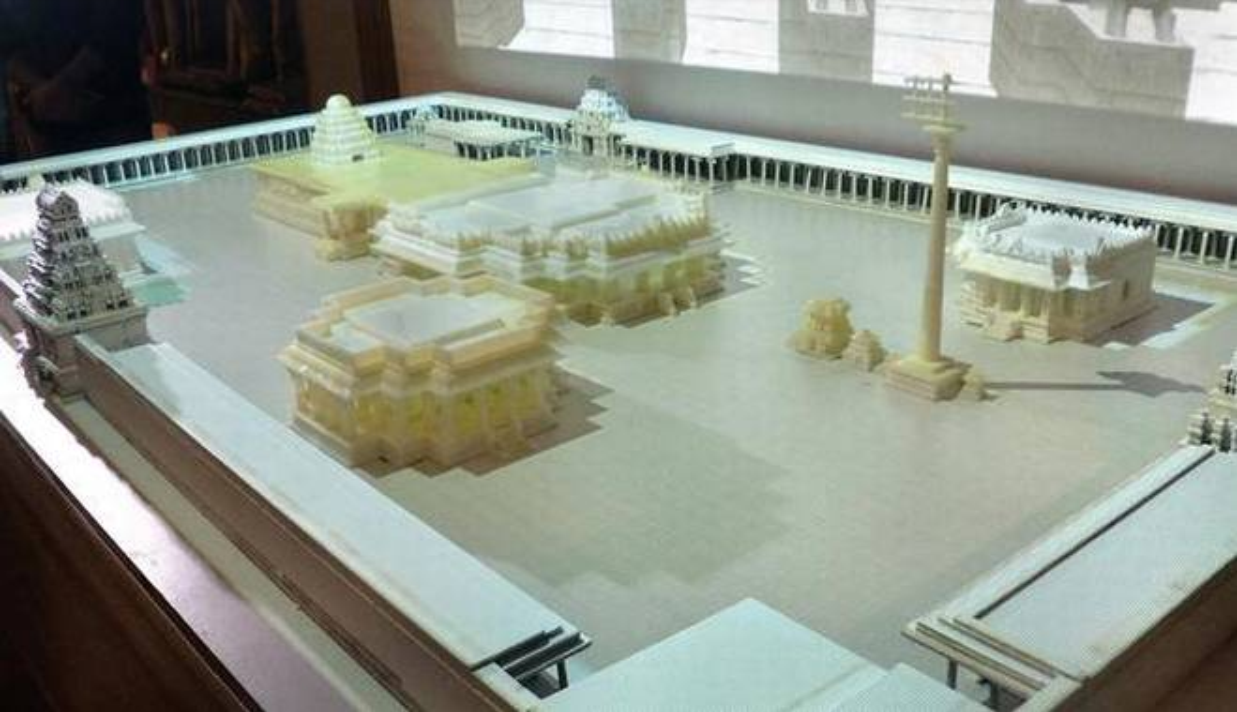
On a calm March evening, I virtually travel hundreds of kilometres from my home in Mangalore to a temple complex by the Tungabhadra river. Courtesy Google Art, Hampi, the pride of the Vijayanagara empire, comes alive through many frames, some of them panoramic. The project gives you an idea of the scale and scope of the temples: the Vitthala complex looms large as do the Stone Chariot, Bhim’s Gate and the Maha mantapa, among others.
Now, imagine if you could go on a digital walkthrough and see 3D recreations of the sculptures that were damaged, rotate them 360 degrees to appreciate their workmanship better, and understand why Hampi is special. If all goes as per plan, and if the Indian Digital Heritage Project is taken to its logical conclusion, this could well become a possibility in the near future.
A Department of Science and Technology (DST) initiative, the project that started in 2012 brought together researchers in the areas of technology and humanities for the digital preservation and interpretation of tangible and intangible heritage. The project concluded in 2016 and plans are now afoot to extend it to underwater structures.
Switch to 3D
In 2011, Professor AN Rajagopalan of IIT Madras visited Hampi, where more than 500 monuments dot 26-odd square kilometres. The Chennai resident was familiar with the reasonably well-maintained Pallava-era sculptures by the beach at Mamallapuram. He presumed Hampi would be similar, but was shocked to see the ruins. However, looking beyond the broken noses and smashed-in faces, Rajagopalan could imagine their former magnificence.
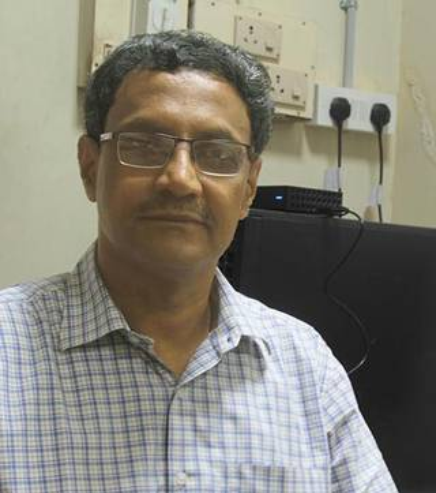
When the IIT Madras team he was a part of had to report on what was possible at the UNESCO World Heritage site, an idea struck him.
He wondered if the image inpainting technique (used to fill in missing information on a two-dimensional photograph or painting, based on the details around the damaged region) could be adapted to 3D, to reimagine the broken sculptures. That is how the digital arm of the project, inspired by Stanford University’s Digital Michelangelo Project and the Google Art project, took shape.
First steps
The team started off by taking extensive photographs and videos of the sculptures from various viewpoints. The hunt then began for similar works — those that could be reworked digitally using references from the other.
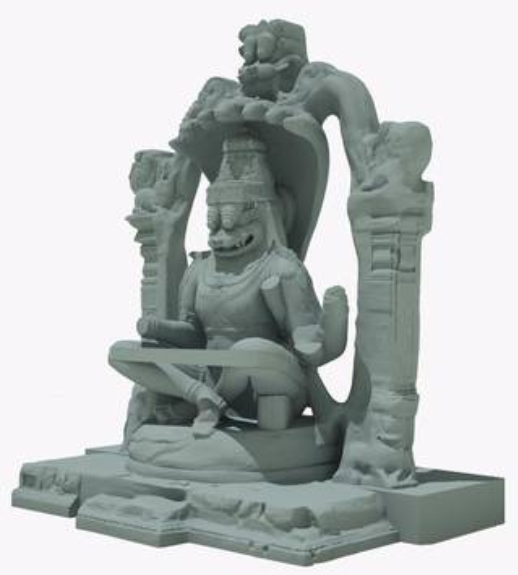
A 3D model was then built. The first sculpture they worked on was of a Narasimha in the Vitthala temple, whose shoulder was damaged. The original measured 1.5 ft by 2.5 ft on a pillar, and it was a recurring motif across the complex.
Printing a pillar
To create models for the walk-through, Rajagopalan printed — what looked like a mythical beast on a pillar (from the Kalyana Mandapa) — on a Polyjet 3D printer using a pale yellow and opaque material called Veroclear. It cost about ₹1,200 per cubic inch. “3D printing is very expensive. What we did was approximately a 1:1,000 scale of the pillar; something you could hold in your hand. While the model will not look like the original — it has the appearance of a candle — you can touch and feel the dips and mounds,” he says.
Group effort
Ensuring this project had the best minds working on it was Sharada Srinivasan of the National Institute of Advanced Studies, Bengaluru. As culture co-ordinator of the IDH Hampi Project, she worked with art historian S Settar and scientist S Ranganathan.
Speaking about why the project is special, she says, “We got together diverse groups from IITs, NGOs and the Crafts Council of Karnataka... It did not stop with the academic circle. A very interesting dialogue emerged and, at some point, we looked at digital renditions,” says Srinivasan, who has worked on South Indian bronzes. Also a dancer, she has choreographed and performed around the musical pillars at Hampi. She explains how as part of the project, groups worked on automatic detection of cracks, inscriptions, digital reconstructions, street mapping and digital 3D printing. “We can’t say this is the definitive attempt at conjectural reconstruction, but it is a major step towards it. This is one approach towards making heritage more accessible and inclusive,” says Srinivasan.
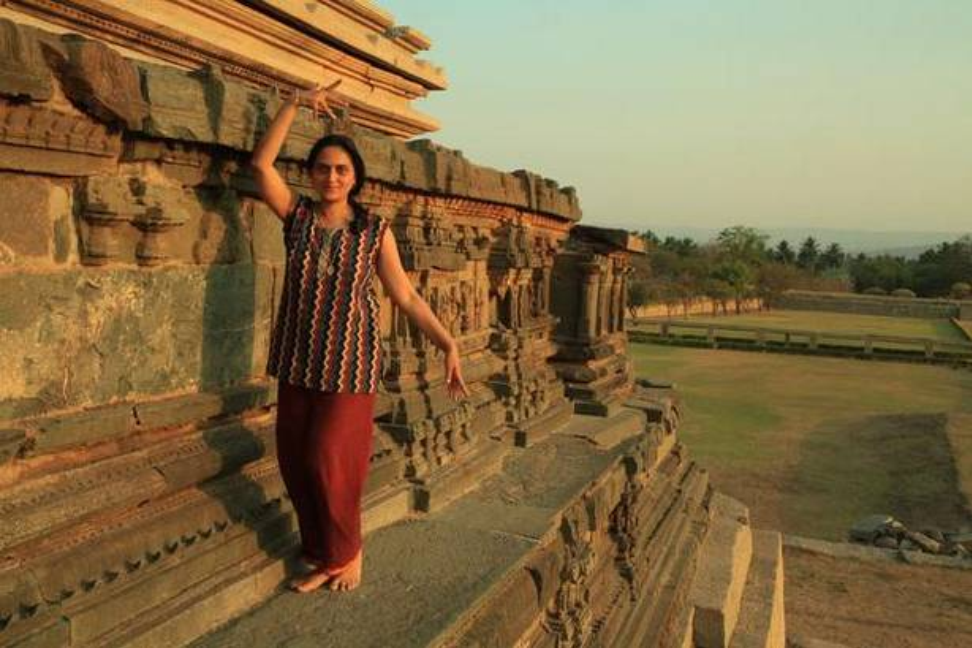
Even now, in its much-damaged state, the UNESCO World Heritage site continues to charm visitors. If things work out, the technology can be used to digitally revive similar structures elsewhere.
By Subha J Rao subha.rao@thehindu.co.in
THIS ARTICLE WAS ORIGINALLY PUBLISH ON THE HINDU