
While climate change affects everyone, its effects are especially strong in northern, cold climates. In Alaska, for instance, temperatures are rising faster than any other state, according to the National Climate Assessment. Although the dramatic rise in temperatures has lengthened the agricultural growing season, Alaska will now face water shortages, coastal erosion, and melting sea ice.
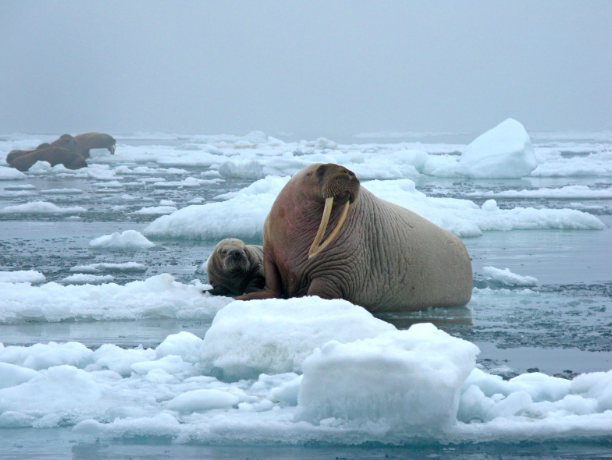
Alaska holds 40% of the United States’ native population, and Alaskan native populations are more susceptible to climate change than non-native Alaskans. Often living in remote locations, native Alaskans depend on the oceans for fish, and the land for hunting and agriculture. One threat facing native communities is a decline in sea ice. The National Climate Assessment predicts that northern waters will be ice free by 2030, which will likely result in a decline in food sources. Many native communities rely on walruses for food, and walruses need sea ice in order to survive. In 2014, the US Fish and Wildlife Service recorded that the number of walruses caught by Alaskans fell by a third of the amount caught at the turn of the century. A reduction in sea ice will also reveal underwater possibilities for ocean oil rigs which were once concealed by ice. This will make the Alaskan coast prone to oil spills, which could have a detrimental effect on oceanic ecosystems.
The increase in temperatures will also cause permafrost, a thick layer of frozen soil, to thaw beneath lakes and ponds. Permafrost often contains organic material which will release carbon dioxide into the air as it melts. However, the thawing permafrost is causing the land to become unstable. This will make once stable lands unstable, and cause coastal erosion, landslides, and floods.
The coastal erosion caused by thawing permafrost is the most pressing issue facing Alaskans. Many native communities, such as the Yup’ik aboriginal peoples of Newtok, Alaska, have been forced to relocate because their homeland is now uninhabitable, due to coastal erosion caused by permafrost. The coastal community of Shishmaref, Alaska is slowly eroding into the ocean, and by 2023 almost half of the village is estimated to be eroded by raising temperatures. Newtok and Shishmaref are unfortunately not unique cases for native communities; as of 2017, there were 12 native towns considering relocation.
Although some countries are attempting to minimize their carbon footprint, their efforts are undermined by the many countries who choose to ignore the realities of climate change. Thus, climate change is only accelerating, and Alaskan indigenous communities will be affected at greater rates in the future. The National Climate Assessment estimates that temperatures will rise by 10 degrees fahrenheit to 12 degrees fahrenheit in the north, and 8 degrees fahrenheit to 10 degrees fahrenheit in the interior. The United States has allocated $15 million to Newtok to cover the cost of relocating to a more stable environment, yet little is being done on a grand scale to put an end to climate change. Although it was kind to offer aid to native communities, it is unfair to forced to communities to relocate due to forces out of their control. One can only hope that in the future, governments will take a more proactive role in preventing damage from climate change, so that areas like those in Alaska will not undergo major challenges due to the warming climate.
GINNY KEENAN is an NYU student currently studying abroad in London. She intends to major in journalism, and reads in her free time. She is always looking for new travel opportunities.