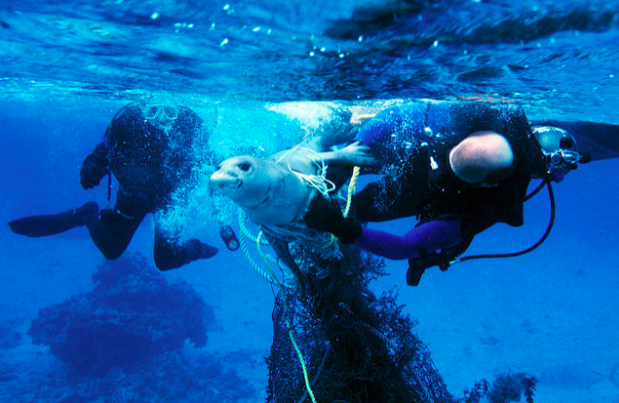
It’s no secret that plastic waste harms marine life. Pictures of turtles caught in six-pack rings and seals stuck in netting circulate the web, reminding consumers to limit their waste, and to reduce, reuse, recycle. The most recent trend in ocean-awareness has been a campaign to stop using plastic straws, which are too lightweight to make it into a mechanical recycling sorter, and end up in the sea.
Now, the data is even more clear. A recent study based on four years of diving on over 150 coral reefs concludes that a coral’s likelihood of disease increases from 4% to 84% when it comes in contact with plastic. Plastic harms coral by decreasing their exposure to the sun, and tearing open their skin, thereby making them more susceptible to disease.The facts are frightening, especially considering that it is estimated that there 5.25 trillion pieces of plastic debris in the ocean.
One outstanding organization, Project AWARE’s Dive Against Debris, is trying to change these statistics. The organization was founded in 2011, and has empowered 50,000 divers to clean and report on debris from the reefs they love to visit.
Dive Against Debris focuses on two aspects of conservation: policy and community.
Their policy arm focuses on advancing local, national, and international laws on shark awareness and marine conservation.
Community work involves cleaning debris from reefs, and collecting data on the types and quantity of the waste. Data can be found on their interactive map, which shows type and quantity of debris by location.
Another aspect of community work involves fundraising and activism. Divers are encouraged to raise funds and awareness for the cause, as well as encourage environmentally-friendly diving practices among their peers. They are active on social media through campaigns like #NoExcuseForSingleUse or #MakeTimeForMakos.
Dive Against Debris makes it easy for enthusiastic scuba divers to find a community and make an impact while exploring the ocean and doing what they love.
ELIANA DOFT loves to write, travel, and volunteer. She is especially excited by opportunities to combine these three passions through writing about social action travel experiences. She is an avid reader, a licensed scuba diver, and a self-proclaimed cold brew connoisseur.